Shows how export controls limit Chinese compute, informing expectations for Chinese model capability and hardware availability.
Key takeaways · AI-distilled
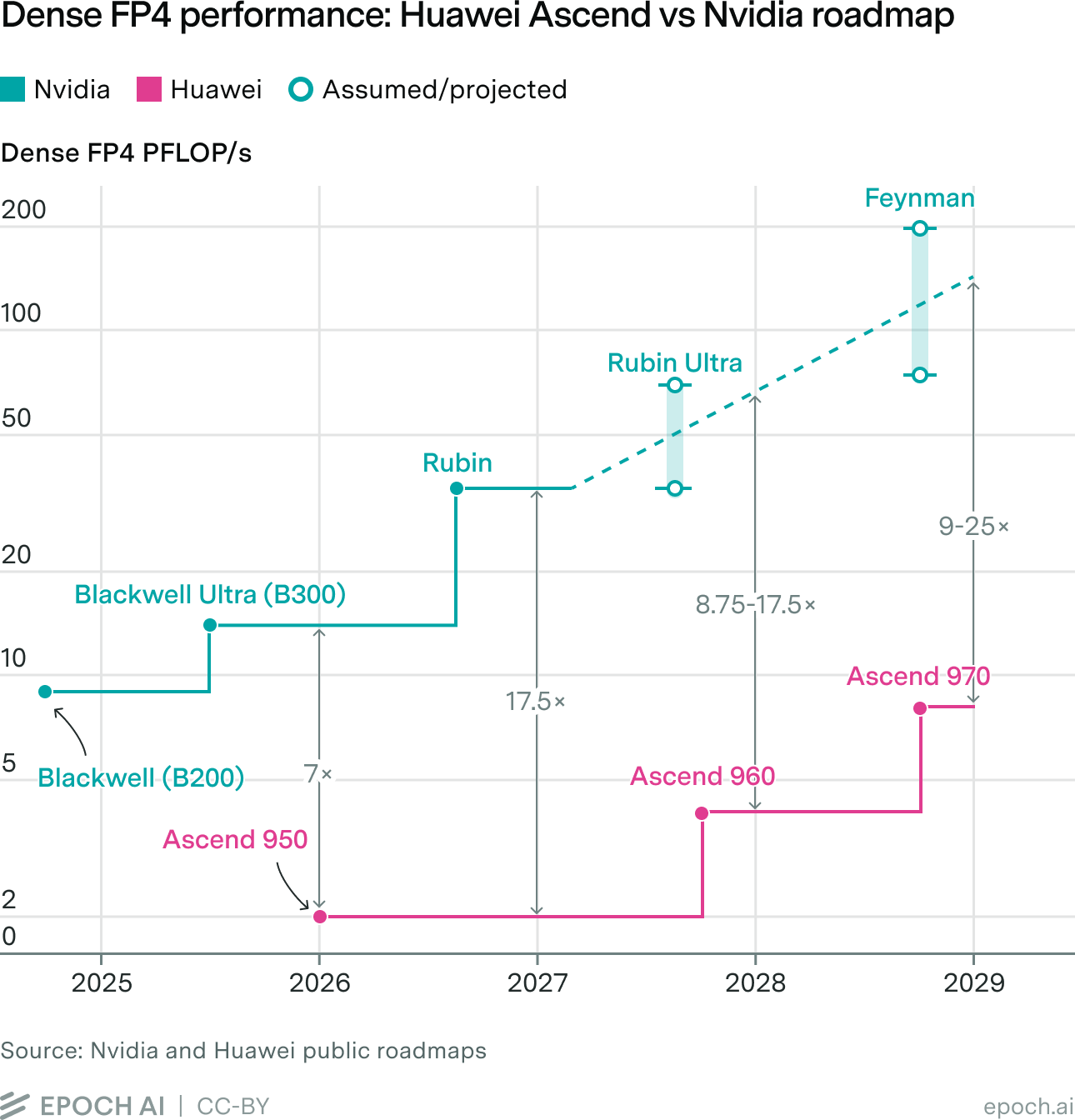
Epoch's 2026 baseline: Huawei's Ascend 950 delivers about 7x less compute than Nvidia's B300 and half an H100, and Huawei will make about 1.5M chips versus Nvidia's roughly 6M, so total compute trails by about 25x.
Huawei's roadmap leans on bigger chips, low-precision architecture changes and vertical die stacking (LogicFolding) because SMIC cannot match TSMC density, but stacking reaches Ascend only in 2030, two years after Nvidia's Feynman reportedly stacks dies.
Huawei's planned SuperPoDs link 8,192 chips through a tiered network to offset weaker chips, versus Nvidia's 72-chip full-speed racks; Epoch says real performance is unclear because Huawei has not published key metrics.
Software is a major gap: Epoch reports DeepSeek could not finish an R2 training run on Ascend even with Huawei engineers on site, and says CANN remains years behind CUDA, so Huawei's real deficit is likely larger than peak specs suggest.
HBM supply caps volume: Epoch puts Huawei near 1.5M H100e in 2028 from domestic memory, about 1.5% of Nvidia, and even an implausible tenfold smuggling scenario (over $40B) only reaches about 16% of Nvidia's output.