Reports where GPT-6 Astra sets records and evidence of differing GPT and Claude architectures from long-context windowThe maximum amount of text a model can consider at once — its working memory for the current conversation or task.Full definition → latency scaling.
Key takeaways · AI-distilled
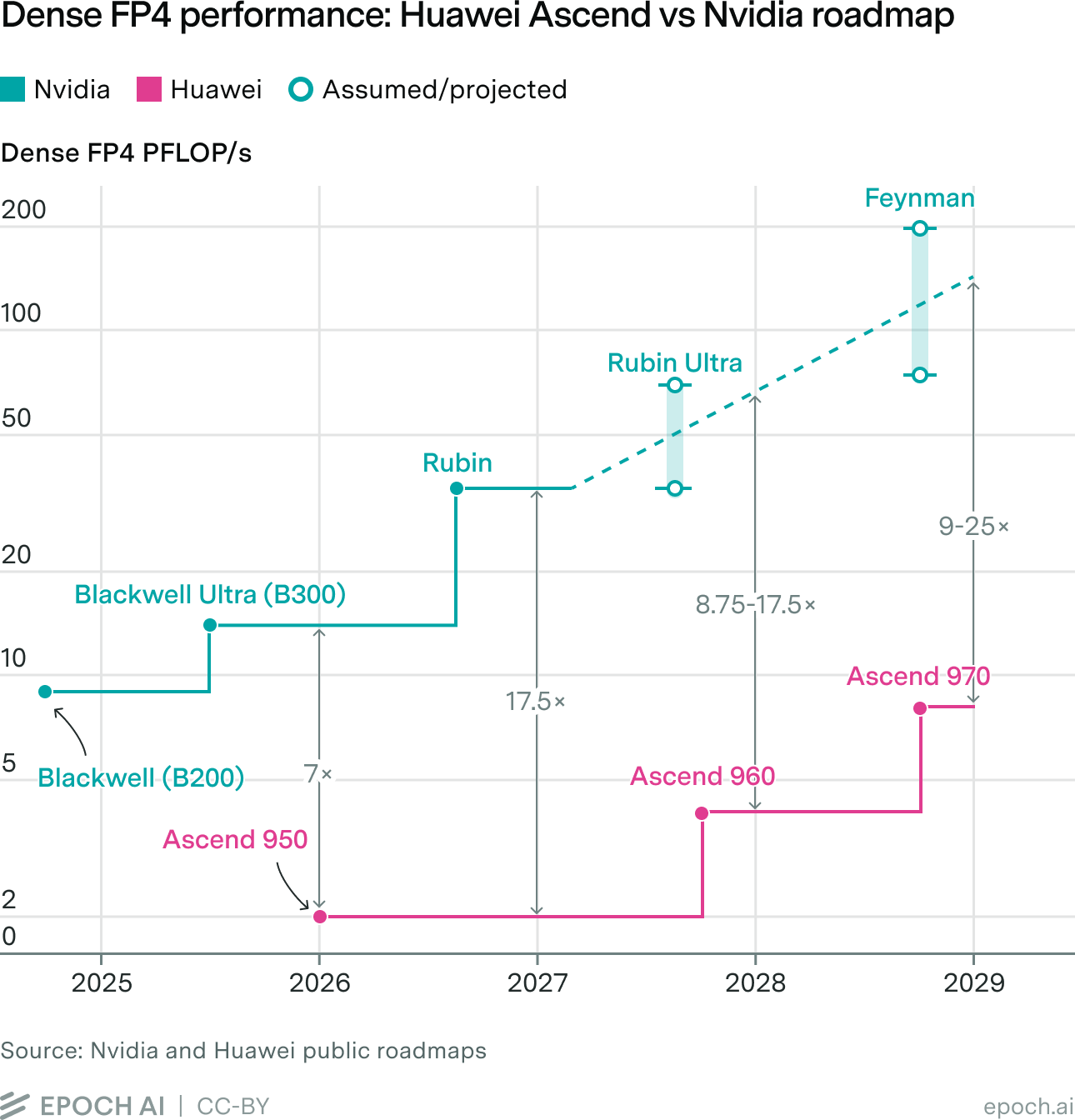
Epoch's Huawei report finds its most powerful AI chip has roughly half the H100's arithmetic performance and estimates Huawei will produce under 4% of Nvidia's AI compute in 2026, with export controls limiting both per-chip gains and volume.
Epoch argues US GDP statistics miss most of the value Nvidia creates by designing chips that are manufactured and sold abroad, understating US GDP growth by about 0.3 percentage points over the past year.
Measuring time to first tokenThe chunk of text a model reads and writes in — roughly three-quarters of a word — and the unit AI usage is billed in.Full definition → up to 1M tokens, Epoch researcher Jason Li found GPT-5.6 latency has a noticeable quadratic component while Claude 5 stays closer to linear, which Epoch reads as evidence of different architectures.
Epoch's data insights: the ECI frontier has gained about 14 points a year since reasoning models arrived in September 2024, versus 6 for non-reasoning models, and the largest AI data center's power capacity has doubled every 10 months.
In Epoch's pre-release tests GPT-6 Astra topped ECI among 247 tracked models, solved 2 of 68 FrontierMath Erdős problems (the first model to solve any), and scored 98% on FrontierMath Tier 4, which Epoch now treats as saturated.
Terms in this piece · Glossary
eval — A repeatable test for AI quality — a set of tasks plus scoring — used the way software teams use test suites, because model output is too variable to judge by eyeballing.
context window — The maximum amount of text a model can consider at once — its working memory for the current conversation or task.
token — The chunk of text a model reads and writes in — roughly three-quarters of a word — and the unit AI usage is billed in.