OpenAI starts watermarking ChatGPT and Codex text for the EU AI Act
- Source
- x.com
- Date
OpenAI is extending its content provenance work from images and audio to text. The watermark is an invisible statistical signal embedded as text is generated, with no visible marks or special characters, and a detector can look for it. OpenAI says it answers one question, whether text was likely generated by an OpenAI model. It does not identify the author, owner, account, conversation or prompt. The company reports no effect on model capability, speed or how responses read in its testing. It is also direct about the limits: watermarks are often undetectable in short passages, and rewriting or translating text can remove them completely. For now only approved researchers get access to the detector. Engineers who ship generated text or code to EU users should note the timing, and API customers who want provenance can opt in today. Nobody should treat the presence or absence of a watermark as proof of authorship.

We're expanding our approach to content provenance to include text in response to EU regulatory requirements, while recognizing the significant limitations of current text watermarking technology. Our tools already help verify whether an image or audio file was created with our models. This work builds on those efforts to help people better understand when content may have been generated or edited with an OpenAI model. In the EU, we’ll start watermarking eligible text from ChatGPT and Codex over the coming weeks to comply with the EU AI Act. Customers using our API can turn on text watermarking for select models worldwide today.
Context
OpenAI is adding text to the content it marks as machine-made, and it is doing so on two different terms. In the EU, it says it will start watermarking eligible text from ChatGPT and Codex over the coming weeks to comply with the EU AI Act, so there the marking follows from a legal requirement. Separately, API customers anywhere can choose to turn on text watermarking for select models, starting the day of the post. A watermark here is a marker meant to let a tool later recognize that content came from a model. OpenAI says its existing tools already help verify whether an image or audio file was made with its models, and the text work is meant to help people understand when content may have been generated or edited with an OpenAI model.
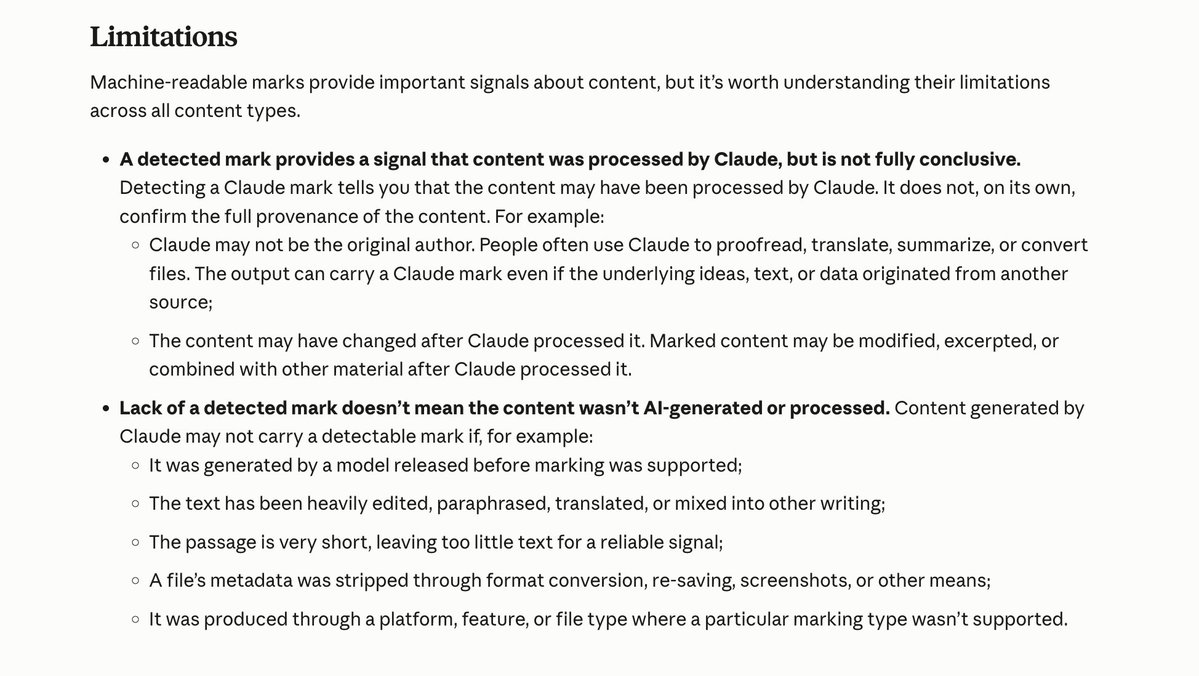
OpenAI presents the move as a response to EU regulatory requirements and is openly cautious about the technology: the post acknowledges the significant limitations of current text watermarking technology, without saying what they are. It also does not say which ChatGPT and Codex text counts as eligible, which API models support the option, how the watermark works or who can check for it, so how reliably a reader could identify OpenAI-generated text is not established by this announcement. Anthropic published an FAQ on watermarking Claude's text for the same EU law earlier, which is the closest point of comparison.





Checking sign-in…
Loading comments…