QuiverAI ships a hosted MCP server for SVG generation
- Source
- docs.quiver.ai
- Author
- QuiverAI
- Date
Context
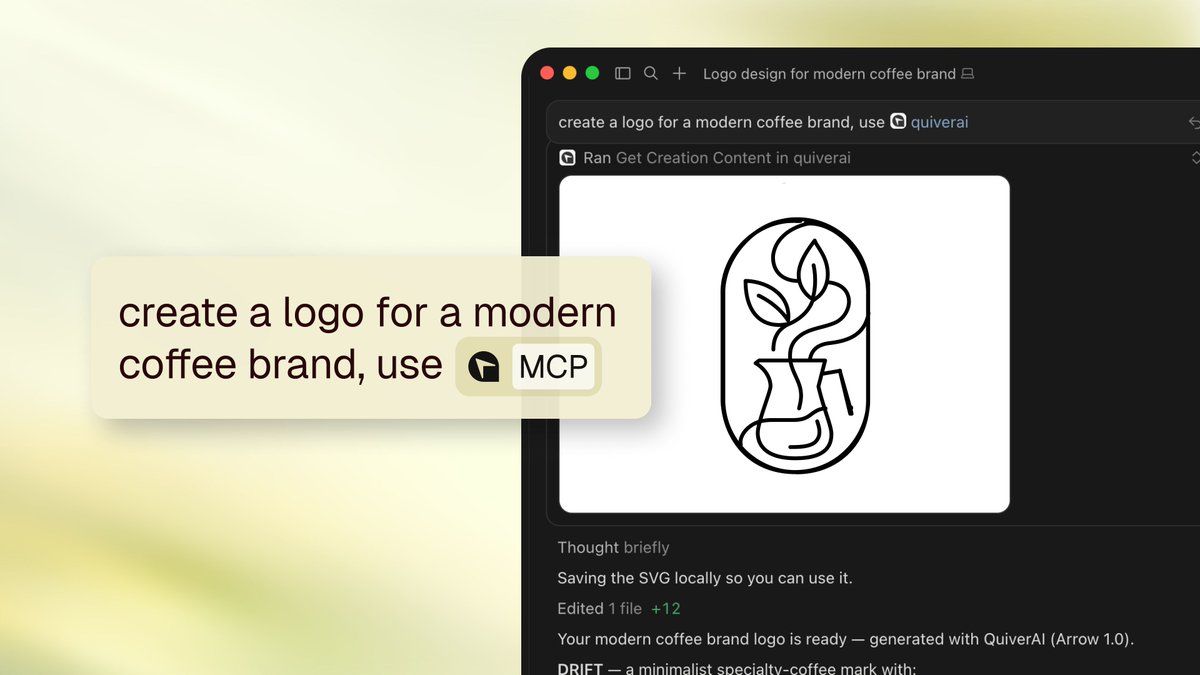
QuiverAI's hosted server lets an create and edit SVG vector graphics, such as icons, logos, illustrations and animations, from inside tools like Cursor and Codex, and everything it makes is saved to the user's QuiverAI account. MCP, the Model Context Protocol, is the connection standard these clients use to give an agent outside tools. QuiverAI's documentation gives setup steps for Cursor, Visual Studio Code, Codex and Claude Code, all pointing at one hosted address, with an OAuth sign-in that issues a scoped to the user's account. Each request runs in a QuiverAI Chat, so the agent's work also appears in the QuiverAI app.
The tools cover a full job. An agent can list the models available to the account, send a prompt that generates, vectorizes, edits or animates artwork with up to four source or reference images and up to four outputs, check a job's status, cancel it, search the user's library and fetch a finished SVG, optionally with a PNG preview the chat client can display directly.
Most of the design deals with generation jobs that can outlast a single tool call. A prompt call waits up to 40 seconds, and if the job is still running the agent gets a chat ID and polls for the result. Every prompt carries an idempotency key, an identifier unique to that request, so a client that times out and retries with the same key gets the original job back and is not billed twice. A job keeps running if the client disconnects, a chat runs one job at a time, and each user can have at most three running at once through connected apps.
Prompts draw first on the user's weekly QuiverAI app allowance and then on prepaid app usage. They never buy more, and they are refused when usage runs out, while public API calls bill separately against the API Platform balance. QuiverAI announced the server in June 2026 as a beta.
- MCP — The Model Context Protocol — an open standard that lets any AI assistant plug into any tool or data source without custom integration code.
- AI agent — An AI system that doesn't just answer once but works toward a goal in a loop — taking actions, reading the results, and deciding what to do next.
- token — The chunk of text a model reads and writes in — roughly three-quarters of a word — and the unit AI usage is billed in.


Checking sign-in…
Loading comments…