A decodability criterion predicts when hidden-state selection beats majority voting in large language models
Source
arxiv.org
Author
Zhixiang wang, Ziliang Hong, Ulas Bagci
Date
Context
Asking a Large language modelA model trained on large amounts of data to process and generate language.Full definition → the same question repeatedly can reinforce a shared mistake: the most frequent answer may still be wrong. CASE instead trains a selector to score candidate answers using the ModelA computational system that uses learned patterns to produce an output from information supplied to it.Full definition →'s internal activity. The researchers' central finding concerns when that alternative is worth using.
They measure whether the selector ranks correct answers above incorrect ones on previously unseen questions. This separation matters because a test can otherwise reward recognition of the question rather than correctness. The authors report that this measure predicts improvements over voting, with gains reaching 19 percentage points on medium-difficulty questions. Using the method requires access to internal model states and a trained selector.
Terms in this piece · Glossary
Large language model — A model trained on large amounts of data to process and generate language.
Model — A computational system that uses learned patterns to produce an output from information supplied to it.
Token — A piece of text, such as a word, part of a word or a punctuation mark, that a language model represents as numbers and handles as a unit.

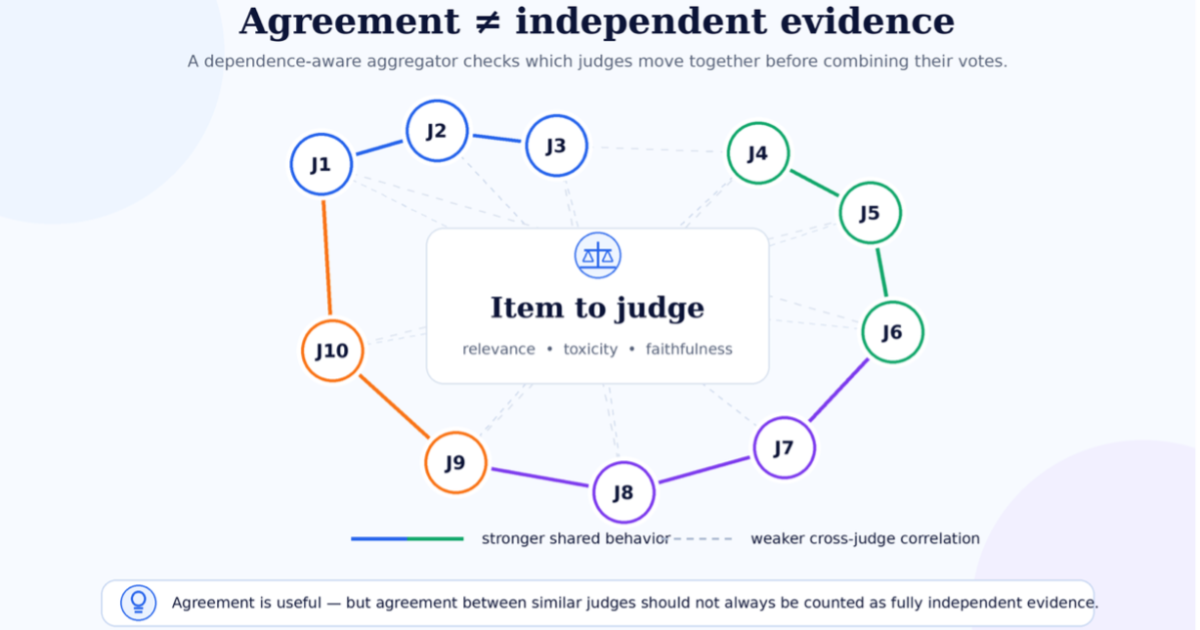 articleWhen LLM judges agree, should we believe them?www.amazon.science
 articleWhen Is a Multi-Agent Code Judge Actually Grounded? Two Label-Free Measurements, and a Judge That Declines to GuessSalma Roshdy Aly, Hussein Assaf, Ziad Kobti
 articleBeyond the Sycophancy Score: How Task, Model, and Pressure Shape LLM YieldingGuang Yang, Homa Hosseinmardi, Fengchen Liu, Amir Ghasemian