When LLM judges agree, should we believe them?
- Source
- amazon.science
- Publisher
- Amazon
- Date
Context
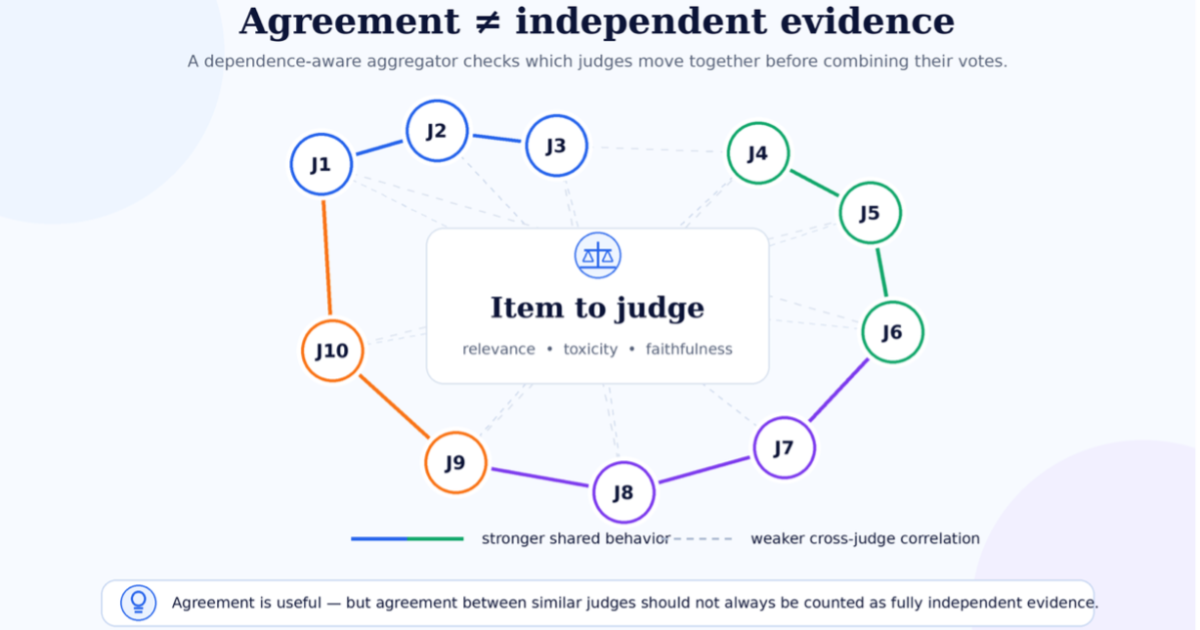
Several AI judges can agree because they share the same mistake. Amazon researchers address this by learning which judges tend to agree beyond what their individual reliability would predict. Their method uses patterns in logs to reduce the influence of redundant votes, rather than counting each agreement as separate evidence. The research account describes learning these relationships without human answer labels during .
On the reported relevance-classification test, the strongest configuration reached 91.2% accuracy, compared with 82.0% for weighted majority voting, using all ten judges and the maximum available training data. Human reference labels were used afterward to measure accuracy. The result supports evaluating the panel's shared error patterns when deciding how much confidence to place in its consensus.
- eval — A repeatable test for AI quality — a set of tasks plus scoring — used the way software teams use test suites, because model output is too variable to judge by eyeballing.
- Training — The process that adjusts a model using examples and a measure of how well it performs.
- Large language model — A model trained on large amounts of data to process and generate language.
- Model — A computational system that uses learned patterns to produce an output from information supplied to it.
 articleAgreement Overstates Evidence: Error Dependence in LLM Judge ConsensusElias Hossain, Niloofar Yousefi, Ser-Nam Lim
 articleChain-of-Models: Cross-Model Auditing for Bias-Robust LLM JudgesQian Wang, Zhanzhi Lou, Zhenheng Tang, Nuo Chen, Bingsheng He
- blogThe Lifecycle of LLM-as-a-Judge: Building, Aligning, and Monitoring at scaleNetflix Technology Blog