Meta returns to open weights: Muse Glimmer, its first open-weights release since
- Source
- x.com
- Date

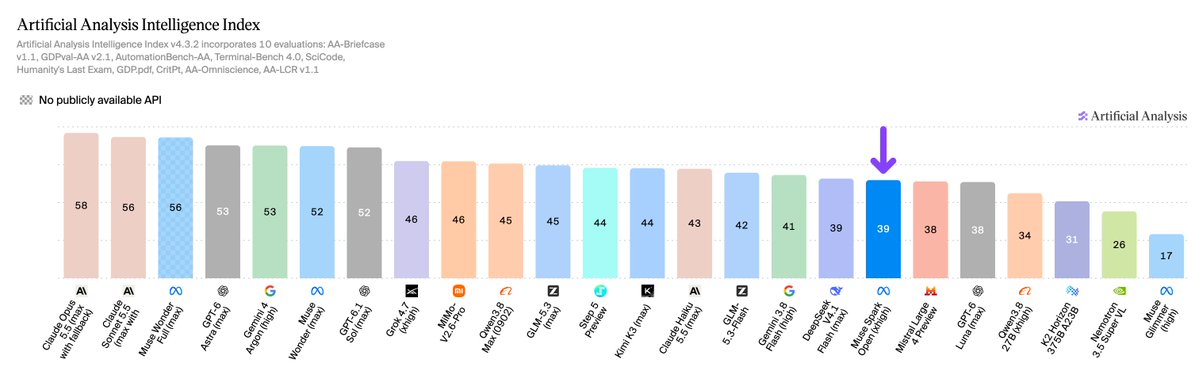
Meta returns to open weights: Muse Glimmer, its first open-weights release since Llama 4, scores 35 on the Artificial Analysis Intelligence Index. It is a 30B-parameter model, and the first from Meta to be released under Apache 2.0 Muse Glimmer (high) arrives 16 months after Llama 4, scoring 21 points above Llama 4 Maverick (14), Meta's last open weights release. It sits alongside Kimi K2.5 (Reasoning, 36) and just behind Qwen3.6 27B (Reasoning, 38) and Ling 3.0 Flash (38), and creates a two-tier Meta lineup together with the proprietary flagship Muse Spark 1.2 (xhigh, 57) @AIatMeta shared access with us ahead of public release for benchmarking. Congratulations to @AIatMeta, @finkd, and @alexandr_wang on the release! Key Takeaways: ➤ Meta's open-weights line is back, under its most permissive license yet. Every prior Meta open release shipped under a Llama License; Muse Glimmer uses Apache 2.0, placing almost no restrictions on commercial use or derivatives ➤ Strong intelligence for its parameter count. At 30B parameters, Muse Glimmer scores 5 points above Gemma 4 31B (Reasoning, 30) at the same size, and effectively matches 1T total parameter Kimi K2.5 (Reasoning, 36) with…

Context
Muse Glimmer is Meta's first open-weights model since Llama 4, which means the trained model files are published for anyone to download and run themselves. Artificial Analysis, which Meta gave early access for benchmarking, measured it at 35 on its Intelligence Index at the model's high setting, against 14 for Llama 4 Maverick, Meta's previous open release 16 months earlier. At 30 billion parameters it effectively matches Kimi K2.5 (36), a model with about 33 times as many, though the slightly smaller Qwen3.6 27B still scores higher at 38. It is also Meta's first model under Apache 2.0, a license that Artificial Analysis says places almost no restrictions on commercial use or derivatives; Meta's earlier open models used its own Llama License.
Artificial Analysis says the model is small enough to host on a single GPU. The weights take about 60 GB at full BF16 precision or about 18 GB at four bits. While a model reads a long document it keeps a working memory of the earlier text, called the , and that memory usually grows with the length of the input. Muse Glimmer limits it by having three of every four attention layers look only at a sliding window of recent text, which Artificial Analysis says holds the cache to a minimum of about 1.8 GB at its 128K-token context before extension. By its account, that lets the model run at full context on a single H100 GPU at full precision, or on a high-end MacBook or RTX 5090 at four bits.
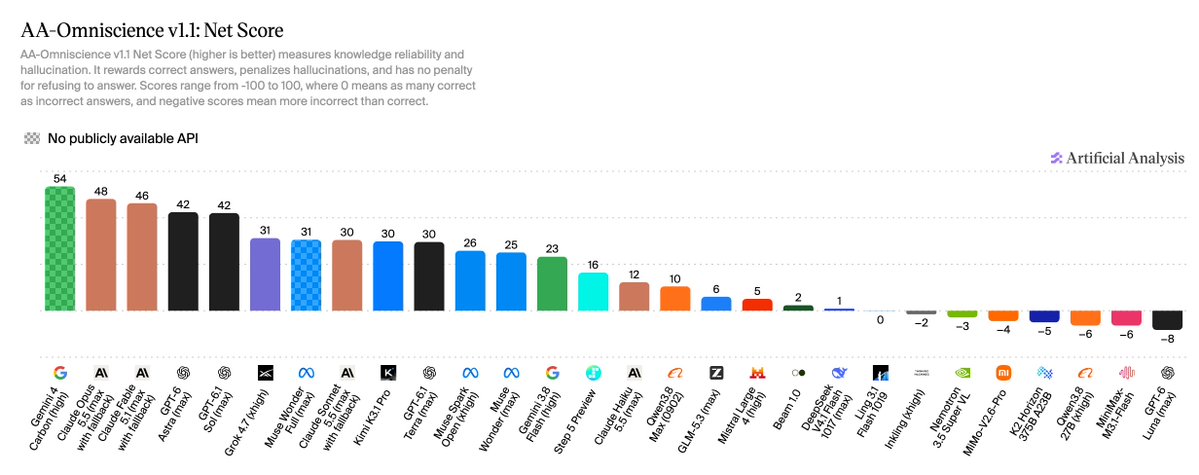
The weak spot Artificial Analysis found is agentic knowledge work. On GDPval-AA v2, which rates models against a human baseline of 1,000, Muse Glimmer scored 953, behind Qwen3.6 27B and Gemini 3.5 Flash-Lite at 1,141 each. Its knowledge- score was low as well, which Artificial Analysis attributes to an 82% rate (49% for Qwen3.6 27B) rather than to weaker accuracy. Agentic was the exception: 24% on Tau3-Banking, ahead of both of those rivals. At release Meta was not serving the model through its own API, so pricing and speed depend on third-party providers and were not yet known.
- KV cache — The memory a model keeps about text it has already read, so generating each new token doesn't require reprocessing the whole conversation.
- calibration — How well a model's confidence matches reality — a calibrated model saying "90% sure" is right about 90% of the time.
- hallucination — When a model states something false with full confidence — inventing facts, citations, or APIs that don't exist.
- tool use — A model's ability to call external functions — run code, search the web, edit files — instead of only generating text.

Checking sign-in…
Loading comments…