Kimi K3: The open-weights escalation
- Source
- interconnects.ai
- Author
- Nathan Lambert
- Date
Context
Stronger open models could spread AI use while reducing the profits available to finance frontier research. That is Nathan Lambert's economic argument in his Kimi K3 analysis, prompted by Moonshot AI's model announcement.
He reasons that capable alternatives could lower what closed-model providers can charge, reducing both reinvestment and fundraising expectations. Meanwhile, cheaper, customizable models could help more businesses build specialized applications. These are two different effects: slower growth in frontier investment and wider adoption could occur together. His open-model argument was conditional on the promised July 27 weights release; the article presents a forecast, not measured economic consequences.
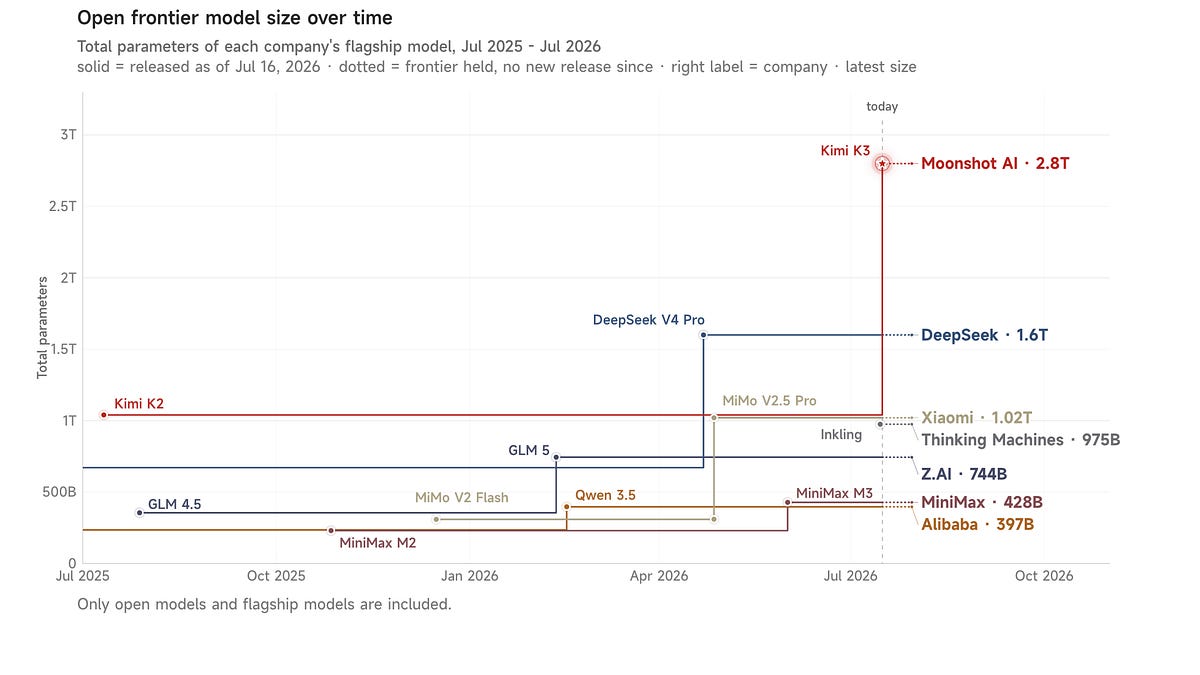
- Kimi K3 is a 2.8T-parameter model — only a slice of those parameters fires per — and it ranks at or near the top of several independent indexes. It is the closest have come to the frontier since DeepSeek R1.
- The gap that matters, open-to-closed or Chinese-to-American, compresses from a debated 6-9 months to something more like 3-5.
- The explanation stops working here. K3 is straightforward scaling execution across data, algorithms, architecture, tools, and environments — the same work the American labs do, done with far fewer resources.
- Xi committed China's AI strategy to open source and global diffusion at WAIC the same week as the strongest open-weight release yet. Read literally, that is a government signaling it does not currently price frontier models as a serious risk.
- Strong open weights are economically decelerationist for frontier labs: they compress margins, leaving less profit to reinvest and lowering the terminal value markets assign, which slows capex. They accelerate diffusion instead — a much slower exponential.
- mixture-of-experts — A model built from many specialist sub-networks where only a few activate per token, giving big-model capability at small-model running cost.
- token — The chunk of text a model reads and writes in — roughly three-quarters of a word — and the unit AI usage is billed in.
- open weights — A model whose trained parameters are published for anyone to download and run — unlike API-only models you can access but never possess.
- distillation — Training a small, cheap model to imitate a big one's outputs, keeping much of the capability at a fraction of the cost.
“The key fact is that either the open-to-closed or American-to-Chinese model performance gap has been reduced from the debated 6-9 months to something shorter, say 3-5 months.”
“Moonshot AI is going toe to toe with Anthropic and OpenAI with far, far fewer resources. It is clearly the strongest open model ever released.”
“It is becoming clear that the Chinese labs are far more capital efficient.”
“I think that if Claude Mythos was released as an open-weight model today, the negative outcomes would be relatively minor.”
“Kimi K3 is a watershed moment because frontier open-weight models are now real.”




Checking sign-in…
Loading comments…