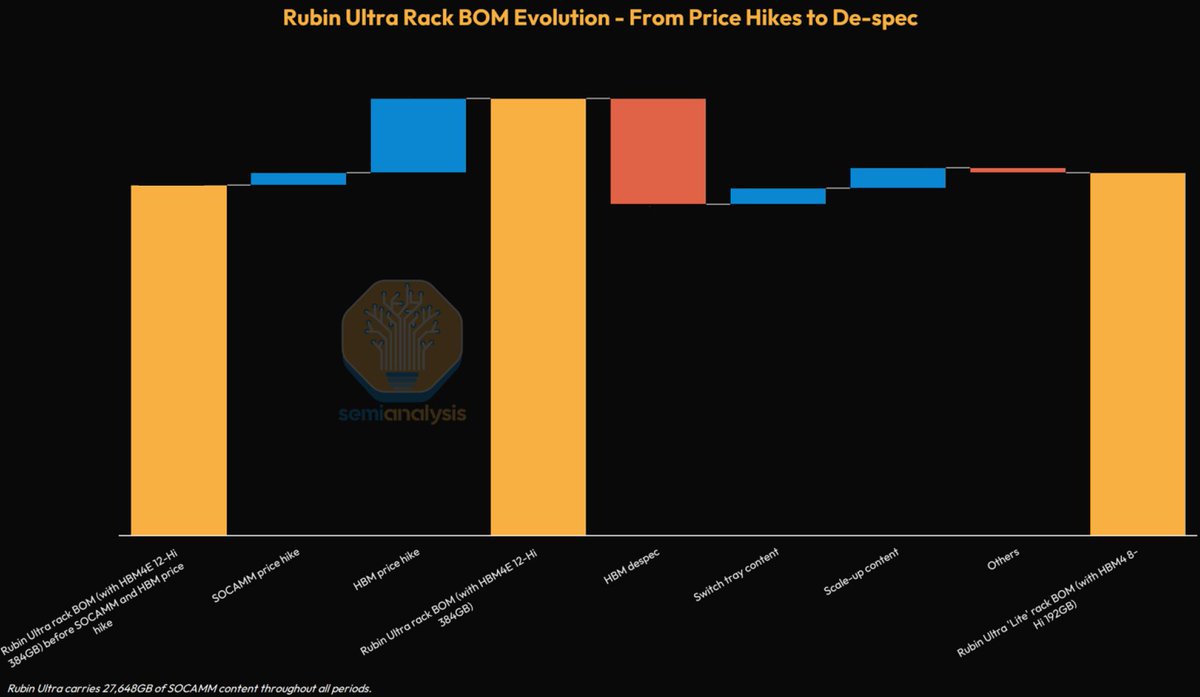
Stacking more DRAM dies on top of each other in a single HBM module raises total memory capacity, but every added layer also adds thermal and yield problems that get worse the taller the stack gets. SemiAnalysis argues the industry misjudged where that tradeoff pays off. Taller 12-hi stacks looked attractive purely on capacity, but for inference workloads, which are bottlenecked on memory bandwidth far more than raw capacity, shorter 4-hi and 8-hi stacks deliver more bandwidth for every dollar spent on packaging and yield losses. Nvidia's decision to cut Rubin Ultra's memory capacity down to 192GB is presented as evidence the market is already correcting toward this view rather than chasing capacity numbers for their own sake. For teams planning hardware purchases or capacity for the next generation of accelerators, the practical implication is that memory bandwidth, not stated capacity, should drive comparisons between competing chip designs, and that supply for shorter HBM stacks is likely to tighten as more vendors follow the same shift.