Rubin Ultra HBM cut to 192GB, a fifth of the preview
- Source
- x.com
- Publisher
- SemiAnalysis
- Date

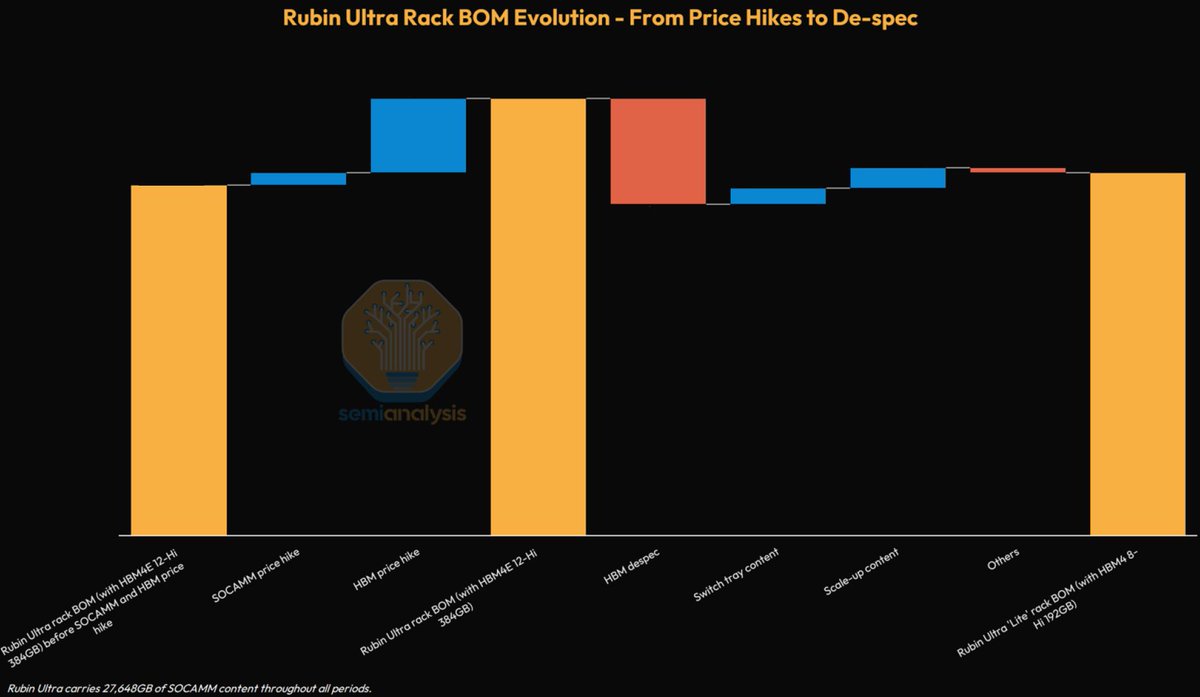
HBM MASSIVE CONTENT DOWNGRADE ALERT🚨🚨: Nvidia Rubin Ultra will ship with 192GB of HBM4 8-hi. Not only is this a huge downgrade from the original Rubin Ultra which was previewed with 1TB of HBM, but it is even lower than regular Rubin which has 288GB. How did HBM content for Rubin Ultra get cut to 1/5th of the original? The number of cubes got cut to 8 when 4 die Rubin Ultra was scrapped. Then the stack height got reduce to 8-hi instead of 16-hi. Last it is cut to HBM4 which uses 24Gb dies instead of 32Gb dies with HBM4E, although an 8-hi HBM4E upgrade could com later. What was Nvidia's reasoning behind this? (1/2)🧵

Context
SemiAnalysis, a semiconductor research firm, reports that NVIDIA's Rubin Ultra accelerator will ship with 192GB of high-bandwidth memory (HBM), about a fifth of the 1TB shown when the chip was previewed and less than the 288GB on the regular Rubin. HBM is the stacked memory packaged beside a GPU that holds a 's weights and working data, so its capacity sets how much one chip can hold before work has to spread across more chips.
In the post, the reduction compounds in three steps. The number of memory stacks fell to eight when a four-die version of Rubin Ultra was scrapped. Each stack dropped from 16 layers of memory chips to 8. And the memory moved from HBM4E, built from 32-gigabit chips, to HBM4 with 24-gigabit chips, though SemiAnalysis says an 8-high HBM4E upgrade could come later. Eight stacks of eight 24-gigabit chips is 192 gigabytes.
This is an analyst's report about a future product, not an NVIDIA announcement. The post closes by asking what NVIDIA's reasoning was, and a later SemiAnalysis thread argues the motive was cost: after recent HBM and DRAM price rises, it says memory had become about 40% of the system's total capital cost of ownership. That thread describes the step down from a 384GB HBM4E 12-high plan rather than from the 1TB preview.
- Model — A computational system that uses learned patterns to produce an output from information supplied to it.