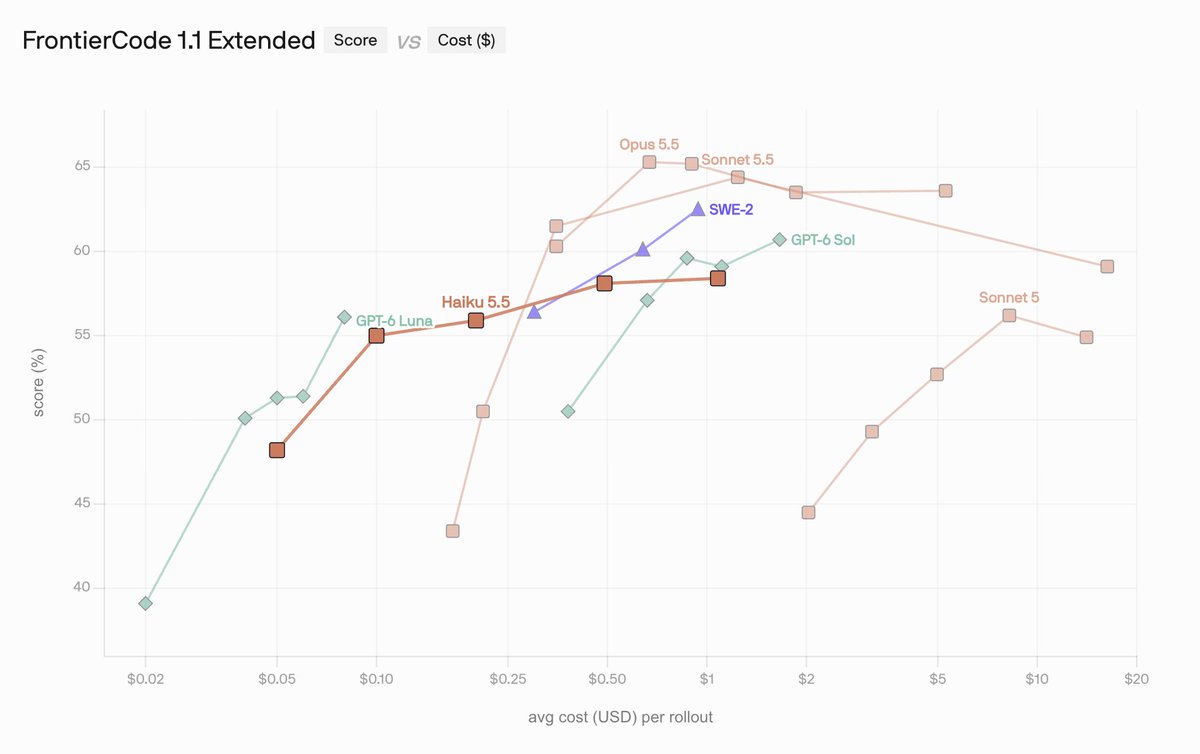
On the tested tasks, Haiku 5.5 cost 19 to 30 times less than Opus 5.5 with the same pass rate, so default to a cheaper tier and reserve Opus for long, ambiguous work. Verify on your own tasks.
Key takeaways · AI-distilled
On OpenRouter's own runs, Sonnet 5.5 beat Opus 5.5 on GPQA Diamond (92.4% vs 90.4%) and tau-bench airline (78.7% vs 75.5%) at under half the cost per task; Opus leads only by 1.6 points on the Artificial Analysis index.
All three tiers passed all 25 attempts on 11 hidden-test Python tasks, including a regex engine without the re module and SQL three-valued NULL logic; on hard tasks Haiku used 3,202 reasoning tokenThe chunk of text a model reads and writes in — roughly three-quarters of a word — and the unit AI usage is billed in.Full definition → to Opus's 1,252 yet finished fastest.
OpenRouter cautions its tasks were short and well specified, so they cannot rule out an Opus advantage on long-running agentic work, and with 100 to 200 tau-bench tasks per model, gaps of a few points may be noise.
Claude Code 2.1.307 does not recognize OpenRouter's Haiku 5.5 slug and assumes a 200,000-token window; OpenRouter says adding [1m] to the slug restores the full 1-million-token context windowThe maximum amount of text a model can consider at once — its working memory for the current conversation or task.Full definition →, and it strips the suffix before routing.
Opus 5.5 carried about 2.5 times Sonnet's OpenRouter token volume in the week of October 12 and is Claude Code's default on most plans, so users who never set a model are running the most expensive of the three tiers.
Terms in this piece · Glossary
token — The chunk of text a model reads and writes in — roughly three-quarters of a word — and the unit AI usage is billed in.
context window — The maximum amount of text a model can consider at once — its working memory for the current conversation or task.