Lab-in-the-Loop at Compute Speed — Ian Quigley, Leash Bio
Source
latent.space
Author
Brandon Anderson
Date
Why it matters
Shows how a large proprietary experimental dataset can become a verifiable RL environment for scientific agents, and why data rigor matters for that.
Key takeaways · AI-distilled
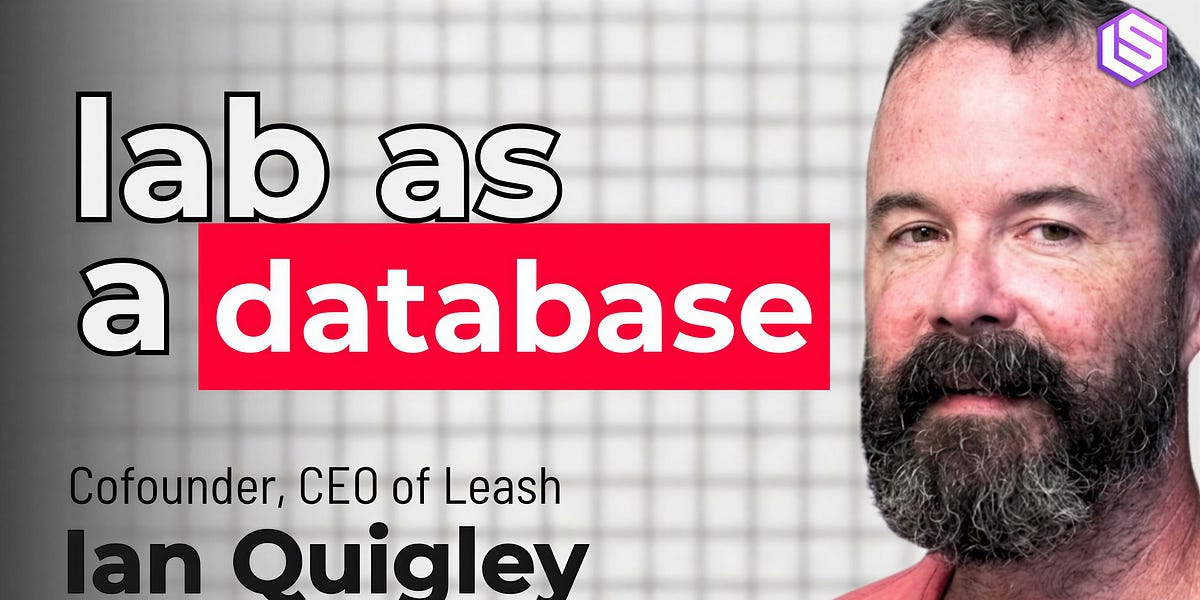
Leash Bio works with DNA-encoded libraries and, per the episode notes, puts dozens of barcodes on each molecule to catch proteins that bind the DNA tag instead of the drug, one way it extracts clean, reproducible data for large-scale modeling.
Leash's Kaggle competition used about 4B measurements and drew about 2,000 teams, with nobody beating chance on an unseen chemical library. Separately, in ChEMBL, knowing which chemist made a molecule predicts activity about as well as its structure does.
Hermes, trained only on Leash's own data, is described as keeping pace with Boltz on public benchmarks. After catching it memorizing protein 'nicknames' instead of binding sites, the team engineered protein mutants at scale to break that shortcut.
Ian describes an AI agentAn AI system that doesn't just answer once but works toward a goal in a loop — taking actions, reading the results, and deciding what to do next.Full definition →sandboxAn isolated environment where AI-generated code or agent actions run without being able to touch anything real.Full definition → where LLMs reason about structure-activity relationships in plain English to find the best binders among 6.5M molecules on a budget of 100. It has since matured into Minos, released with a preprint and open dataset.
Terms in this piece · Glossary
AI agent — An AI system that doesn't just answer once but works toward a goal in a loop — taking actions, reading the results, and deciding what to do next.
sandbox — An isolated environment where AI-generated code or agent actions run without being able to touch anything real.