Building production voice agents: latency, WebRTC and turn detection
- Source
- deeplearning.ai
- Publisher
- DeepLearning.AI
- Author
- Andrew Ng
- Date
Context
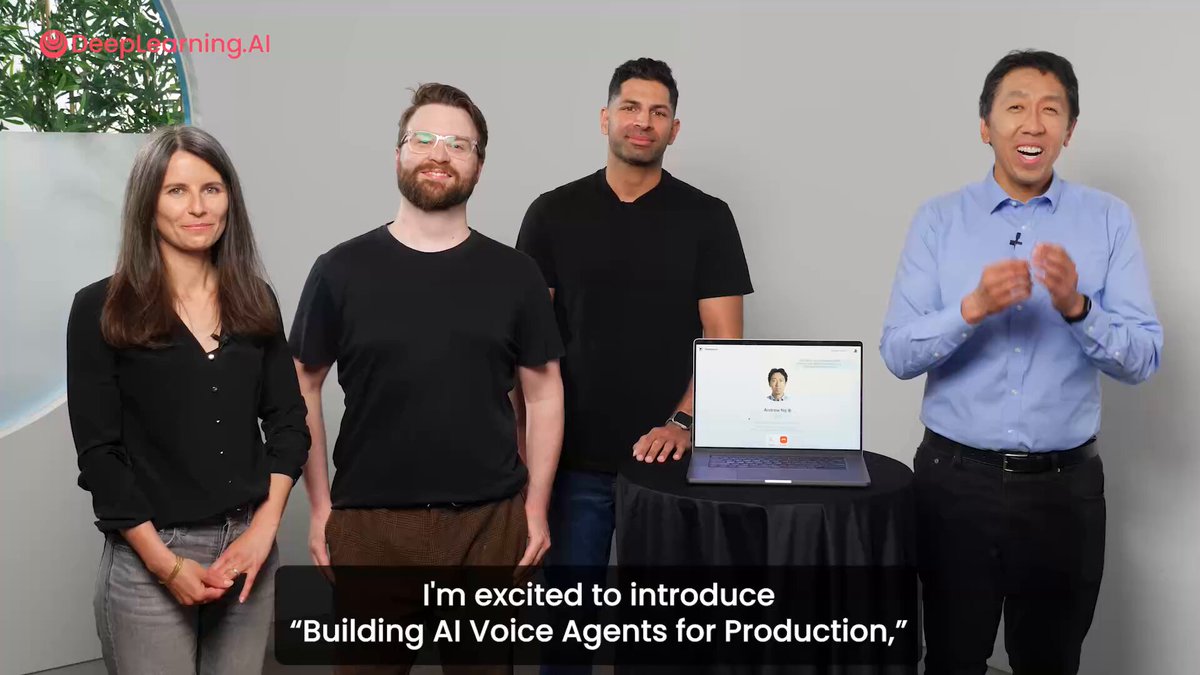
A feels responsive only if two problems are solved: each processing step has to be fast, and the agent has to know when it is its turn to speak. Building AI Voice Agents for Production, announced by Andrew Ng on X, teaches both using the system behind the "AI Andrew" avatar, which answers users in what sounds like Ng's voice. In the announcement video, Ng describes that build as a chain of steps: speech-to-text transcribes what the user says, a works out a reply, and text-to-speech reads it back. The course says latency is introduced at each of those layers, has students add metrics that measure delay at every stage, and compares this modular pipeline with speech-to-speech APIs that handle audio directly.
Turn-taking is the second problem. The course uses voice activity detection, which notices whether someone is speaking, plus end-of-turn detection and management, to decide when a user has finished, handle interruptions and keep the conversation flowing. For the network, it connects client devices with WebRTC, which the course says outperforms HTTP and WebSocket for low-latency audio . The one-hour, seven-lesson course is taught by Russ d'Sa, co-founder and CEO of LiveKit, LiveKit developer advocate Shayne Parmelee, and Nedelina Teneva, head of AI at RealAvatar, with voice technology from ElevenLabs. Students build an agent and deploy it to the cloud to serve many users at once. Because LiveKit provides the communication infrastructure the course is built on, its lessons on how LiveKit reduces latency are a vendor's account of its own platform. The comparisons are presented as teaching material, with no benchmark figures in the announcement.
- Realtime conversational agent — An agent that processes streaming audio or visual input while a session is live.
- Large language model — A model trained on large amounts of data to process and generate language.
- Context and context window — Context is the information available for a generation; the context window is the capacity available to hold it.
- streaming — Sending a model's response token by token as it is generated, so the reader sees text immediately instead of waiting for the whole answer.