Three LLM inflection points in twelve months
- Source
- simonwillison.net
- Date
Context
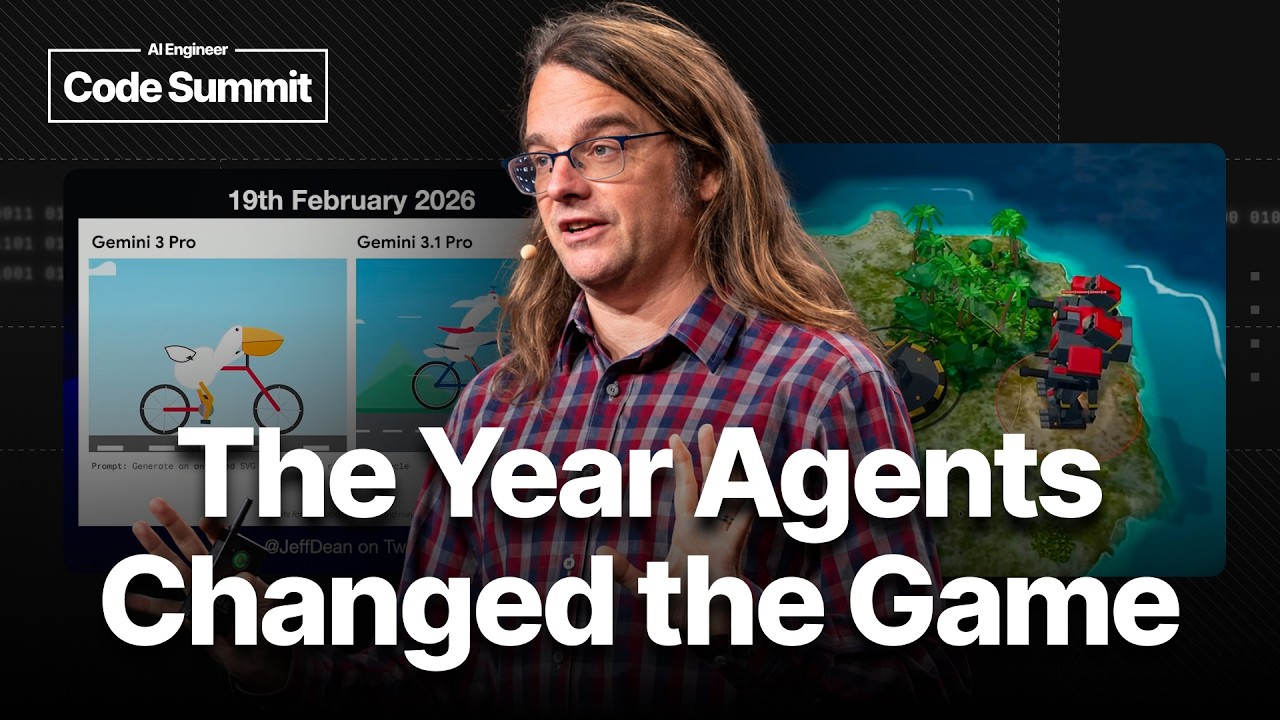
Simon Willison, a programmer who blogs about his experiments with AI tools, argues in a November 24 post that language models and coding agents crossed three thresholds in the past twelve months, each of which changed what he could hand to an agent. The post expands a keynote he gave at the AI Engineer Code Summit. Each threshold is his judgment from daily use, dated by the model releases he credits, rather than a benchmark result.
The first came in November 2025 with Anthropic's Claude Opus 4.5. Claude Code, Anthropic's , had then been out for nine months, but Willison had not used it daily because he had to correct it often enough that it did not clearly speed him up. Opus 4.5 was the first model he used with it where the default result was generally right, so for most of his everyday problems it was faster than solving them himself. He says OpenAI's GPT-5.1 releases that month, including GPT-5.1-Codex and GPT-5.1-Codex-Max, did the same for its Codex agent. After a December of experimenting, he and many others were using these tools for real work by January.
The second arrived in June and July 2026 with Claude Fable 5, which he describes as a defanged version of Claude Mythos, the model Anthropic had said in April was too dangerous to release because of its cybersecurity abilities. US export controls took Fable 5 away three days after launch until July 1. Willison now groups models of this kind as "Fable class", and the examples he gives are about initiative, which he has called being "relentlessly proactive": asked to fix a Safari display glitch, Fable built its own screenshot tool and a local logging server to chase the bug, and more recently Opus 5.5 and Fable 5.2, given five browser microphones, located a mysterious beep to within about 40cm (his beep write-up). He counts Fable 5, 5.1 and 5.2 and Opus 5.5, which he calls "cheap Fable", in the class, along with GPT-6 Astra and possibly Gemini 4 Neon, and treats them as his baseline for a frontier model.
The third, in September and October, is 3D modeling and games. He says frontier models became able to produce credible 3D models with Blender or Three.js code, a he first noticed in Fable 5 that grew with Opus 5.5, GPT-5.6 Sol, GPT-6 Astra and the Gemini 4 family. The larger change for him was fun. In August a Fable 5 heist game looked like a game but played poorly, and in a September talk he told the audience that designing fun games remained a human job. Then he asked Opus 5.5, released September 22, to make his real-time strategy game much more fun, and after 12 hours of playtesting and rebalancing it went from boring to deeply entertaining, in his account. He wrote about that shift in an October post.
He leaves a possible fourth threshold open: whether Fable 5.2 is another inflection point or an incremental improvement. His evidence is output, eight releases of his Datasette and projects in three weeks, and his sense that its taste nearly matches his own. If it is a threshold, he says, the change is that software you can imagine and describe clearly can now be built by Fable. The post is most useful as a dated from one experienced user that ties each change in what he delegates to a specific release. It does not show how often these results hold for other people, projects or tasks.
- Willison dates his own switch to Claude Code as a daily driver to Claude Opus 4.5, released a year before the post. Earlier models needed correction often enough that the agent was not a clear accelerant over writing the code himself.
- He defines a Fable class model by relentless proactivity, citing Fable 5 building its own pyobjc screenshot mechanism and a CORS logging server to chase a Safari glitch, and counts Fable 5 through 5.2, Opus 5.5 and GPT-6 Astra in that class.
- The September to October shift he reports is 3D: models became able to produce credible Blender or Three.js models of almost anything. He notes spatial awareness is a prerequisite for using vision models in robotics, and is unsure which drove which.
- He had used game design as the example of work that stayed human, then withdrew it. Telling Opus 5.5 to make his RTS a lot more fun worked, after the model spent 12 hours playtesting and rebalancing the game.
- Willison has not decided whether Fable 5.2 is a fourth inflection point. His proposed test is whether software that can be clearly described can be built, with three Datasette alphas and five LLM releases in three weeks as his evidence so far.
- Agent mode — A mode in which one agent can inspect, edit, run commands, and iterate toward an outcome.
- agent skill — A reusable instruction file that teaches an agent how to do one job well — the procedure, the tools, and what counts as done.
- Large language model — A model trained on large amounts of data to process and generate language.
- Record — One unit of data in a file or table, such as one supplier's quote; distinct from a line of text.
Checking sign-in…
Loading comments…