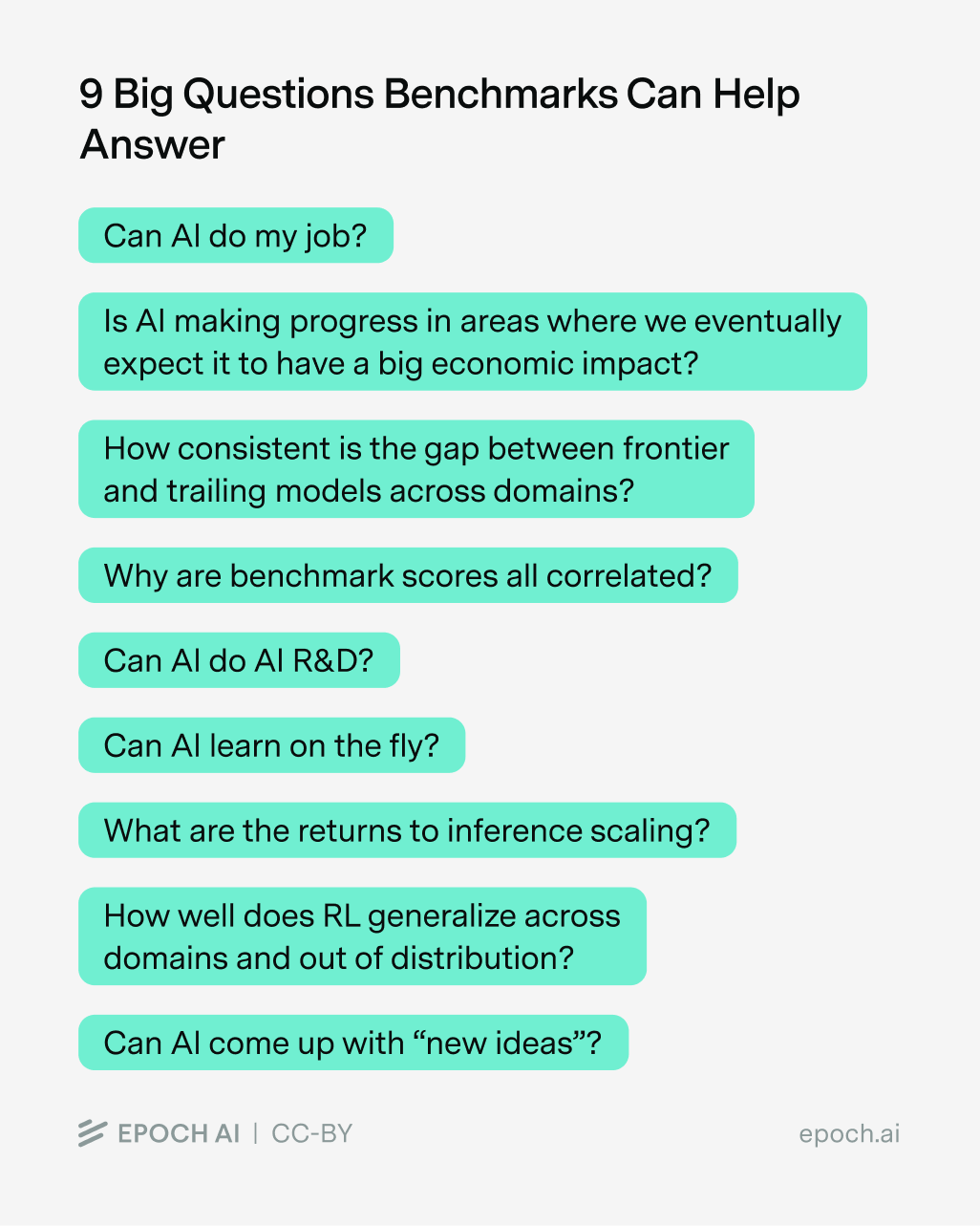
Names which unresolved capability questions benchmarks should answer, helping engineers judge which evaluation results actually predict real-world agent usefulness.
Key takeaways · AI-distilled
On whether AI can do whole jobs, the author notes Epoch polling shows workers still mostly use AI for part of a task, and points to MirrorCode, Remote Labor Index and Andon Café, a real cafe run by an AI agentAn AI system that doesn't just answer once but works toward a goal in a loop — taking actions, reading the results, and deciding what to do next.Full definition →, as attempts to test messier work.
benchmarkA standard public test set for comparing AI models — the shared scoreboards behind every "model X beats model Y" claim.Full definition → scores are highly correlated across domains, which is what lets ECI work; the author asks whether that reflects separate per-benchmark training effort or a general factor, noting log time horizons tracked ECI closely before saturating.
On continual learning, the author says EBR-bench models are not bad at the board game but show little if any improvement over repeated play, which matters because pre-deployment testing fails to bound capabilities if AI can improve on the fly.
inferenceRunning a trained model to get answers — the phase where AI is actually used, as opposed to trained.Full definition →-scaling experiments tend to show logarithmic gains at best, the author writes, and open problems include the best way to spend compute (serial thinking versus multi-agentUsing several AI agents on one problem — splitting work in parallel, checking each other, or filling different roles like planner and reviewer.Full definition → harnesses) and whether easy-to-verify domains keep gaining after others plateau.
Evidence on RL generalization so far: models improved on puzzles from an undisclosed game they were unlikely to be trained on, and do nearly as well on MirrorCode in low-resource languages, though generalization to harder-to-verify tasks remains unclear.
Terms in this piece · Glossary
benchmark — A standard public test set for comparing AI models — the shared scoreboards behind every "model X beats model Y" claim.
AI agent — An AI system that doesn't just answer once but works toward a goal in a loop — taking actions, reading the results, and deciding what to do next.
inference — Running a trained model to get answers — the phase where AI is actually used, as opposed to trained.
multi-agent — Using several AI agents on one problem — splitting work in parallel, checking each other, or filling different roles like planner and reviewer.