Speaking the Language of Physics: Introducing the First Instruction Set Architecture (ISA) for Dynamical System Hardware
Source
Ang Li
Author
Ang Li
Date
Key takeaways · AI-distilled
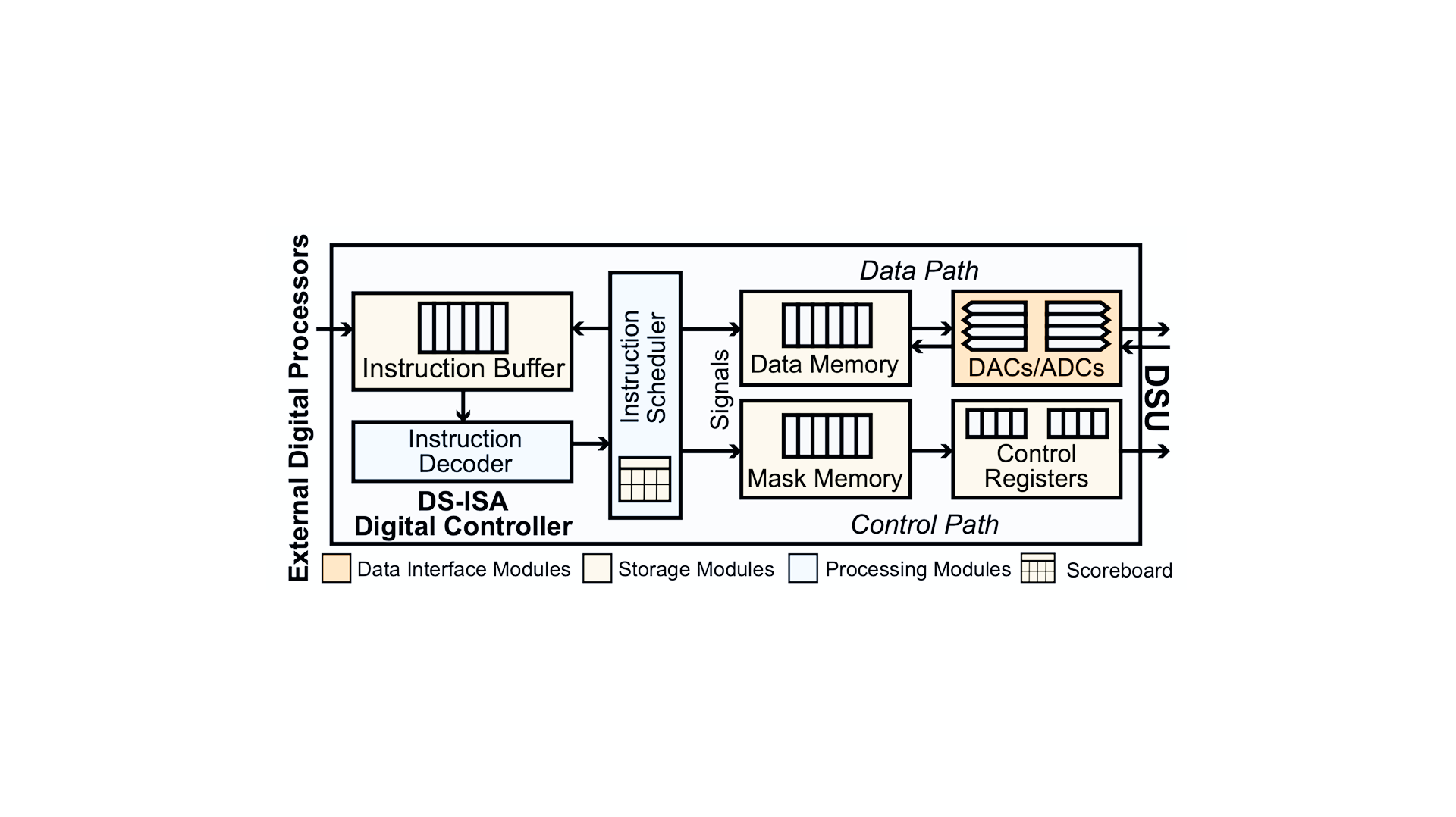
DS-ISA breaks dynamical-system computation into five composable phases (Connect, Load, Lock, Evolve, Store) and shows an entire unit can be orchestrated with a minimalist 9-instruction ISA using a 'label-and-trigger' mechanism to unleash physical evolution.
To let one physical system feed another, mirroring multi-layer neural nets, the paper proposes a Cascading Node Evolution pattern where the equilibrium state one dynamical stage reaches becomes the direct physical input driving the next stage.
For multi-tenancy the architecture borrows a GPU-like grouping scheme: a two-level mask (inter-group for macro sync, intra-group for fine control) lets one instruction act on a whole group, supports concurrent batched inferenceRunning a trained model to get answers — the phase where AI is actually used, as opposed to trained.Full definition →, and reclaims unused hardware for wear-leveling.
The underlying paper (Wu, Song, Liu, Geng, Li; ISCA 2026, DOI 10.1109/ISCA66397.2026.00123) is framed explicitly as an academic proof-of-concept rather than a commercial product; lead author Ang Li will be inducted into the ISCA Hall of Fame for it.
Terms in this piece · Glossary
inference — Running a trained model to get answers — the phase where AI is actually used, as opposed to trained.