The Jev Revolution: What Engineers Are Already Building with System One Models
- Source
- latent.space
- Author
- Richard MacManus
- Date

Context
A Latent Space report from the AI Engineer Code Summit describes engineers building with what speakers called system one models, and the useful idea is what those models return (Latent Space). Instead of generating text, a system one model gives a structured answer: a choice among options, a score or a probability. The article describes them as typically much faster and cheaper than reasoning LLMs, which it calls system two models. The model behind the trend is Jev, released in September by TypeSafe AI (its launch announcement is in Intel).
TypeSafe AI's chief executive, Diogo Almeida, framed the case around reliability. A generative model, he said, gives "Einstein 95% of the time, but Mr. Bean 5% of the time," and software that cannot tell which answer it got cannot be trusted to automate anything. His answer is to call these models from inside ordinary code. Latent Space founder swyx read that as a call to put system one calls throughout application code rather than stitching prompts together and hoping the output is usable. Almeida calls Jev "reliable intelligence"; the article reports that claim without presenting any measurement of it.
The talks that followed showed what this looks like in practice. Chinmay Goyal said Glean runs Jev alongside LLMs and other classifiers, and that Jev powers a significant number of its flows; its advantage there is that when the set of categories changes, the team does not have to a model again. Engineers from UiPath, an automation platform, had Jev rank document chunks in a tournament, picking the most relevant chunk from small groups and advancing the winners round by round, and the whole process took under a second despite thousands of Jev calls. Scott Roberts of Workday showed a prototype that starts filling in a time-off request while the user is still typing. These are talks and prototypes, not measured comparisons, so they support the claim that fast, cheap decisions make new software designs practical, not yet the claim that such models are more reliable than LLMs.
- TypeSafe AI CEO Diogo Almeida framed the case for Jev as reliability: an that gives you "Einstein 95% of the time, but Mr. Bean 5% of the time" cannot automate work when you can't tell which answer you got.
- Glean's Chinmay Goyal said Glean runs Jev alongside LLMs and other classifiers because its zero-shot flexibility means the models need no repeated fine-tuning as the decision taxonomy changes. Glean hides from customers whether a flow used Jev or a full LLM.
- UiPath showed Jev ranking document chunks in a tournament: it picked the most relevant chunks from small groups, winners advanced each round, and the whole run took under a second despite thousands of Jev calls.
- UiPath's Chibi Vikram argued that Jev looks less intelligent on its own but gets more capable when composed into patterns like that tournament, treating the model as an adjustable building block.
- Workday principal engineer Scott Roberts prototyped an interface that fills in a time-off card while the user is still typing, which he described as moving "from predicting what you want to say to predicting what you want to do."
- fine-tuning — Taking a trained model and training it a bit more on your own examples so it gets better at one specific job.
- LLM — A large language model — the neural network behind tools like Claude and ChatGPT, trained on huge amounts of text to predict what comes next.
- articleAI Engineer Code Summit: OpenAI on New Ways of Working With Codex
 articleAgents Prompt People: Using Agents for Long-Horizon Financial Work
- articleCan Frontier Models See Past a Decoy? Elorian Tests Visual Reasoning
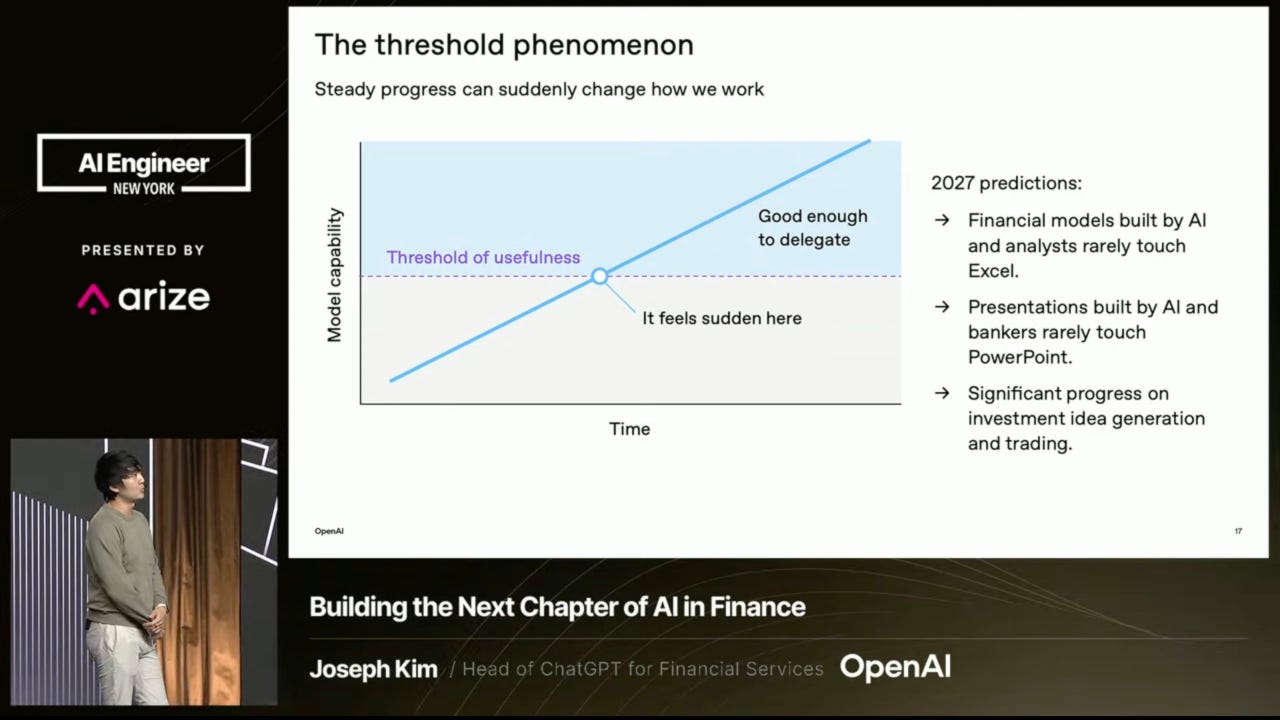 articleCrossing the Threshold: How OpenAI and Anthropic Approach Autonomy and Safety in Financial Agents


Checking sign-in…
Loading comments…