Ian Buck Kicks Off NVIDIA’s Week at SC26 as Science Enters the Age of Agents
- Source
- blogs.nvidia.com
- Author
- Brian Caulfield
- Date
Context
NVIDIA opened its week at SC26, the annual supercomputing conference, by presenting AI agents as the new way scientists will work with supercomputers. In a special address, Ian Buck, NVIDIA's vice president for hyperscale and high-performance computing, described agents as software that can plan experiments, run code and check results on researchers' own systems, working alongside simulation, which he said remains the foundation of scientific computing. Several of the announcements were tied to that idea.
The software piece is Nemotron for Science, which combines NVIDIA's open Nemotron 3.5 Super VL model with a new open chemistry dataset and post-training recipes, instructions for further training the model, for life sciences and chemistry. Because the model is open, researchers can run it on their own machines, from a DGX Spark, NVIDIA's desk-sized system that it also offered this week as a four-node developer kit, up to their own supercomputer. "You own your data. You own the model," Buck said. He gave examples of agents at work: at Argonne National Laboratory, an built with the toolkit took a single prompt, planned and tested hypotheses, chose which simulations to run and identified two new binding sites; an agent from KTH Royal Institute of Technology that repairs broken setups for GROMACS, a molecular simulation program, fixed 81% of test cases in one overnight run on a single DGX Spark; and NVIDIA's own Nsight AI Porting Agent converted a routine from the WRF weather model to run on GPUs, making it more than five times faster at a cost of about 150 million . These are demonstrations NVIDIA reported; the post does not say how the test cases were chosen.
The CPU announcement follows from what agents do between model steps. Buck said agents rely on CPUs to run tool calls, the commands and programs an agent invokes and whose results it reads before deciding what to do next. That is the case NVIDIA makes for its Vera CPU, which DKRZ, the German Climate Computing Center, has chosen for its HLRE-5 supercomputer, expected in early 2028. For the calculations themselves, NVIDIA introduced Rubin HPC, a GPU for science and engineering expected in 2028, with more than 50,000 CUDA cores, about three times as many as its Hopper generation, and support for number formats from 64-bit (FP64) down to 4-bit (FP4) precision.
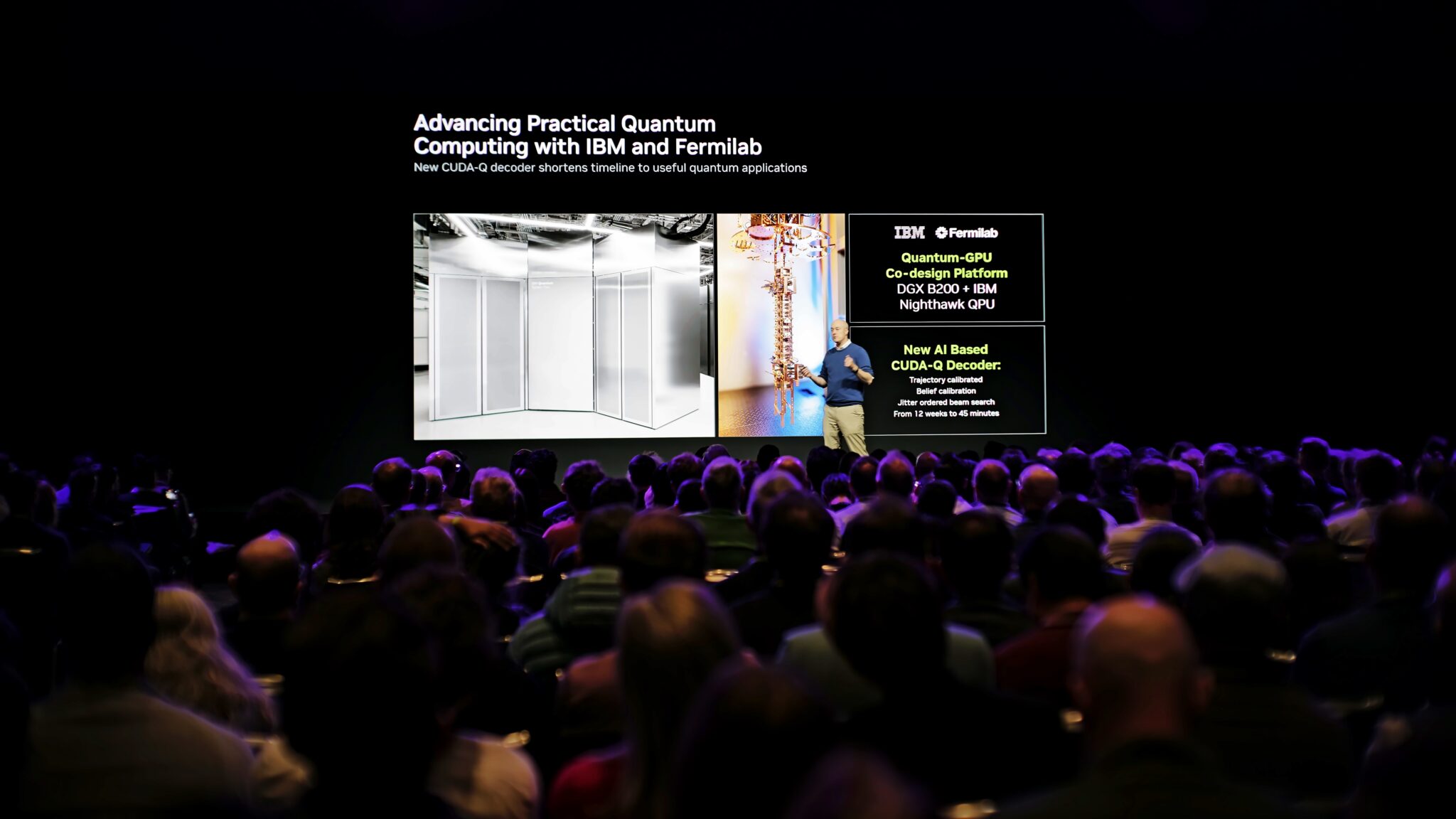
Quantum computing was the third strand. NVIDIA, IBM and Fermilab announced plans for a shared co-design platform for research on quantum applications and error correction, the techniques that detect and correct the mistakes quantum hardware makes, pairing NVIDIA DGX B200 systems with IBM quantum computers. Buck also said a new decoding algorithm in NVIDIA's CUDA-Q software cuts error-correction research computation from 12 weeks to 45 minutes. As with the agent examples, these figures come from NVIDIA's own presentation.
- Buck said an agent from KTH Royal Institute of Technology repairs broken GROMACS simulation setups on its own, fixing 81% of test cases in one overnight run on a single DGX Spark.
- NVIDIA's new Nsight AI Porting Agent ported a routine from the WRF weather model to GPUs and sped it up more than 5x, using about 150 million tokens, according to Buck.
- Buck argued agents need strong CPUs because tool calls run on the CPU between model steps; Germany's DKRZ climate center picked Vera CPUs for its HLRE-5 supercomputer, expected in early 2028.
- Rubin HPC supports precisions from FP64 down to FP4, adds sparse-data acceleration, and has more than 50,000 CUDA cores, about three times Hopper's count, per Buck; it is expected in 2028.
- Buck said a new CUDA-Q decoding algorithm, TCBP-JOBS, cuts error-correction research computation from 12 weeks to 45 minutes, and the goal is to bring quantum decoding latency from about 300 microseconds to 10.

Checking sign-in…
Loading comments…