Tencent Launches Hy4 Flash To Power High Speed Cost Efficient Ai Deployment For Everyday Workflows
- Source
- tencent.com
- Author
- Tencent editorial sitemap
- Date
Context
Tencent's pitch for Hy4 flash is about the cost of finishing a task rather than the price of a token, and both parts of that pitch come from Tencent's announcement. The token price is the part anyone can check: about US$0.070 per million input tokens, US$0.281 per million output tokens and US$0.003 per million cached input tokens. Tencent charges US$0.90, US$2.70 and US$0.045 for the same three rates on Hy4, its larger model, so flash costs roughly a thirteenth as much for input, a tenth for output and a fifteenth for cached input.
Tencent attributes the low cost to a model that does less work per token and writes fewer tokens. Hy4 flash has 224 billion parameters, but only 12 billion are active for any one token, so each token needs a small fraction of the computation the full size suggests. Of the total, 64 billion are Engram parameters, a lookup of learned vectors for recurring text patterns that SemiAnalysis has described as able to sit outside an accelerator's scarce high-bandwidth memory. Tencent says the , the memory a model keeps for the text already in its , is a sixth the size of Hy4's and a 24th of Hy3's, which matters for a model that accepts up to 1 million tokens. It also says reinforcement learning halved the average number of output tokens per task, without naming the model it compared against, and that 4-bit and other inference work lift decoding above 150 tokens per second.
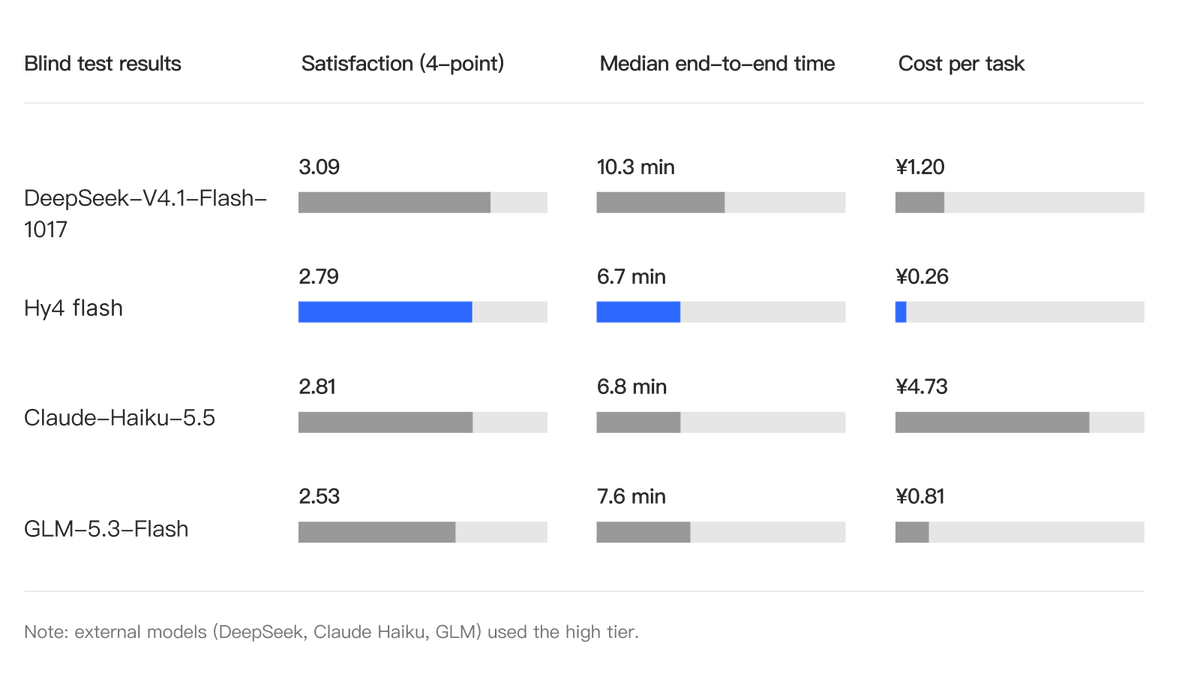
The quality claims come from Tencent's own tests. WorkIndex is an internal benchmark built from typical tasks in WorkBuddy, Tencent's agent workspace: making and editing slide decks, editing documents, repairing spreadsheets, processing audio and video, and visual understanding. On it, Tencent says flash slightly outperforms the much larger Hy4 Preview overall at a 13th of its cost per task, and costs a 20th as much as Hy4 and an eighth as much as DeepSeek-V4.1-Flash-1017 at its Max tier and peak-hour prices. Hy4 Preview and Hy4 have the same token prices, so the gap between those two ratios comes from how many tokens each model spends on the tasks, not from the price list. In a blind test with 85 internal WorkBuddy users across 259 tasks in 27 categories, Tencent reports satisfaction close to Anthropic's Claude Haiku 5.5, with the lowest per-task cost and shortest completion time of the models tested.
The price cut is established; the claim that flash comes close to Claude Haiku 5.5 rests on Tencent's tasks, Tencent's users and Tencent's scoring, and the announcement's text cites no outside evaluation of flash. Tencent itself recommends flash for everyday work such as research, document processing and slide generation, and points users to Hy4 for long-horizon software engineering. Flash is available in Tencent products and on Tencent Cloud TokenHub, free on WorkBuddy and at half price on TokenHub until November 30, and Tencent says it plans to open-source the model.
- Tencent says Hy4 flash combines hybrid attention, LatentMoE and Engram layers, and that its KV cache is 1/24 the size of Hy3's and 1/6 the size of Hy4's.
- Reinforcement learning in post-training cut average end-to-end task output tokens by 50 percent, according to Tencent. Shorter outputs lower the cost of each task on top of the lower per-token price.
- On Tencent's internal WorkIndex benchmark (slide decks, document editing, spreadsheet repair, audio/video and visual tasks), Hy4 flash cost 1/13 as much per task as Hy4 Preview, 1/20 of Hy4 and 1/8 of DeepSeek-V4.1-Flash-1017 at Max tier peak pricing.
- In a blind test with 85 internal WorkBuddy users across 259 tasks in 27 categories, Tencent reports satisfaction close to Claude Haiku 5.5, with the lowest per-task cost and shortest completion time of the models tested. Both evaluations are Tencent's own.
- Tencent recommends Hy4 flash for research, document work, deck generation, simple front-ends and computer use, and points long-horizon software engineering to the larger Hy4. It is free on WorkBuddy and 50% off on Tencent Cloud TokenHub until November 30.
- KV cache — The memory a model keeps about text it has already read, so generating each new token doesn't require reprocessing the whole conversation.
- context window — The maximum amount of text a model can consider at once — its working memory for the current conversation or task.
- quantization — Shrinking a model by storing its numbers less precisely — like rounding — so it runs faster and fits on smaller hardware, at a small quality cost.
- mixture-of-experts — A model built from many specialist sub-networks where only a few activate per token, giving big-model capability at small-model running cost.


Checking sign-in…
Loading comments…