voyage-code-4 trains on how coding agents actually fetch context
- Source
- x.com
- Date

Coding agents issue dozens of context-fetch calls per task across multi-file, evolving repos. Most embedding models were never trained for that. 📢 Introducing voyage-code-4 — trained on retrieval patterns from real issue-fixing pull requests. 32K context. 📈voyage-code-4 outperforms Cohere Embed v4 and Gemini Embedding 2 by an average of 28.25% and 31.03% on agentic code retrieval Get started with voyage-code-4:

Context
Voyage AI's voyage-code-4 targets a step that comes before fixing a bug: finding the relevant files when the request describes a symptom rather than naming a function. Its release article says the training corpus draws on completed code-change requests, connecting natural-language problems with code.
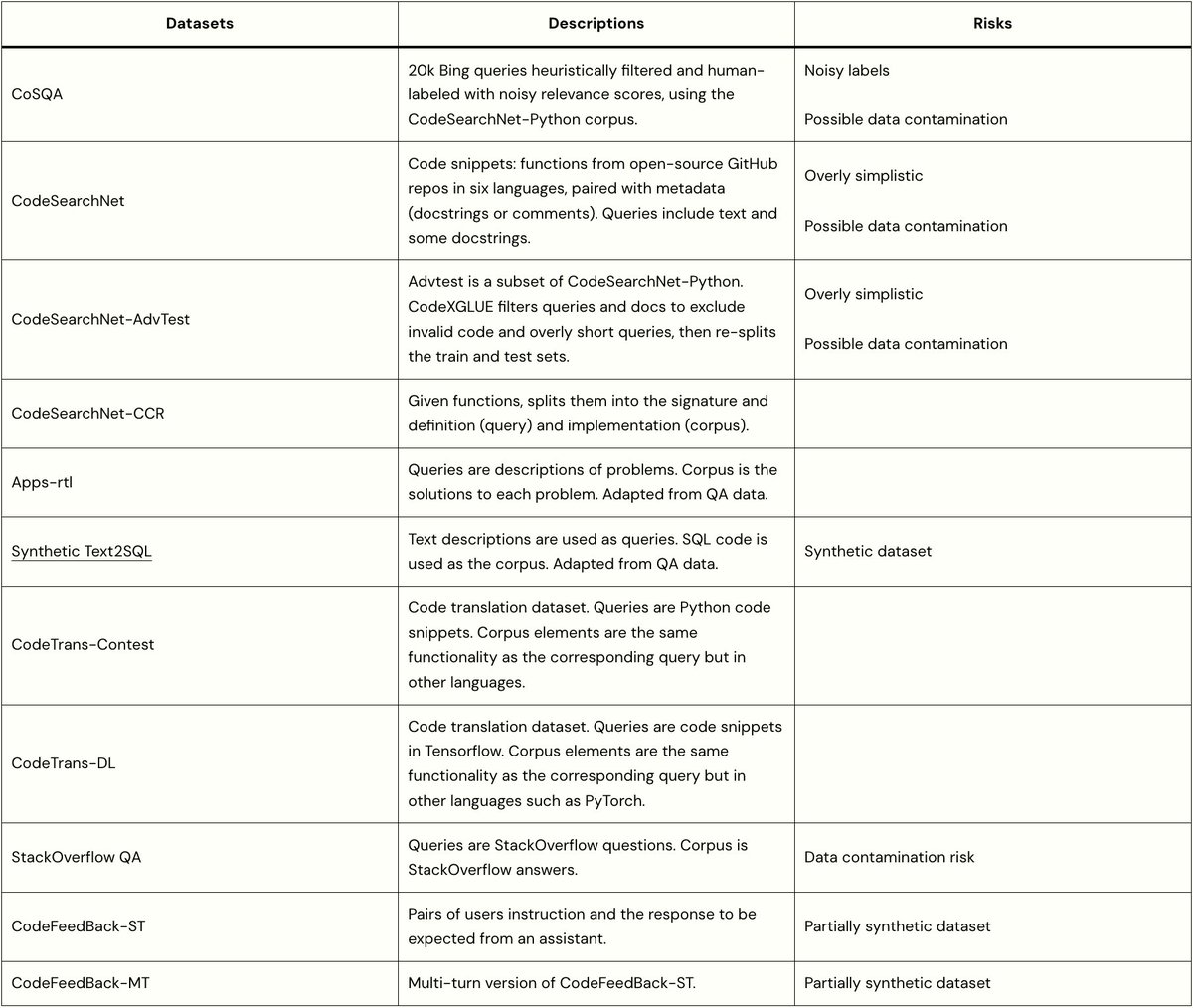
The accompanying makes that goal concrete. Across 19 benchmarks, each query is an issue description and the target files are those changed by the merged fix. The test repositories were excluded from training. This evaluates whether search directs an toward the code associated with a repair; it does not measure whether the agent can produce a correct repair itself.
- eval — A repeatable test for AI quality — a set of tasks plus scoring — used the way software teams use test suites, because model output is too variable to judge by eyeballing.
- AI agent — An AI system that doesn't just answer once but works toward a goal in a loop — taking actions, reading the results, and deciding what to do next.
- embedding — A list of numbers representing a piece of text's meaning, so that similar meanings end up numerically close and can be searched.
- context window — The maximum amount of text a model can consider at once — its working memory for the current conversation or task.

Checking sign-in…
Loading comments…