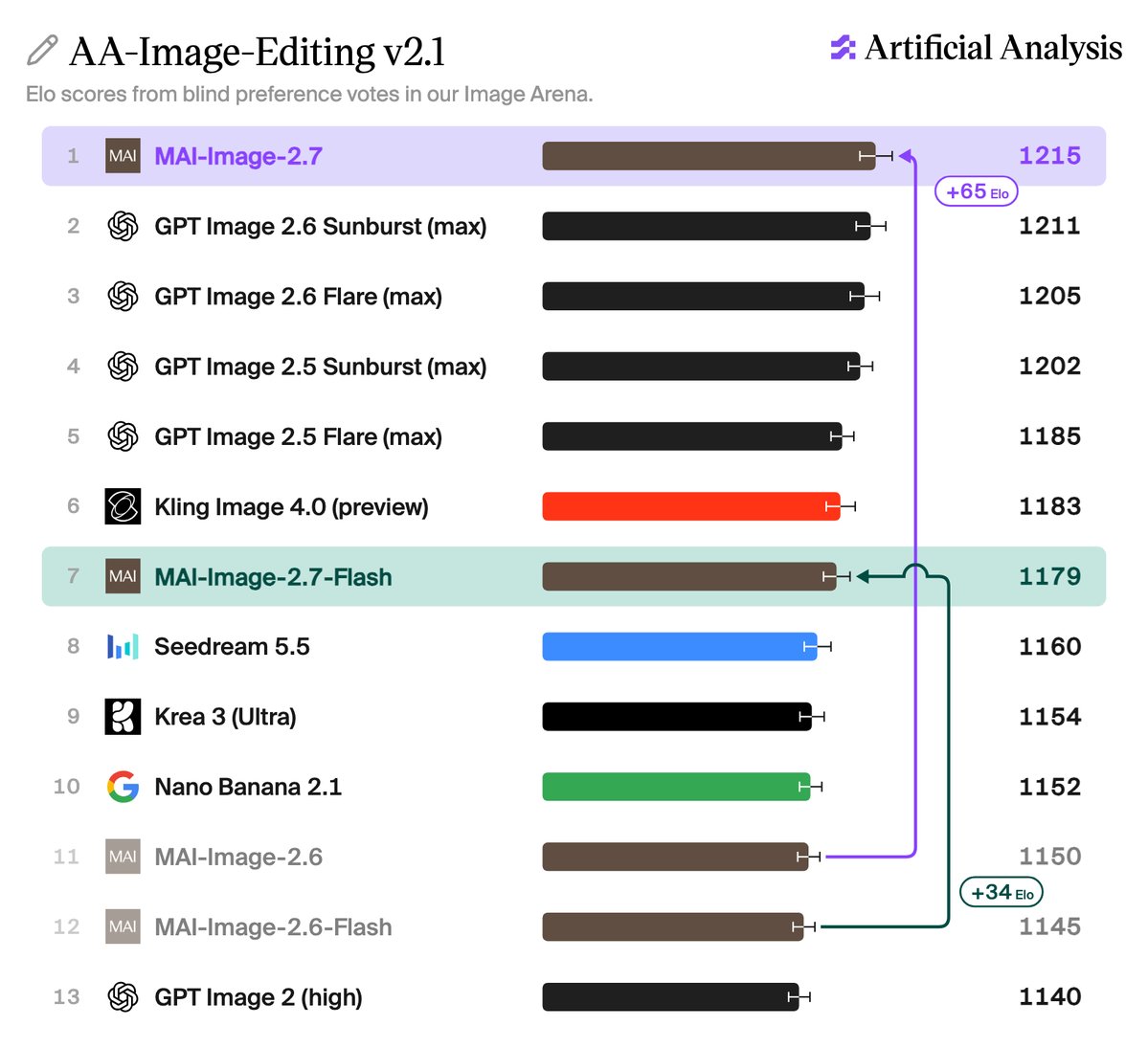
Vercel has added Microsoft's MAI-Image-2.6 and MAI-Image-2.6-Flash to AI Gateway, letting developers generate images and edit existing ones using a gateway API key without a separate provider account. The changelog shows the same image-generation FunctionA named block of instructions that takes inputs, called arguments, and hands back a result, called its return value.Full definition → accepting either a text PromptInformation or instructions supplied to a model; in a chat, the request you type is often called your prompt.Full definition → or an image plus editing instructions. This puts initial creation and subsequent revision behind one interface. Vercel positions the standard model for final assets where quality takes priority, and Flash for faster, lower-cost iteration. Both accept up to five reference images to guide edits or combine subjects.
Key takeaways · AI-distilled
Both models handle photorealistic images, text rendering and targeted edits to products, portraits and layouts, accept up to five reference images, and output up to 1536 x 1536.
Edits use the same generateImage call, passing the existing image in the prompt's images array together with a text InstructionA statement in the context that tells the model how to behave or what to do; module 3's first layer.Full definition →.
Besides the AI SDK, the models are reachable through an OpenAI-compatible APIAn API that accepts the common OpenAI request shape so existing clients can call another provider with fewer code changes.Full definition → and the AI CLI, using the IDs microsoft/mai-image-2.6 and microsoft/mai-image-2.6-flash.
Terms in this piece · Glossary
Function — A named block of instructions that takes inputs, called arguments, and hands back a result, called its return value.
Prompt — Information or instructions supplied to a model; in a chat, the request you type is often called your prompt.
Instruction — A statement in the context that tells the model how to behave or what to do; module 3's first layer.
OpenAI-compatible API — An API that accepts the common OpenAI request shape so existing clients can call another provider with fewer code changes.