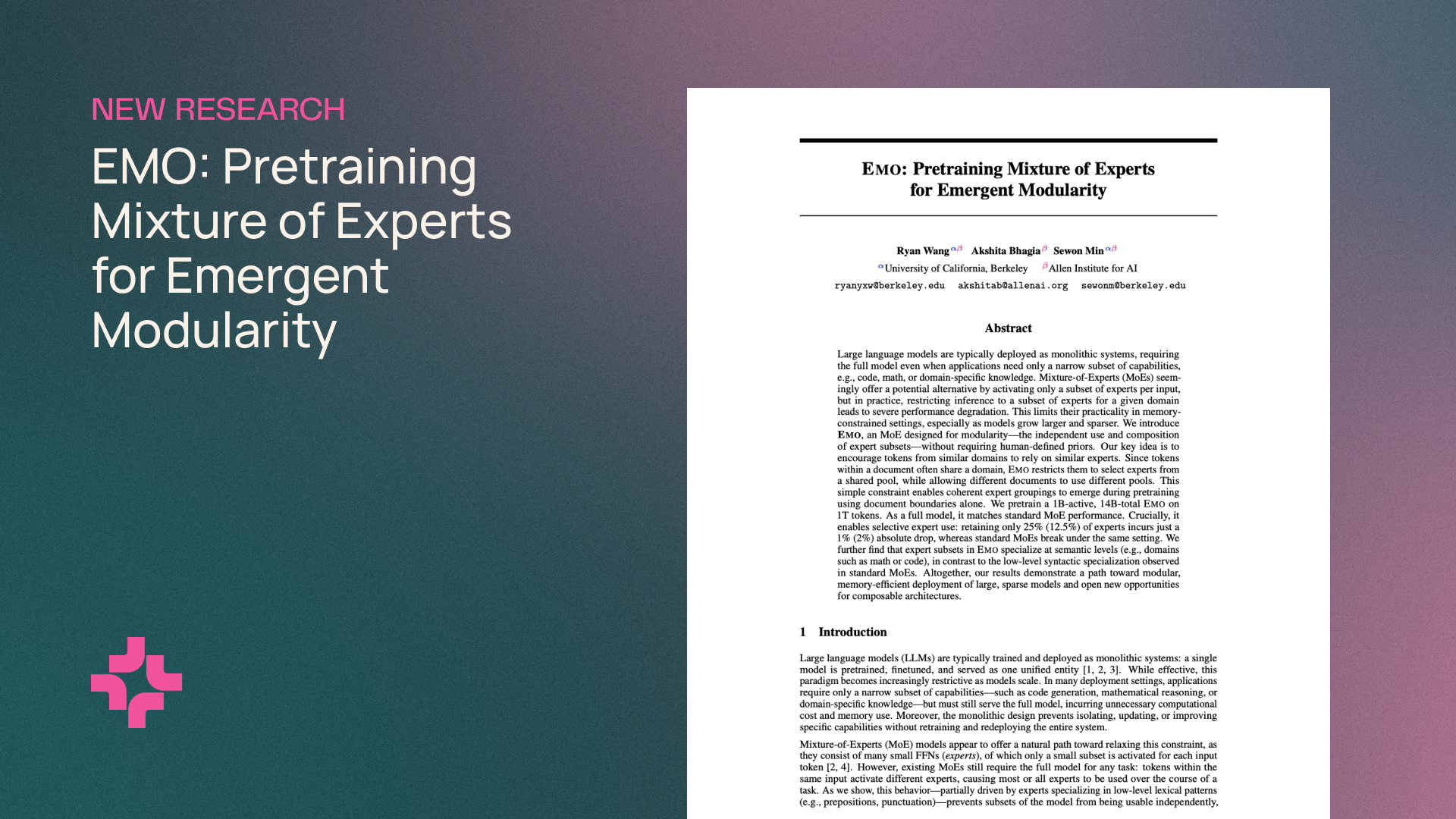
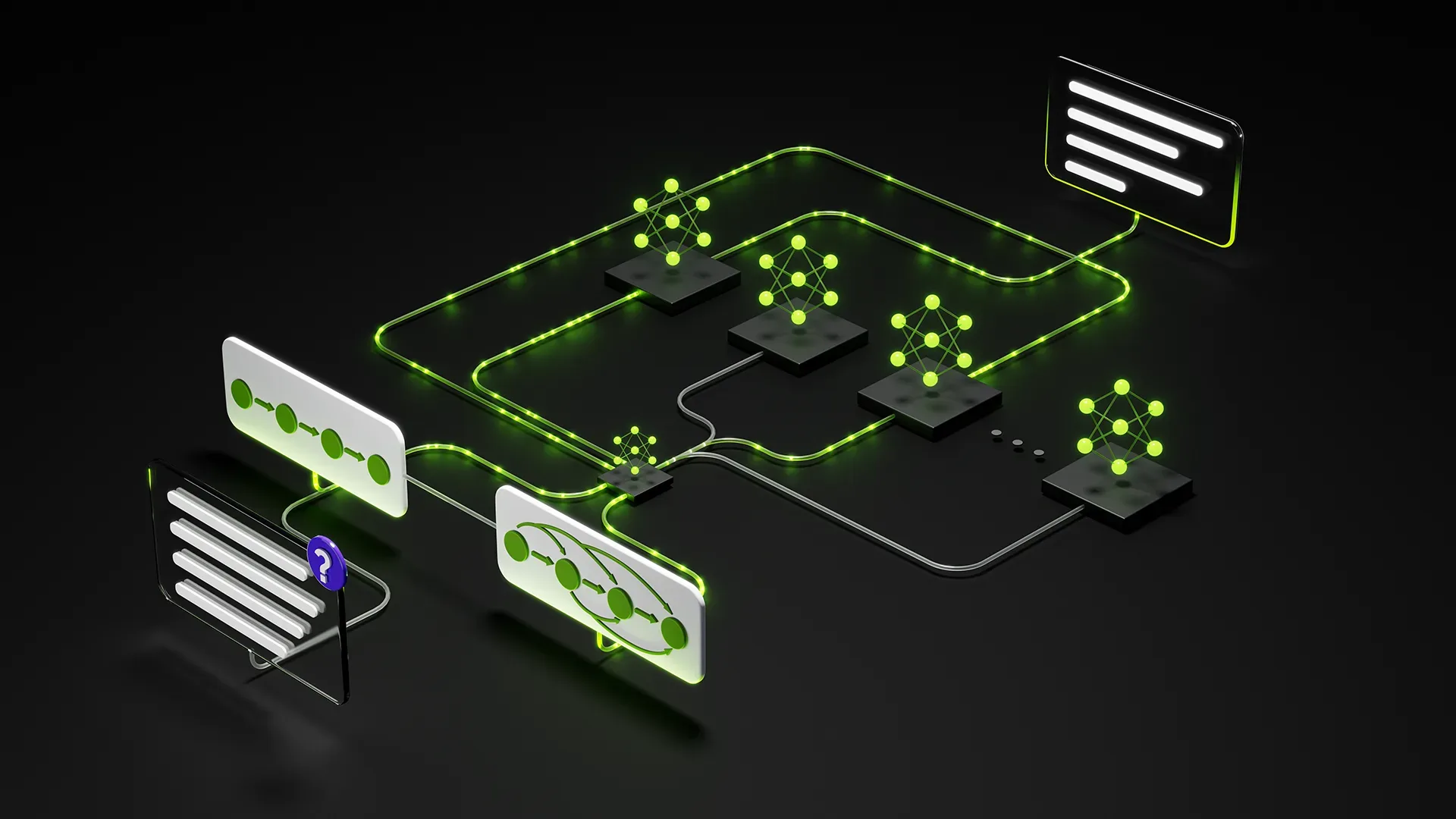
A trained Large language modelA model trained on large amounts of data to process and generate language.Full definition → can become the starting point for a larger mixture-of-expertsA model built from many specialist sub-networks where only a few activate per token, giving big-model capability at small-model running cost.Full definition → model. In this research presentation, an NVIDIA researcher explains upcycling: copying parts of an existing network into expert branches, then training a router to select which branches ProcessA running instance of a program, with its own working memory, open files and identity.Full definition → each piece of text.
Because only some branches activate for each input, the model can add capacity without activating every added parameter. The researchers report that their upcycling experiments outperformed continued training of the original dense models. Initialization is central to their method: the conversion must preserve useful behavior closely enough for further training to build on it.
Key takeaways · AI-distilled
Upcycling copies a dense model's MLP into several experts and adds a random router; the first forward pass must match the dense model or it forgets catastrophically. Mixtral's top-k then softmax keeps parity, but NVIDIA found it trailed softmax then top-k.
Learning rate mattered most: rather than the small final pretrainingThe first, biggest phase of building a model: training it on enormous amounts of text so it learns language, facts, and reasoning in general.Full definition → rate, the original peak rate worked best. Upcycled weights then sit around 0.7 cosine similarity to the base, similar to Mixtral 8x7B versus Mistral 7B, while fine-tuned chat models stay near 1.
Upcycling a 15B model (trained on 8T tokens) on 1T more tokens gave about 4 to 5% lower validation loss and 4% better MMLU than continuing dense training on the same data, which the speaker equates to a 1.7x bigger model at about one-eighth of pretraining compute.
For fine-grained experts, the router is half-initialized and duplicated so each shard is picked once, keeping parity; gains flattened beyond 64 experts. Megatron Core also fuses permute/unpermute and uses CUTLASS grouped GEMM instead of looping over experts.
Terms in this piece · Glossary
Large language model — A model trained on large amounts of data to process and generate language.
mixture-of-experts — A model built from many specialist sub-networks where only a few activate per token, giving big-model capability at small-model running cost.
Process — A running instance of a program, with its own working memory, open files and identity.
pretraining — The first, biggest phase of building a model: training it on enormous amounts of text so it learns language, facts, and reasoning in general.