OpenAI's Agent Pipeline Validated 948 Linux Kernel Root Exploits
- Source
- openai.com
- Author
- OpenAITop Viber
- Date

Context
OpenAI's security researchers ran an automated pipeline against the Linux kernel in mid-October 2026 and ended with 948 distinct bugs, each backed by an exploit that turned an ordinary user account into full control of the machine. These are local privilege escalation bugs: an attacker first needs some foothold, such as a low-privileged login, and the bug lifts that to root, the account that can do anything on the system. OpenAI's research post says the test machines ran a stock desktop Linux distribution with its standard protections switched on, under the same threat model hacking competitions such as Pwn2Own use, rather than a deliberately weakened target. The research post calls the model an upcoming cyber model; OpenAI's November 23 post names it GPT-6 Cyber, the model OpenAI also used to find Firefox vulnerabilities with Mozilla (earlier coverage).
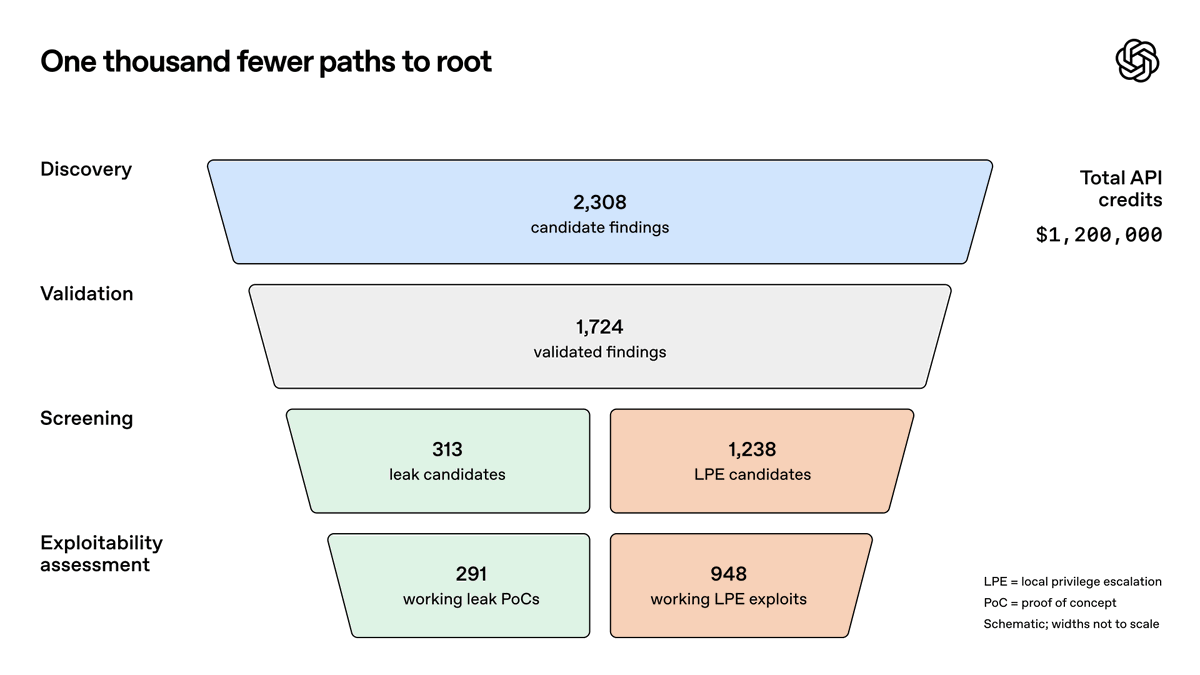
The 948 comes at the end of a series of filters, and most of them keep only what passed a harder test. Scout agents picked 5,034 security-relevant parts of the kernel that low-privileged users can reach, about 7% of its code, and analyst agents read that code and flagged 2,308 candidate bugs. Triage agents then tried to trigger each candidate inside an isolated virtual machine running a kernel build that detects memory corruption, and reproduced 1,724 of them. A reproduced crash shows a bug is real but not how dangerous it is, so exploit-writing agents went after the 1,238 candidates that looked capable of privilege escalation, on machines with the protections a standard distribution enables. They wrote 1,169 working root exploits. The last step is a count rather than a test: OpenAI wrote 948 distinct patches for the bugs behind those exploits, because some exploits hit variants of the same flaw, and it counts unique bugs by patches. Success itself needed checking: in an early run, human reviewers found that 20 of 200 reported exploits had reached root through a different, unassigned zero-day bug, so OpenAI added an independent check that each exploit uses the bug it was given.
Fixing is the least finished part. The pipeline writes a candidate patch for each bug, and security researchers review the exploit, patch and proposed severity before anything reaches kernel maintainers. Following the kernel community's advice to start with critical bugs, OpenAI says it has sent hundreds of reports and patches and is working with partners in its Patch the Planet initiative to send the rest gradually. In the attached video, an OpenAI researcher says many of the patches sent so far have been merged, without giving a count, and that maintainers have pointed out problems in some, which the team then revised. Others were moving fast too: when the 10 days of scanning and manual analysis ended, OpenAI counted 61 privilege escalation bugs already patched upstream, 43 with staging patches and 299 under public discussion. That is why the team says it checks each report against current code and public discussion before sending it, to avoid duplicates.
The whole run cost $1,213,430 in credits, about $1,279 per exploit by OpenAI's count. OpenAI calls its cost figures more an upper bound, because the research measured capability rather than cost and it expects better could cut the cost of each stage. Applying historical Pwn2Own and TyphoonPWN payouts of $20,000 and $70,000 per Linux kernel root exploit, OpenAI arrives at a hypothetical value of $18.9 million to $66.3 million. A separate 112-hour campaign against Google's kernelCTF, a reward that pays for exploits against a hardened kernel with fewer features exposed, produced 21 root exploits and 25 information-leak proofs of concept for about $32,936; for comparison, OpenAI notes that kernelCTF had accepted 26 confirmed zero-day root exploits in 2026 at the time of writing. The was not identical: the latest kernel is incompatible with one of kernelCTF's defenses, SLAB_VIRTUAL, so OpenAI dropped it. OpenAI also compares models. In late July, while the pipeline was still being developed, GPT-5.6 Sol found and exploited 166 unique bugs for $513,690. In mid-October the newer model found and exploited 948, which OpenAI describes as more than five times as many despite three months of hardening between the scans. Its advice to defenders is that for the near and medium term, a low-privileged account on a system missing its latest patches should be treated as functionally equivalent to root against a well-resourced attacker.
- Scout agents cut the audit to 5,034 targets reachable by low-privileged users, about 2.8 million lines or roughly 7% of the kernel, for $3,426. Analyst agents then produced 2,308 deduplicated candidate findings in 12 hours for $316,549.
- Triage agents reproduced 74.7% of candidates under KASAN in isolated VMs, and only 3.1% reflected incorrect model analysis. Validating a false positive cost about as much as a true one, so OpenAI says filtering false positives earlier makes the pipeline cheaper.
- Failed exploit attempts averaged $3,922 each across 69 cases versus $360 for 1,169 successes, driven by a few hard bugs such as race conditions. OpenAI says a give-up rule, like stopping after an hour without progress, would have cut that cost significantly.
- In an early run, 20 of 200 reported root exploits reached root through a different 0-day than the one assigned. OpenAI added an independent check that each final exploit used its assigned vulnerability before counting it.
- A library of 103 exploitation techniques raised GPT-5.5 Cyber's success from 76.2% to 88.9% on 63 candidates, but GPT-5.6 Cyber without it beat that setup, and adding it back gained only 1.5 points, so OpenAI dropped the scaffolding.
- API — Application programming interface: the agreed set of operations, inputs and outputs through which one piece of software uses another.
- Harness engineering — Designing the full environment and feedback system around an agent.
- Program — A set of instructions stored so that a computer can run it.
- Setup — The combination of a model, a harness, its connections and the path the task's data takes, considered together for a task.





Checking sign-in…
Loading comments…