← All IntelClip / Education
Modular vs end-to-end voice agents, and what the text bottleneck costs
From Voxtral Realtime and Voxtral TTS Explained · ≈1:04
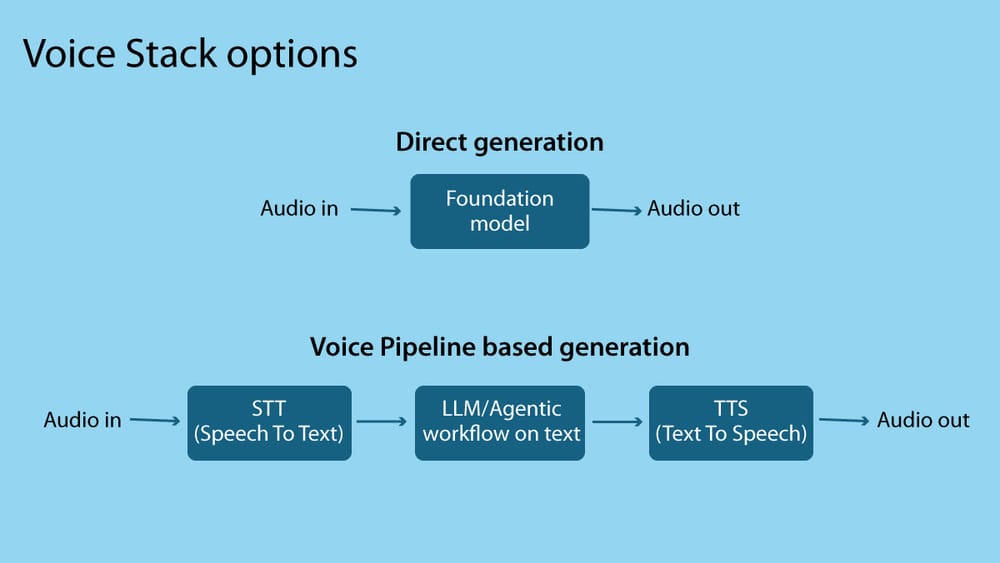
“The alternative is end-to-end models, which treat speech as a first-class citizen and remove the text bottleneck.”
Julia Turc
“The most obvious benefit of this loose decoupling is that you can mix and match. For each stage, you're free to pick the single best model for your use case.”
Julia Turc
“On the one hand, having text as an intermediate representation is convenient for debugging and provides an audible paper trail in regulated settings. But on the other hand, it throws away all the non-verbal information in the audio input, like frustration, sarcasm, or hesitation.”
Julia Turc
“And chaining three models means latency accumulates at every stage. There's just no free lunch.”
Julia Turc
What’s in it
- Lays out the real trade: ASR+LLM+TTS lets you pick the best model per stage and gives an auditable text paper trail for regulated settings, but loses paralinguistics and stacks latency.
Clip transcript
>> What's the meaning of life? >> Some would say 42. When building voice agents with a speech-to-speech interface, there are actually two schools of thought. One is modular, nesting an LLM between two other powerful models. This is the more practical approach, embraced among others by Voxygen, and will be the focus for this video. The alternative is end-to-end models, which treat speech as a first-class citizen and remove the text bottleneck. Thinking Machines is one of the most visible proponents for this approach, and we'll talk about it in the next video. A modular voice agent is really three modules chained together. A speech-to-text model transcribes the audio into text. It's also commonly known as an automated speech recognition model, or ASR. Its output is fed into a standard LLM, which does the heavy reasoning. The response finally goes through a text-to-speech, or TTS model, which maps it back to an audio output. These three components are trained separately and only communicate through text. The most obvious benefit of this loose decoupling is that you can mix and match. For each stage, you're free to pick the single best model for your use case. Say you're running customer support for a European bank that serves a dozen countries. Then you'll prioritize an ASR model that does well on European languages and are probably willing to compromise on Chinese quality. Then you'll take the LLM and fine-tune it on the bank's playbooks. Also, for the text-to-speech model, you might want to prioritize latency as opposed to emotional nuance or rich acoustics. On the one hand, having text as an intermediate representation is convenient for debugging and provides an audible paper trail in regulated settings. But on the other hand, it throws away all the non-verbal information in the audio input, like frustration, sarcasm, or hesitation. And chaining three models means latency accumulates at every stage. There's just no free lunch. The models from Mistral can be plugged in as
Recommended reads
Comments
Checking sign-in…
Loading comments…