Software engineering after code becomes cheap with Satya Nadella
- Source
- newsletter.pragmaticengineer.com
- Author
- Gergely Orosz
- Date
Context
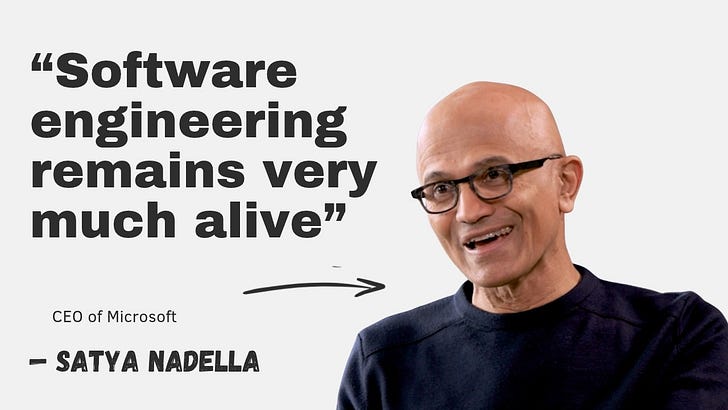
Satya Nadella, the chief executive of Microsoft and a former software engineer, argues that once AI agents write most of the code, the hard part of software engineering becomes saying precisely what the code should do and proving that it does it. "In a world where code generation has become cheap, what has become hard is verification," he tells Gergely Orosz on The Pragmatic Engineer podcast. In his description, code has moved from being what engineers type in to being what the system puts out, so specifications, design documents and statements of intent carry more weight than before. Nadella says he is still coming to grips with the term "software factory", which he uses for the whole arrangement a team builds to produce and check that output: the instructions, the agents, the tests and the operational processes around them.
Verification, as he describes it, is a set of habits rather than one tool. Agents get small tasks, and the team makes sure each one is truly done. Every failure is turned back into a test case. A model from a separate model family reviews the work, so that the blind spots of one family of models do not pass straight through. The step he says he is really excited about uses production logs: a fault seen in production leads to a fix that is checked against the full test suite and deployed only once it passes, which he calls his own version of recursive self-improvement. Orosz notes in his takeaways that the conversation reached no settled answer on how to verify AI-written code, and Nadella names the problem without claiming to have solved it.
His examples are mostly about existing products rather than new ones. Because AI models now find security vulnerabilities in Windows, he says, the Windows team is building a new pipeline from crash traces to fixes, while the Windows build system stays as it was. He calls builds and the CI/CD pipelines that test and ship code the hardest part of such projects. At GitHub, the volume of work from coding agents has grown so much that Microsoft is changing the Git protocol and storage system underneath it. The Azure networking team, which deals with about 500 fiber operators worldwide through emails and improvised processes, built an system that now runs those operations, which Nadella cites as a factory that covers operations as well as code.
He gives the same reason for two workforce questions Orosz raises. The slowdown in hiring junior engineers, at Microsoft and elsewhere, may come, he says, from teams first reorganizing themselves around these factories; once they are set up, new people can be added with their own budgets, the way he says AI-native companies grow. He calls it too early to read the slowdown as a long-term trend. He presents Microsoft's voluntary exit offers as a way for employees on teams that are not changing to move somewhere better. He also explains why Microsoft was caught out by command-line coding agents: after Anthropic's model made the command line work as a form factor, he says, IDEs faded within about six months, and he takes the lesson that a product built around one model must be ready to change shape when the next model makes a large jump.
These are the views of the head of a company that sells developer tools, AI models and cloud services, given without figures beyond the examples above. The transcript used here is Substack's automatic transcript, which has no speaker labels and garbles some names, so the quotation and attributions rest on its wording.
- Satya Nadella said Claude Code's move from the IDE to the command line caught Microsoft off guard, and that the IDE faded within about six months. His lesson: after a non-linear model jump, the way people use a model can change fast.
- Nadella advises keeping the , memory and model decoupled so a provider can be swapped, building private evals to choose models, and treating agents as insider risks checked by a separate verification system, because models are intelligent but unreliable.
- Nadella says code generation is cheap but verification is hard: model critique of generated code runs into problems, such as making tests pass by deleting failing tests. Verification loops built on production traces still need models that can verify fixes.
- Nadella's hybrid-intelligence bet: last year's frontier-equivalent model already runs on a laptop, so a router can send work to cheap, unmetered local models and escalate to costlier cloud ones. Microsoft is building that routing with its MAI models and Surface hardware.
- Nadella attributes the junior hiring slowdown to teams reworking their sizes, roles and the balance of human effort against token budgets, and expects hiring to recover after that. Microsoft and Carnegie Mellon's PRAISE program pairs new engineers with experienced preceptors.
- AI agent — An AI system that doesn't just answer once but works toward a goal in a loop — taking actions, reading the results, and deciding what to do next.
- token — The chunk of text a model reads and writes in — roughly three-quarters of a word — and the unit AI usage is billed in.
- agent harness — The scaffolding around a model that turns it into a working agent — the loop, the tools it can call, and the rules for when to stop.
- alignment — The work of making AI systems actually pursue what their builders and users intend, rather than something subtly or dangerously different.
Checking sign-in…
Loading comments…