Measuring inference in tokens per megawatt
- Source
- x.com
- Date

A useful metric for evaluating LLM inference is tok/s/MW: how many tokens a system generates per second for each megawatt of all-in provisioned power. At one concurrent user, the B300 configuration below generates ~14 output tok/s per GPU on DeepSeek V4. The SemiAnalysis Datacenter Industry Model estimates 1.9 kW (0.0019 MW) of provisioned power per B300. 14 tok/s ÷ 0.0019 MW = 7,368 tok/s/MW That’s roughly 7,400 output tok/s per provisioned megawatt. (1/4)🧵

Using the fact that 1 MW = 1,000,000 J/s and 1 joule = 0.000239 food Calories, we can convert power efficiency into tokens per Calorie: 7,368 tok/s/MW = 0.007368 tok/J 0.007368 ÷ 0.000239 = 30.8 output tok/Calorie Given that an average human speaks at ~3.3 tok/s while the brain consumes ~20 W: 3.3 tok/s ÷ 20 J/s = 0.165 tok/J 0.165 ÷ 0.000239 = ~690 output tok/Calorie That makes human speech roughly 22× more energy-efficient than this concurrency 1 B300 configuration! (2/4)

Finally, a Big Mac contains roughly 580 calories which means: 🟠 B300: 30.8 × 580 = ~18,000 output tokens per Big Mac 🟠 Human: 690 × 580 = ~400,000 output tokens per Big Mac One Big Mac can produce a lot of output tokens! (3/4)

Unfortunately, the average human is much dumber than most frontier language models. So while we can speak to throughput per Big Mac, goodput might be a different story 😅 (4/4)

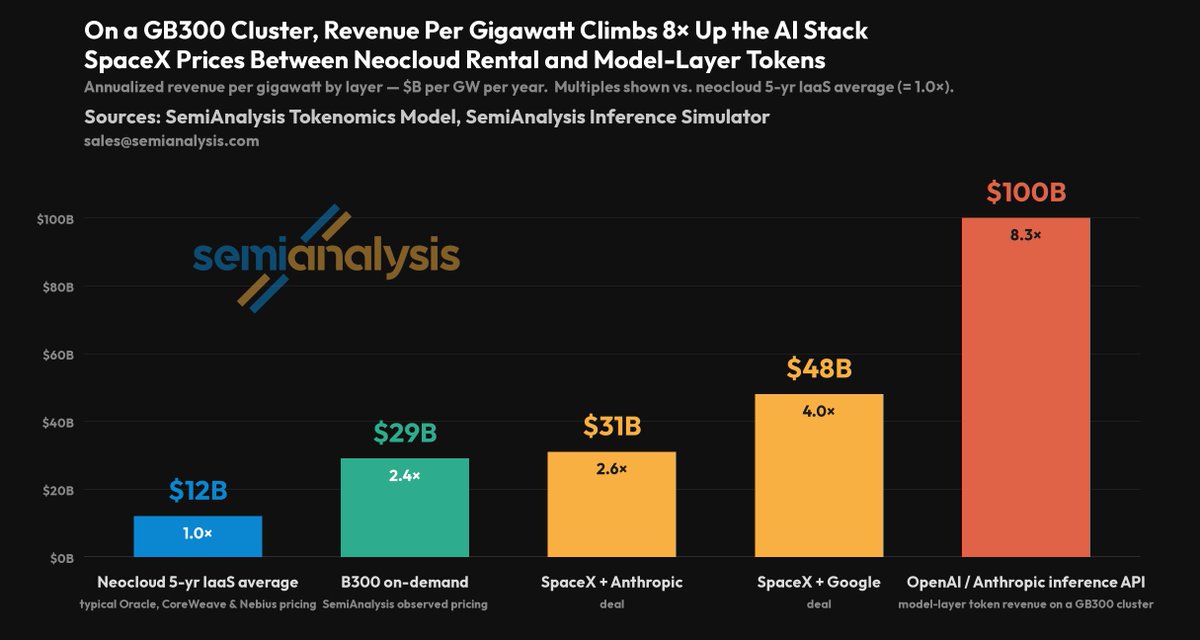
Power, not GPU count, is the binding constraint on serving capacity, so a metric denominated in megawatts is the one capacity planning will use.




Checking sign-in…
Loading comments…