How to Run NVIDIA Cosmos 3 on Local AI Devices Using Hugging Face Diffusers
- Source
- developer.nvidia.com
- Author
- Atharva Joshi
- Date
Context
NVIDIA's developer blog shows how to run Cosmos 3 Nano, a model that generates video from text, images or other video to support robotics and other physical-AI work, on a consumer graphics card with as little as 12 GB of video memory. The measured times are the reason to read it carefully. On a GeForce RTX 5070, generating 189 frames at 1280x720 took 2,624.9 seconds, about 44 minutes, according to the tutorial's benchmark tables. The same request at 432x240 took 207.6 seconds. NVIDIA's own guidance is to start at 240p or 480p on a 12 GB card and to treat 720p as supported but substantially slower.
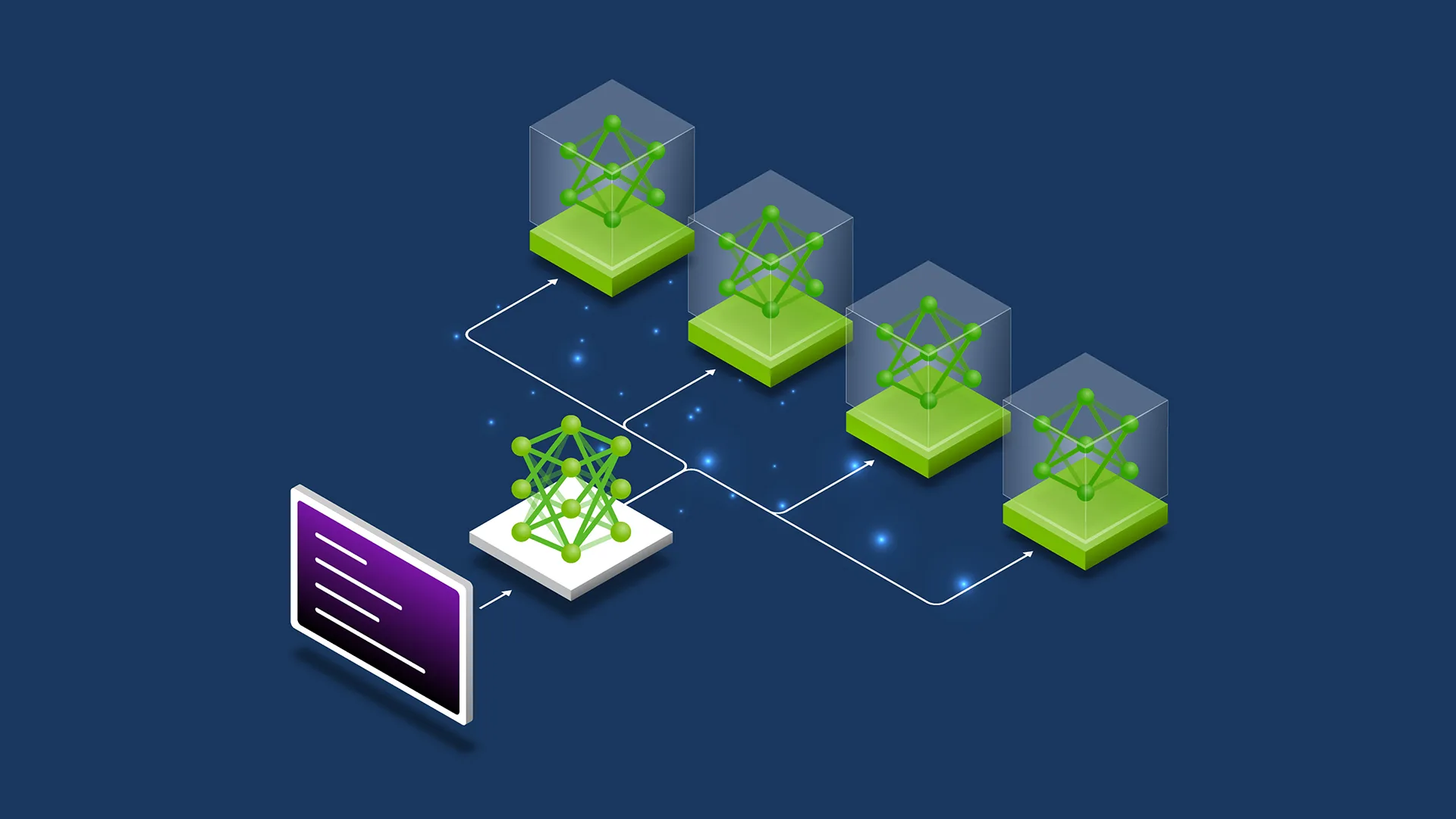
The technique that makes a 12 GB card enough is weight , and the tradeoff is stated plainly. Instead of holding the model in video memory, the adapter keeps its weights in the host's system RAM and moves each block onto the GPU just before that block's turn, so every matrix multiplication and operation still runs on the GPU. A 35-step generation walks 36 transformer blocks on every step, and the weights for each block cross the PCIe bus as they are needed, which is why system RAM and bus bandwidth, rather than disk, govern how long a run takes. Two savings keep that from being worse. The pathway that interprets the prompt runs once and its result is reused across the denoising steps, and each streamed block is reused across both branches of classifier-free guidance, the technique that combines a prediction made with the prompt and one made without it. NVIDIA states that this approach does not provide interactive latency and does not stream weights from disk during inference.
Two figures in the tables matter more than the headline number. The first is system RAM: every tested host had roughly 128 GB of it, which NVIDIA says is not a measured minimum, but it is what the measurements rest on now that system RAM is the model's backing store. The second is what more video memory buys. The same 720p text-to-video job took 1,016.7 seconds on a 32 GB RTX 5090 against 2,624.9 on the 12 GB RTX 5070, so the card decides whether this is a 17-minute wait or a 44-minute one. The FP8 checkpoint trims roughly 15% off the time and a little under a gigabyte off peak memory on the 5070, at 2,235.7 seconds and 9.16 GiB against 9.94 GiB in BF16, and even then attention still runs in BF16, so the pipeline is not fully 8-bit. NVIDIA labels all of these as single-run measurements and says they are not a controlled ranking of GPUs or a multi-seed comparison of the two precisions, so they are a guide to what a wait will feel like rather than a verdict on hardware. The seven supported modes, which include image-to-video, video-to-video, sound, action and control-guided generation, all run through the same Hugging Face Diffusers pipeline, and control-guided generation at 720p is the slowest case in the table at 4,834.9 seconds.
- NVIDIA's adapter keeps Cosmos 3 Nano weights in system RAM and moves one transformer block at a time to the GPU, so a 12 GB card can run it. The cost is system RAM and PCIe traffic: test hosts had about 128 GB of RAM, which NVIDIA says is not a measured minimum.
- Cosmos 3 has separate understanding and generation pathways. With fixed conditioning and precision, the adapter computes the understanding once and reuses it across denoising steps instead of recomputing it every step.
- For classifier-free guidance, the adapter reuses each streamed block for both the conditioned and unconditioned predictions rather than transferring its weights once per branch.
- Offloading trades time for memory: in NVIDIA's single-run tests, 189-frame 720p text-to-video took about 44 minutes on a 12 GB RTX 5070 versus about 17 minutes on a 32 GB RTX 5090, both in BF16.
- The FP8 checkpoint is not end-to-end FP8: it uses 8-bit weights with 16-bit activations for the first and last three denoising steps, 8-bit activations in between, and BF16 attention. On the RTX 5070 it cut 720p text-to-video time by about 15%.
- streaming — Sending a model's response token by token as it is generated, so the reader sees text immediately instead of waiting for the whole answer.
- transformer — The neural network architecture behind modern AI models, built on attention — letting every word directly consider every other word in parallel.
- attention — The mechanism that lets a model weigh which earlier words matter for the word it's currently processing — the core operation of a transformer.
- Context and context window — Context is the information available for a generation; the context window is the capacity available to hold it.
 articleBuild Training-Ready Physical AI Datasets with Two Prompts in NVIDIA CosmosNakul Arora
 articleSimplifying Model Serving Across Multiple GPUs with NVIDIA TensorRT Multi-Device Integration in NVIDIA Dynamo-TritonTanya Lenz
 articlePost-Train NVIDIA Cosmos 3 Edge for On-Device Robot ControlMichelle Horton
Checking sign-in…
Loading comments…