Translates chip and memory supply into agent counts and agent-hour costs, giving a groundingTying a model's answers to checkable sources — retrieved documents, live data, tool results — instead of letting it answer from memory alone.Full definition → bound on how much agentic work future hardware can serve.
Key takeaways · AI-distilled
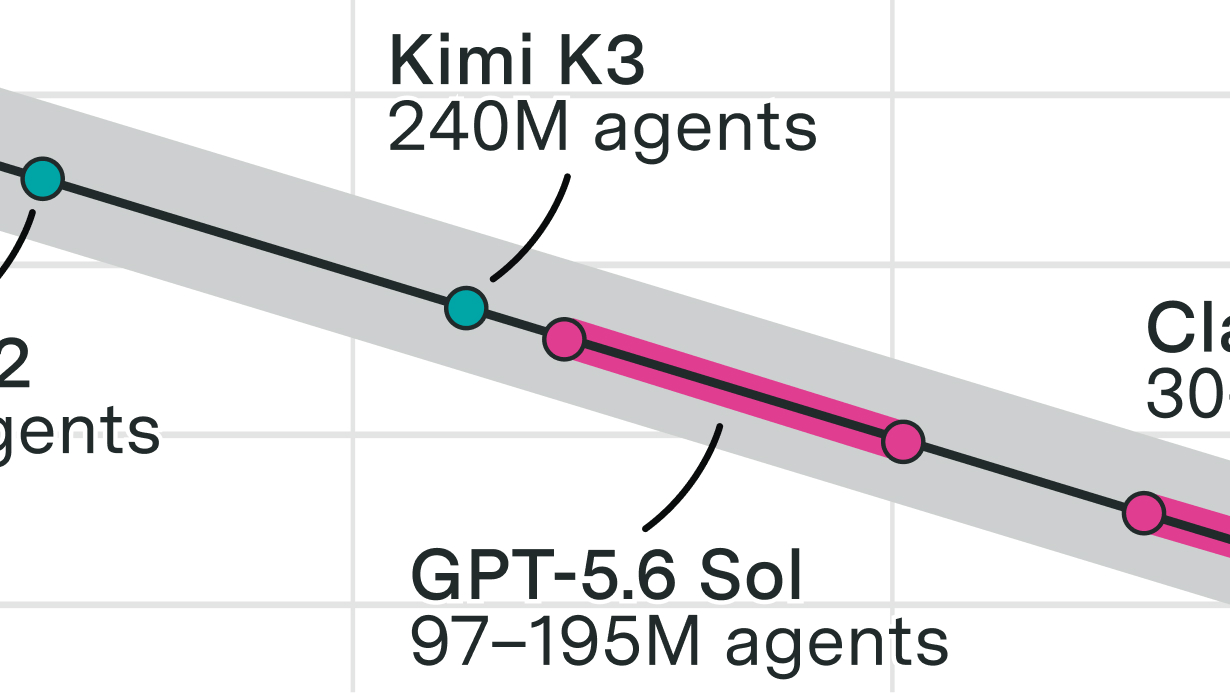
High-bandwidth memory shipped in 2025-26 could support 16 to 56 million concurrent frontier agents once deployed; adding 2027 shipments raises that to about 30 to 170 million, assuming full deployment and allocation to AI agentAn AI system that doesn't just answer once but works toward a goal in a loop — taking actions, reading the results, and deciding what to do next.Full definition → work.
Because an agent can run all 168 hours a week, 4.2 times a 40-hour workweek, chips shipped through 2027 could supply the working hours of about 140 to 720 million full-time employees. Epoch notes the quality of agent output varies.
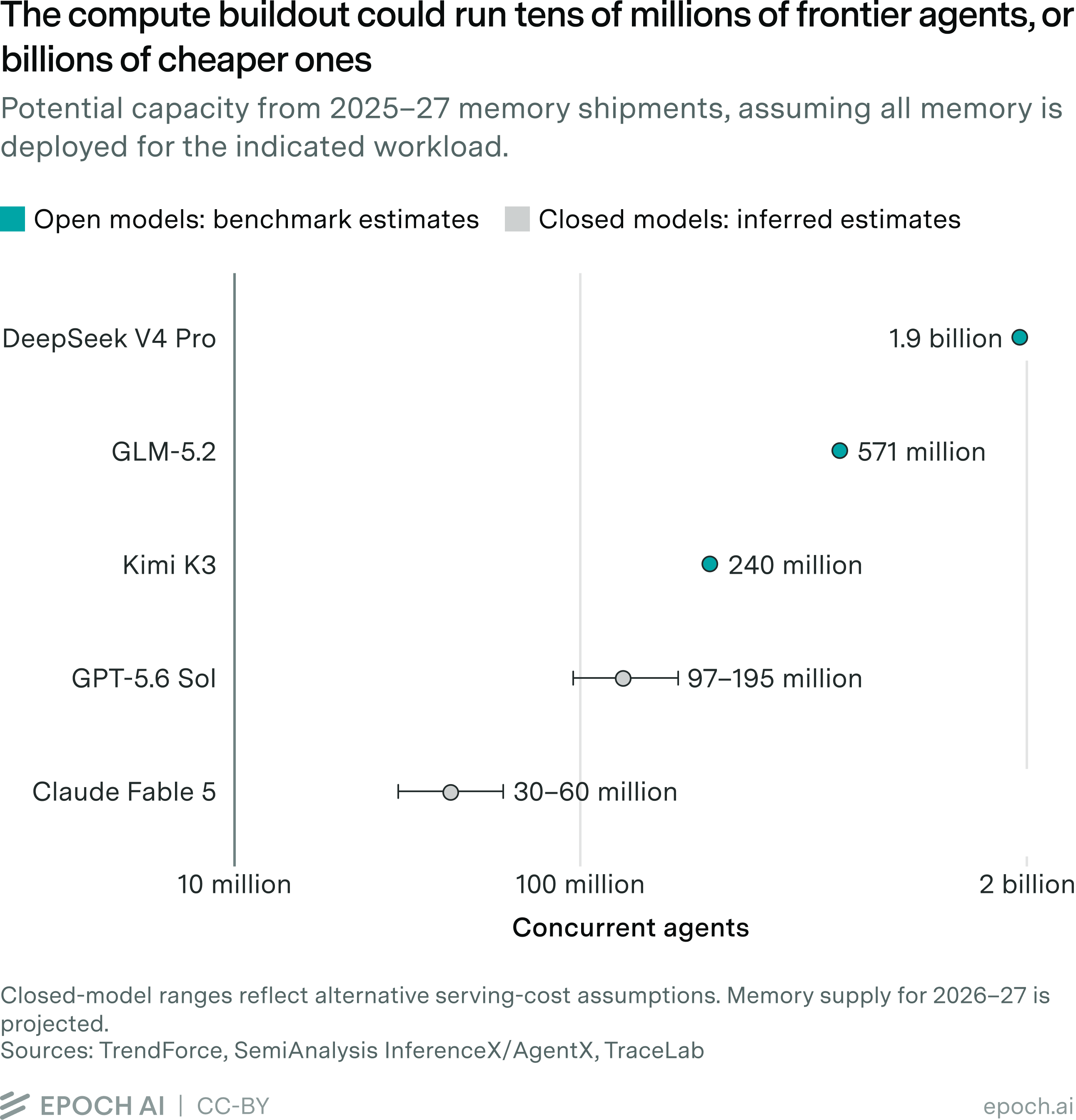
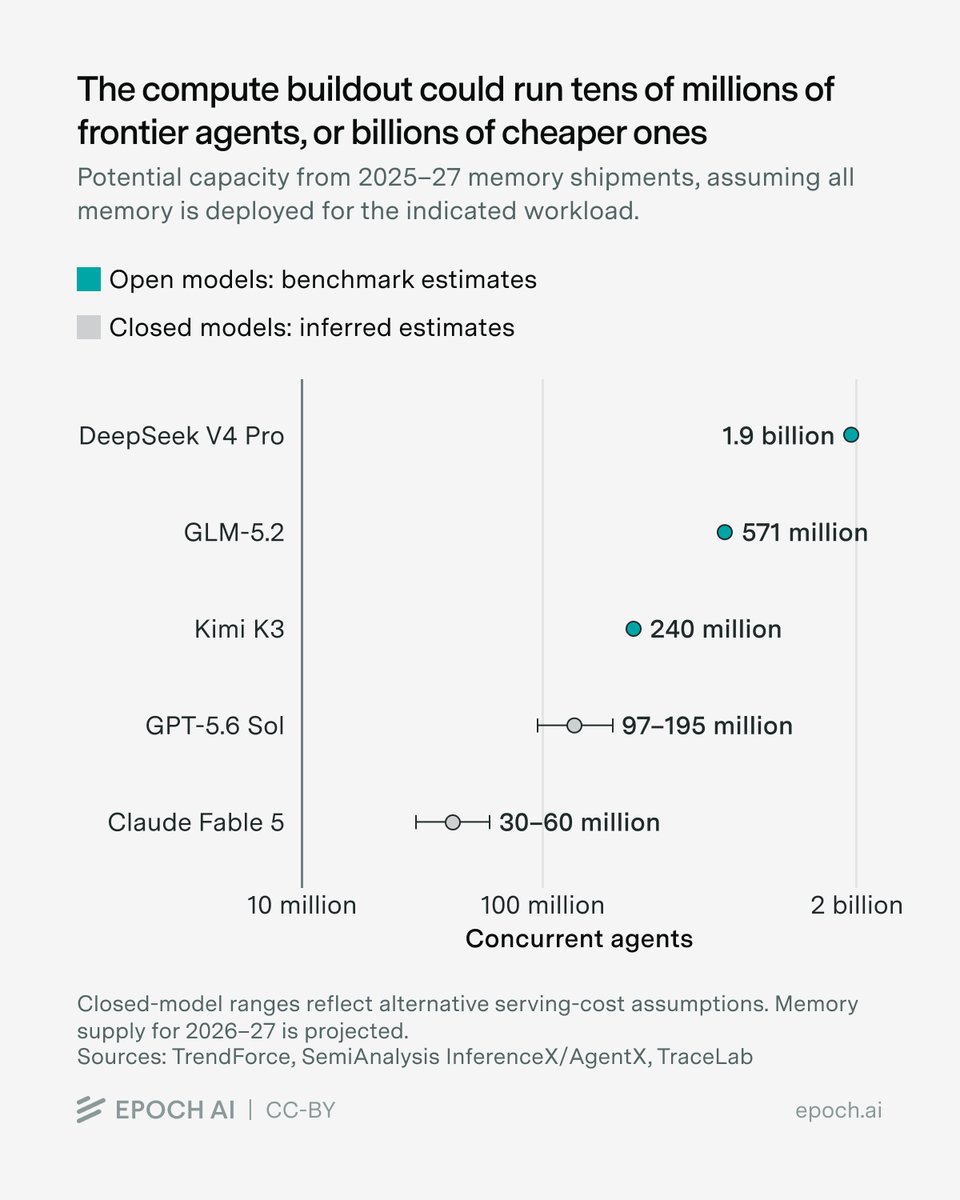
Applying DeepSeek V4 Pro serving benchmarks to the projected hardware yields about 1.9 billion concurrent agents, as many weekly working hours as 8 billion people each working 40 hours.
Using just 20% of the central capacity estimate implies $2.6 to 5.3 trillion a year in API-equivalent spending, against roughly $1 trillion in developer revenue by end-2027 at fivefold annual growth.
In Epoch's analysis of agent traces, Codex workloads averaged about $16 to $18 per hour of continuous agent activity, compared with $24 to $50 for Claude Code workloads.
Terms in this piece · Glossary
AI agent — An AI system that doesn't just answer once but works toward a goal in a loop — taking actions, reading the results, and deciding what to do next.
grounding — Tying a model's answers to checkable sources — retrieved documents, live data, tool results — instead of letting it answer from memory alone.