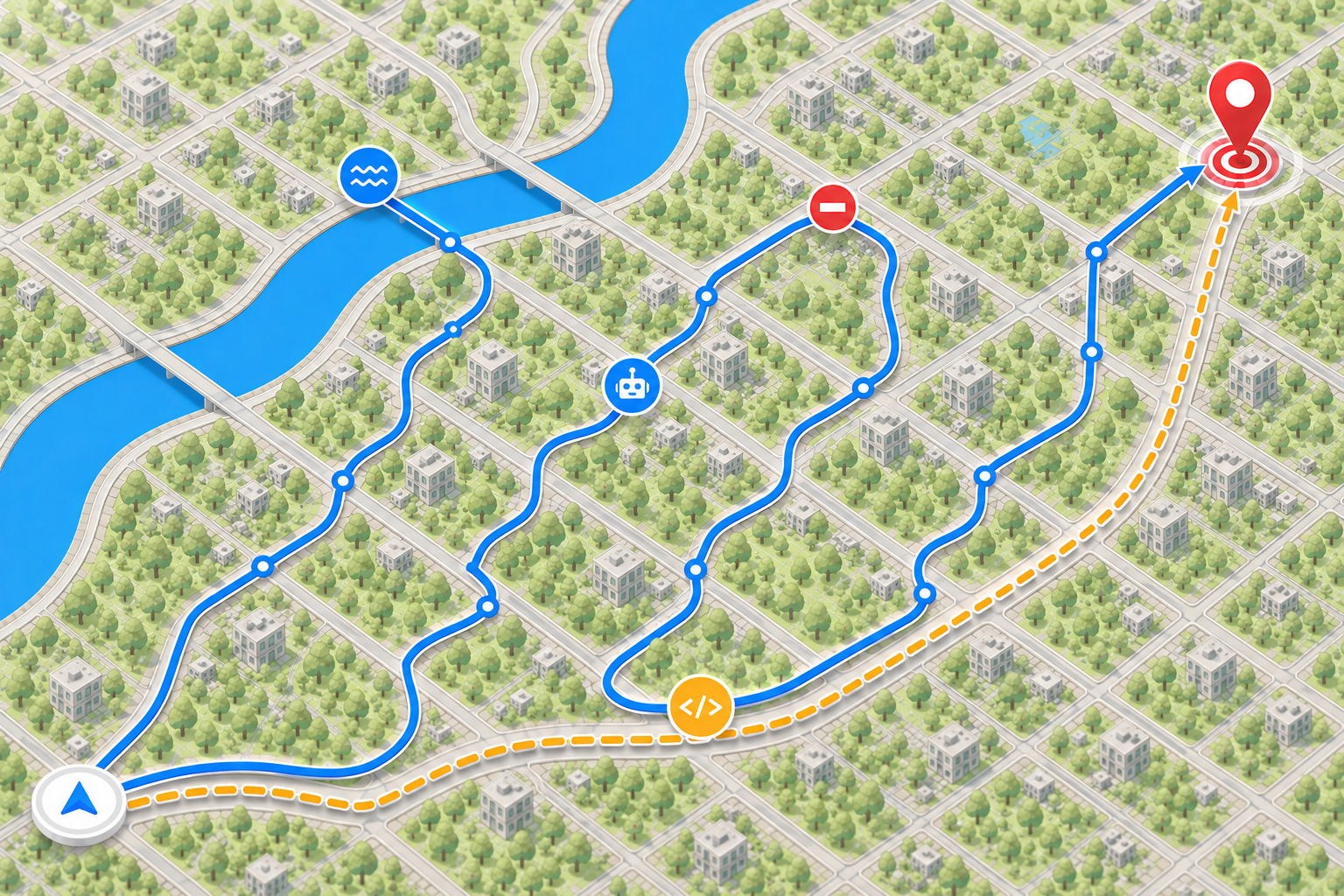
An agent can test whether a user goal remains achievable while adapting its route through an interface. In Slack'stesting experiments, agents repeatedly observed the page and chose their next action, often taking different paths to the same outcome. The study covered more than 200 executions of two flows in non-production workspaces.
That flexibility carries recurring work: ObservationThe result the harness returns into the context after executing a tool: contents, a listing, a status or an error.Full definition →, reasoning and accumulated Context and context windowContext is the information available for a generation; the context window is the capacity available to hold it.Full definition → are processed again on each run. A saved deterministic test replays its code. The authors consequently place agents in exploration and DebuggingFollowing a failure back along the data path to the place where the data first goes wrong.Full definition →, alongside repeatable regression tests. The experiment supports that division of work within its tested flows, rather than a universal ranking of browser tools or models.
Terms in this piece · Glossary
Observation — The result the harness returns into the context after executing a tool: contents, a listing, a status or an error.
Context and context window — Context is the information available for a generation; the context window is the capacity available to hold it.
Debugging — Following a failure back along the data path to the place where the data first goes wrong.
Model Context Protocol (MCP) — A published agreement for an AI application to discover what a separate program offers and ask it to run one of those offerings.