Flux Multilingual handles 10 languages in a single real-time stream
- Source
- x.com
- Date

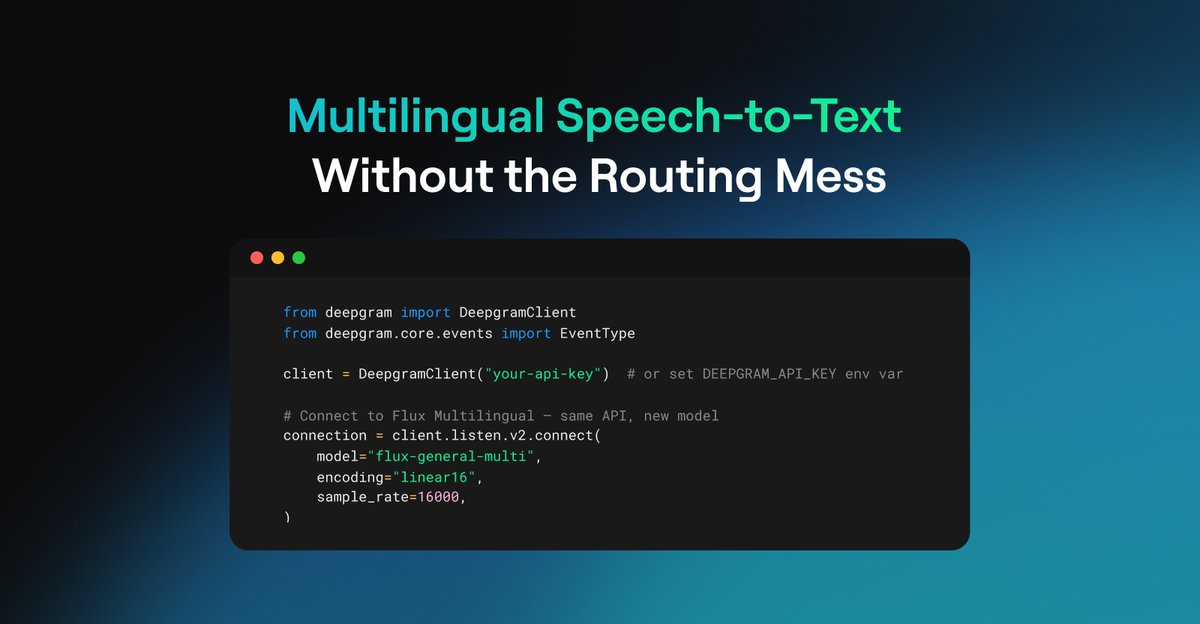
🌐 “Multilingual” shouldn’t mean multi-system. Yet most real-time speech stacks still look like this: → language detection service → per-language models → routing logic → latency you can’t explain There’s a better way. 📈 Deepgram’s Flux Multilingual runs 10 languages in a single real-time stream — with: ✅ automatic language detection ✅ native code-switching ✅ language_hint biasing ✅ one model, one WebSocket No routing layer. No model hopping. No duct tape. If you’re building voice agents, this changes your architecture. Read the technical deep dive ↓
Context
Deepgram's Flux Multilingual handles speech across ten supported languages through one persistent connection. Its technical guide explains that the same model detects languages and transcribes callers who switch between them, avoiding a separate recognition model for each language.
An application can supply language hints when it already knows which languages to expect. Those hints bias detection without forbidding other supported languages. Each conversational turn also reports detected languages, giving the application information it can use to choose an appropriate response voice.
- streaming — Sending a model's response token by token as it is generated, so the reader sees text immediately instead of waiting for the whole answer.



Checking sign-in…
Loading comments…