Context Engineering Is Just Writing Things Down
- Source
- fly.io
- Date
Context
A Fly.io post, Context Engineering Is Just Writing Things Down, argues that an AI coding 's work depends more on how much it knows about your project and its environment than on how capable the underlying model is. is the work of deciding what text the model sees when it acts, and the author's claim is that most of it amounts to keeping the right notes in files the agent reads. That is the author's opinion, illustrated with one worked example rather than tested against stronger or weaker models.
The author starts from the memory system in OpenClaw, which the post calls the only interesting thing about that agent. It keeps two kinds of memory. Daily logs are append-only: every session adds to them, nothing is removed, and older entries matter less over time. MEMORY.md changes only when the agent or the user deliberately promotes something into it, so it holds a curated record instead of a stream. To recall memories, OpenClaw combines BM25 keyword search, which ranks entries by how well their exact words match the query and so finds things like error codes, with vector search, which compares numerical representations of meaning and so finds a loosely remembered discussion about authentication. The two are blended with a 70/30 weighting, results are re-ranked so near-duplicates do not crowd the list, and everything lives in a local SQLite database. The author does not present these features as novel; the point is how deliberately the memory is managed.
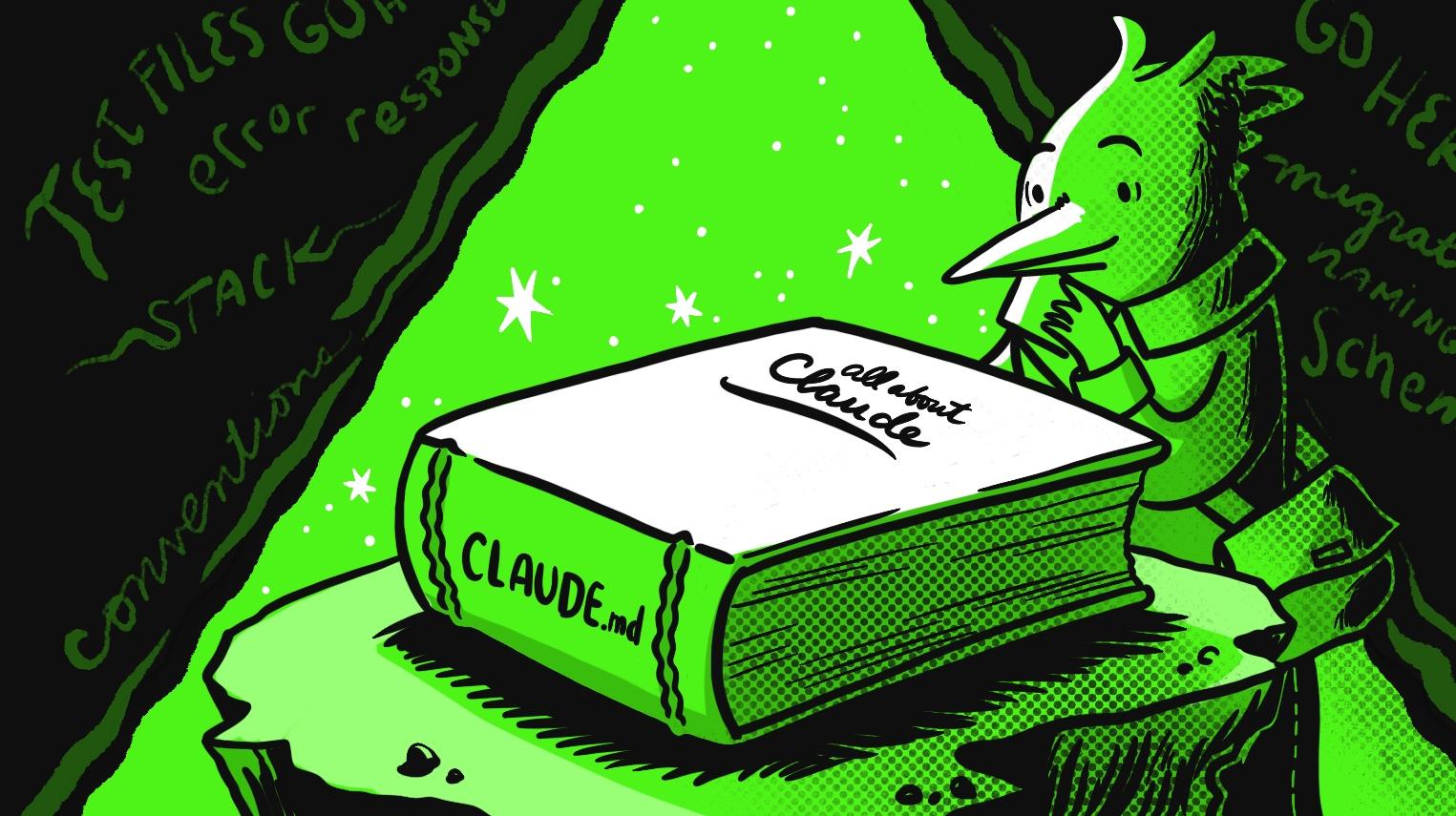
The rest of the post applies that idea to Claude Code running in a Sprite, Fly.io's persistent cloud environment, which the post is promoting. It names four layers. CLAUDE.md holds project conventions and commands, is read at the start of every session, and grows each time the author corrects a mistake such as using the wrong logger. Skills package a repeated multi-step workflow, such as a preflight check that runs tests, type checking and linting before a pull request, so it runs the same way each time. Hooks are scripts that insert the environment's current state, such as a crashed database or the git branch, into Claude's . Checkpoints snapshot the Sprite's whole filesystem, which the author presents as the advantage over a laptop, where these files are scattered and easy to lose.
The evidence is a demonstration on a sample excuse-generating API called Alibi. Asked to fix a bug, Claude used the project's test runner, put the test in the expected place, followed the logging and error formats and saved a checkpoint without being told any of it, which the author credits to those files. It is a single example from the vendor, so it shows what the setup is meant to do rather than how often it works. The post closes by saying none of this needed a vector database or retrieval pipeline, although the OpenClaw recall it praised does use vector search. What the author treats as essential is the curated file, kept up to date from real corrections.
- The author singles out OpenClaw's memory handling: daily logs are append-only and decay in relevance, while MEMORY.md does not decay and changes only when the agent or user deliberately promotes something into it, separating a stream from a curated store.
- OpenClaw recall blends BM25 keyword search and vector search, weighted 70/30, with diversity re-ranking to avoid near-duplicate results, so it finds exact matches like error codes and conceptual ones alike, all backed by local SQLite.
- The post's thesis is that an agent's work depends more on what it knows about the project and its environment than on model capability, and it splits that knowledge across CLAUDE.md, skills, hooks and checkpoints.
- Its rule for CLAUDE.md: write one before the first request, then grow it each time Claude slips, such as using console.log instead of the project logger. Multi-step routines run repeatedly, like a preflight of tests, types, lint and TODO checks, belong in a instead.
- Hooks inject live state such as crashed services or git branch status, so Claude stops reporting the app is live while Postgres is down. In a Sprite, checkpoints then keep the whole setup, files, services and dependencies, as durable environment state.
- context engineering — Deciding what an agent sees at each step — the discipline that replaced prompt engineering once context windows got large enough to fill badly.
- AI agent — An AI system that doesn't just answer once but works toward a goal in a loop — taking actions, reading the results, and deciding what to do next.
- context window — The maximum amount of text a model can consider at once — its working memory for the current conversation or task.
- agent skill — A reusable instruction file that teaches an agent how to do one job well — the procedure, the tools, and what counts as done.



Checking sign-in…
Loading comments…