Profile Relevance Boosting Feed Relevance With Llms At Linkedin
- Source
- linkedin.com
- Author
- LinkedIn Engineering
- Date
Context
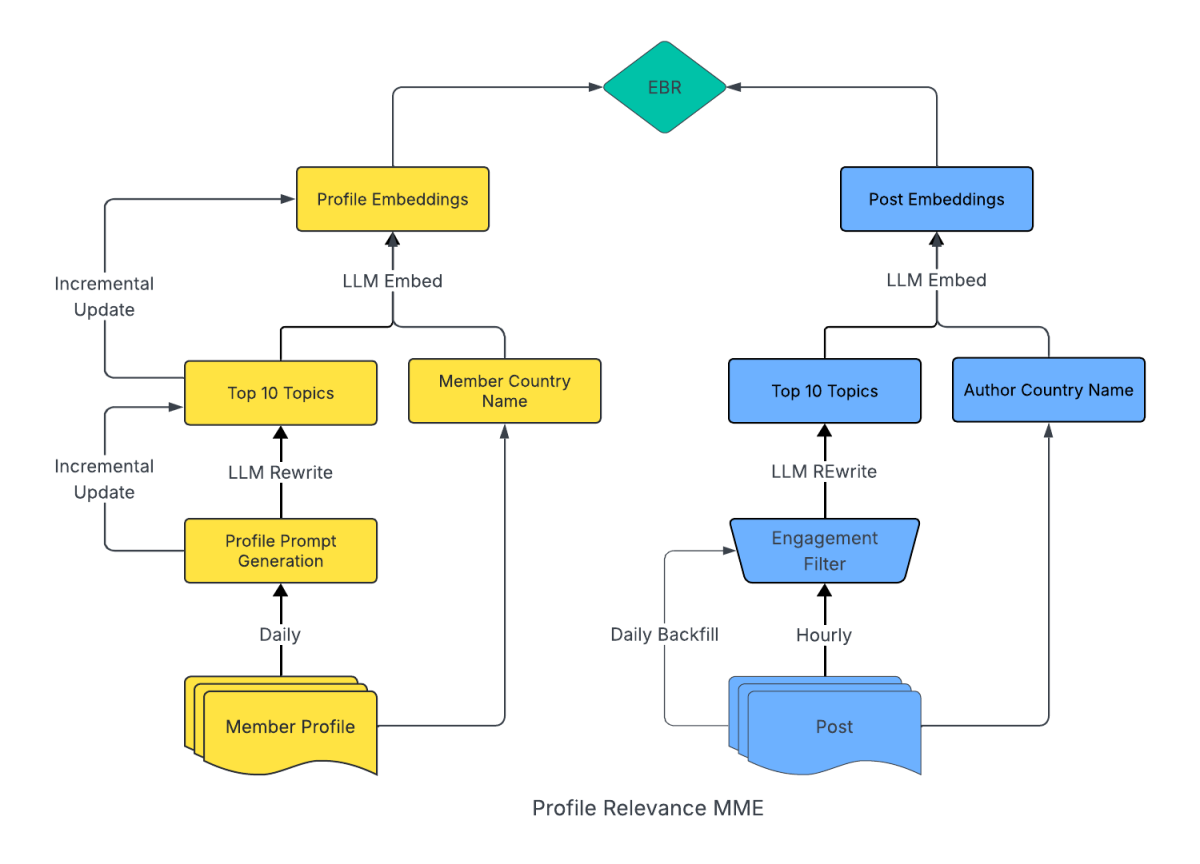
LinkedIn has described how it uses a to find posts for members from people they are not connected to. Feeds usually lean on who you follow and what you and similar people have clicked, which, as LinkedIn's engineers write, makes posts from outside your network hard to surface and hurts creators still building an audience. Their system, Profile Relevance, matches on what the profile and the post say instead. It builds a text summary of each member's profile from the headline, summary, skills, jobs and education, leaving out name and gender, and runs it through an LLM model, which turns text into a list of numbers so that texts about similar things land close together. Posts get the same treatment from their text, titles, transcripts and the author's location, and the system pulls posts whose numbers sit near a member's. It is one of several sources feeding the redesigned feed described in an earlier LinkedIn post.
Because nothing here is trained on clicks, LinkedIn had no click data to grade it with. Engineers first read about 20 member and post pairs per model variant by hand, then built AutoEval, in which an LLM judges whether a post fits a member's topic, location, job title, company, industry, seniority and education. After tuning its instructions until it agreed with human reviewers, they could grade 1,000 pairs per variant, and LinkedIn says Profile Relevance scored a substantially higher on-topic rate than its previous retrieval source. The same tool caught a weakness: a version that first had a large LLM condense profiles and posts into topics lost location cues, so the team now appends member and author country names to the text.
Topical match alone was not enough to earn a place in the feed. LinkedIn found that well-matched posts struggled to compete with posts other members had already engaged with, so a post from this source now needs at least one like, comment or share from someone outside the reader's network before it is recommended. With both changes, LinkedIn reports small overall gains in its online experiments, 0.54% more feed updates viewed and an 18.8% drop in posts hidden, and larger ones for members with little activity history, including 17.7% more viral engagement (LinkedIn's term for likes, comments and shares) and 1.8% more daily active users. Those figures come from LinkedIn's own tests, without stated sample sizes or durations. They suggest the profile text gives LinkedIn something to recommend from for members whose click history is too thin to rely on, although the system still waits for an engagement signal before showing a post.
- LinkedIn's Profile Relevance matches members to posts from outside their network using LLM embeddings of a structured profile prompt (headline, skills, work and education history) that leaves out personal attributes such as name and gender.
- LinkedIn found that rewriting profiles and posts into topics before embedding cut serving cost but weakened subtle cues such as geography, so it appended member and author country names to the prompts to surface more locally relevant posts.
- Topical match alone lost out to posts with social proof, so a Profile Relevance post must first get at least one like, comment or share from an unconnected member before LinkedIn recommends it.
- Online tests of the + Engagement variant showed +0.54% Feed updates viewed, +0.94% viral rate and an 18.8% drop in hide rate. Cold-start members with little activity saw +17.7% viral engagement and +1.8% DAU.
- An LLM-based AutoEval, tuned to agree with human reviewers, scaled from about 20 hand-labeled records to 1,000 per model variant, while incremental updates for changed profiles cut embedding compute to 24% of a full refresh.
- LLM — A large language model — the neural network behind tools like Claude and ChatGPT, trained on huge amounts of text to predict what comes next.
- embedding — A list of numbers representing a piece of text's meaning, so that similar meanings end up numerically close and can be searched.
- generative engine optimization — Making a site the source an AI assistant cites when answering, rather than a link in a list of ten blue results.
- eval — A repeatable test for AI quality — a set of tasks plus scoring — used the way software teams use test suites, because model output is too variable to judge by eyeballing.
Checking sign-in…
Loading comments…