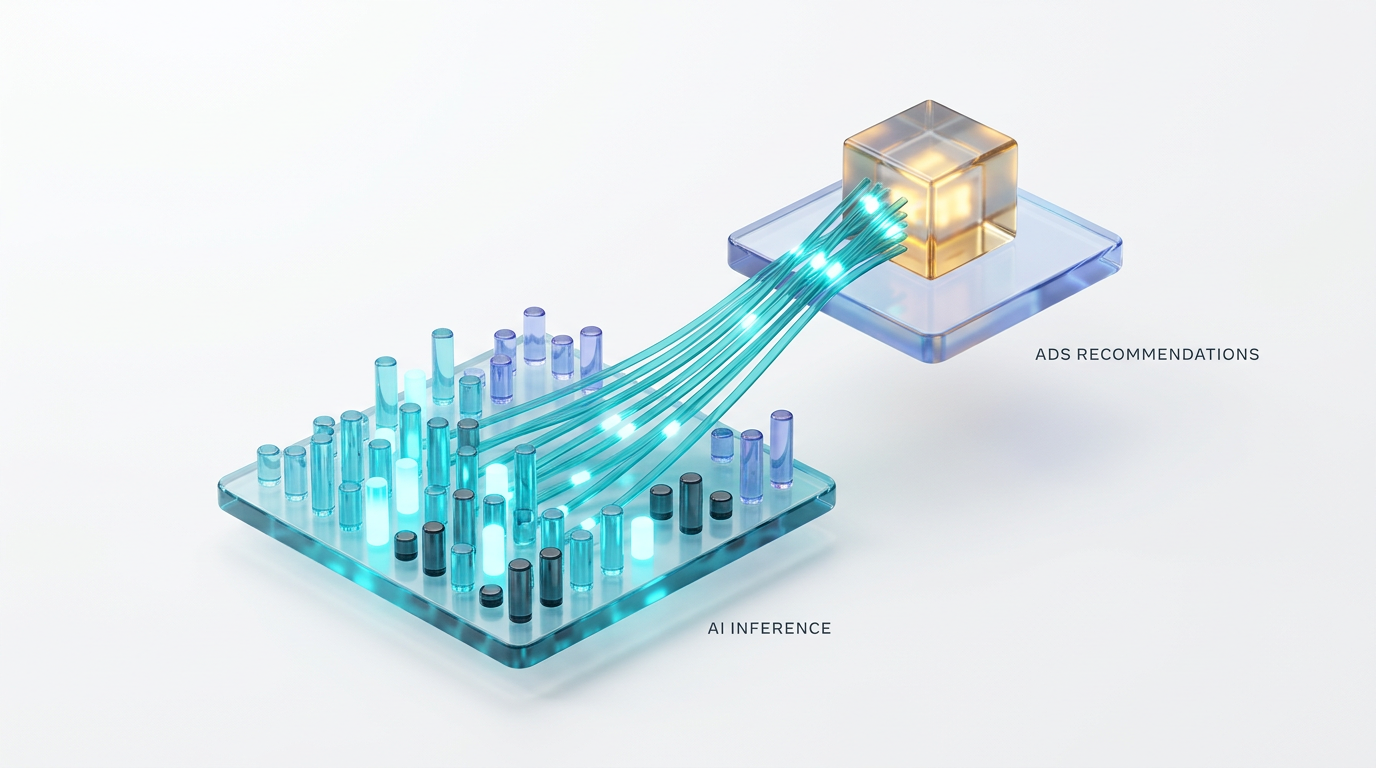
Turning Opportunistic AI Inference Capacity Into Better Ads Recommendations
Source
engineering.fb.com
Date
Why it matters
Shows how a large fleet absorbs reclaimable, heterogeneous capacity by scaling workload quality up and down without hurting baseline serving. The pattern applies to any team running inferenceRunning a trained model to get answers — the phase where AI is actually used, as opposed to trained.Full definition → on preemptible or leftover accelerators.
Key takeaways · AI-distilled
Meta lists four causes of locally idle capacity in a constrained fleet: peak provisioning versus demand swings, capacity arriving before models are ready, regional CPU-to-accelerator ratio gaps, and non-portable accelerator types.
The two levers consume different resources: ranking more candidates needs both CPU and accelerator surplus because extra ads pass through retrieval and feature processing, while routing to stronger models uses accelerator-only surplus.
Candidate volume is governed by a central PID controller that reads tail latency, raising the number of ads ranked when latency is under target and cutting it when latency rises.
model routingSending each request to a model chosen by the difficulty of the task, rather than using one model for everything.Full definition → uses an explore-and-exploit process across engagement segments, because, Meta says, the gain from the stronger model does not always track a request's absolute value; exploratory traffic is kept to avoid stale routing.
Since the central controllers react on the order of minutes, servers and clients also shed lower-value opportunistic work on their own within a few milliseconds when capacity is suddenly preempted.
Terms in this piece · Glossary
inference — Running a trained model to get answers — the phase where AI is actually used, as opposed to trained.
model routing — Sending each request to a model chosen by the difficulty of the task, rather than using one model for everything.