Deepseek Is Back Among The Leading Open Weights Models With V4 Pro And V4 Flash
Source
artificialanalysis.ai
Author
Artificial Analysis articles
Date
Why it matters
V4 Pro leads open models on GDPval-AA, but its 94% hallucinationWhen a model states something false with full confidence — inventing facts, citations, or APIs that don't exist.Full definition → rate means it nearly always answers even when wrong, which matters for reliability-sensitive agents.
Key takeaways · AI-distilled
V4 is DeepSeek's first new architecture since V3 and its first two-tier lineup. V4 Flash is 284B total / 13B active; both are hybrid thinking/non-thinking, text-only, MIT-licensed, with a 1M-tokenThe chunk of text a model reads and writes in — roughly three-quarters of a word — and the unit AI usage is billed in.Full definition →context windowThe maximum amount of text a model can consider at once — its working memory for the current conversation or task.Full definition →, 8x V3.2's.
Pricing is $1.74/$3.48 per 1M input/output tokens for V4 Pro and $0.14/$0.28 for V4 Flash. Running the Intelligence Index cost $1,071 for Pro, versus $4,811 for Claude Opus 4.7 and $948 for Kimi K2.6.
Token use is high: V4 Pro used 190M output tokens and V4 Flash 240M to run the Index, which Artificial Analysis says explains Pro's relatively high total cost despite low per-token prices.
On AA-Omniscience, V4 Pro scored -10, an 11-point gain over V3.2 driven mainly by higher accuracy, while V4 Flash scored -23, roughly level with V3.2.
V4 Pro's GDPval-AA score of 1554 beats GLM-5.1 (1535), MiniMax-M2.7 (1514) and Kimi K2.6 (1484); V4 Flash's Index score of 47 puts it at Claude Sonnet 4.6 (max) level.
Terms in this piece · Glossary
open weights — A model whose trained parameters are published for anyone to download and run — unlike API-only models you can access but never possess.
hallucination — When a model states something false with full confidence — inventing facts, citations, or APIs that don't exist.
token — The chunk of text a model reads and writes in — roughly three-quarters of a word — and the unit AI usage is billed in.
context window — The maximum amount of text a model can consider at once — its working memory for the current conversation or task.


 articleDeepseek V4 Flash 0731 Scores 50 On The Artificial Analysis Intelligence Index 10 Points Above Previous Deepseek V4 FlashArtificial Analysis articles
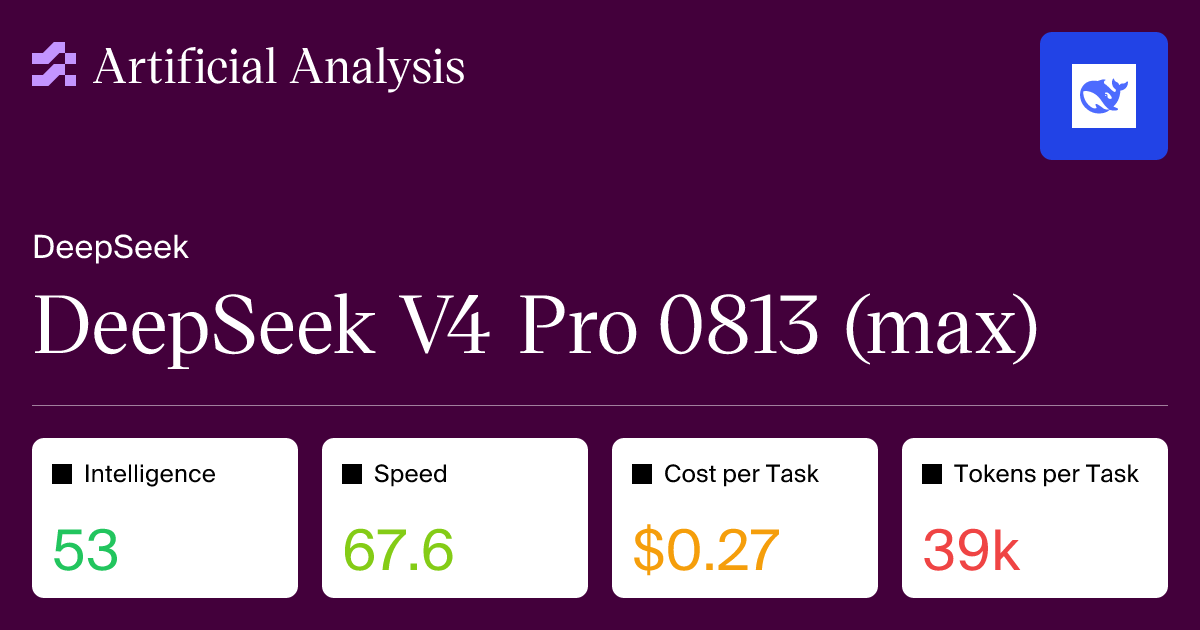 articleSee Artificial Analysis for further details and benchmarks:ArtificialAnlys
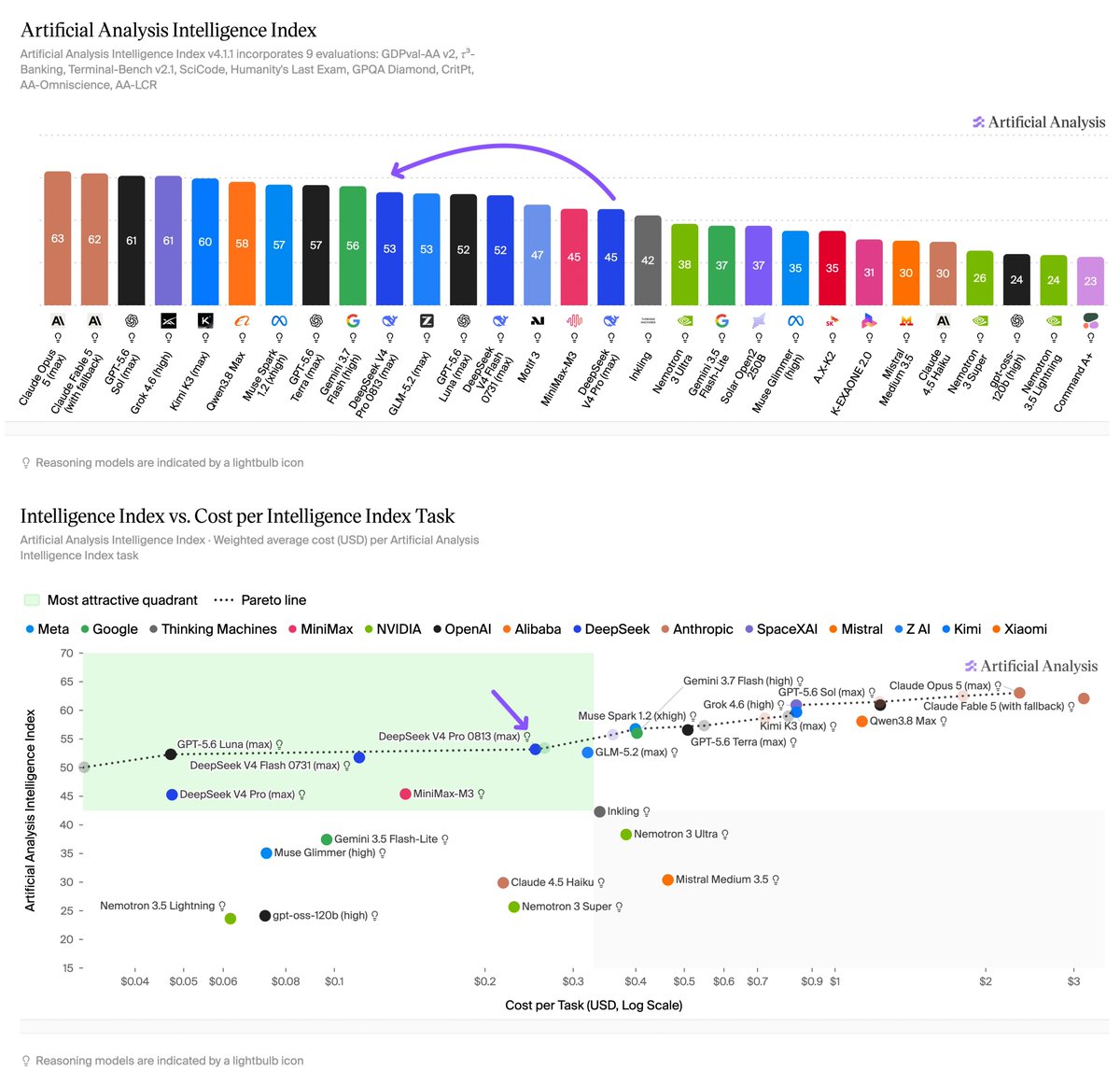 postDeepSeek V4 Pro 0813 scores 53 on the Artificial Analysis Intelligence Index, 8…Artificial Analysis