Kimi K3.1 Pro Goes Live on Inference.net at Launch
- Source
- inference.net
- Author
- Inference
- Date
Context
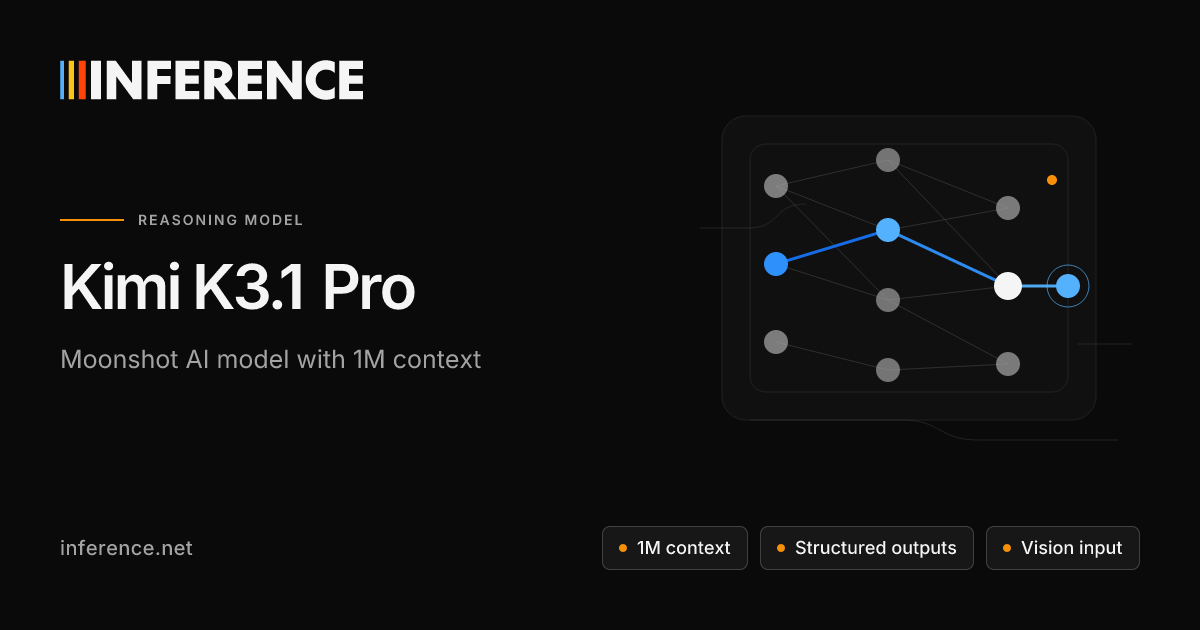
Inference.net, which runs AI models behind a pay-per-token API, announced on November 4 that Moonshot AI's Kimi K3.1 Pro was live on its platform from "Day 0" (announcement). Outside hosts can run the model because Moonshot publishes its weights. The model card describes an model post-trained from Kimi K3, with 2.8 trillion parameters and a of about one million tokens, the amount of text it can take in at once. The license allows commercial use, but a business that sells model access through an API and has more than $20 million in total revenue over any 12 months must first sign a separate agreement with Moonshot, unless it is one of Moonshot's certified inference partners.
On Inference.net, the model sits behind an OpenAI-compatible API, so code written for OpenAI's client library can call it by changing the server address and model name. The model page lists image input, and a setting for how much reasoning the model does before answering; Moonshot's model card lists three levels, low, high and max, with max as the default. needs no extra setup: when calls repeat an identical opening, the repeated part is billed at a lower cache-read rate.
The announcement's first post, the only part of the thread that was collected, claims K3.1 Pro is more capable, cheaper and faster than Kimi K3. Only the price claim can be checked against Inference.net's own page. On November 5 it listed K3.1 Pro at $2 per million input tokens and $10 per million output tokens, against $3 and $15 for Kimi K3, a third lower on both. Inference.net publishes no speed or quality measurements there. Moonshot's card reports its own benchmark results, which this explanation did not evaluate. Nathan Lambert's analysis covers the July Kimi K3 release this model is built from.
- open weights — A model whose trained parameters are published for anyone to download and run — unlike API-only models you can access but never possess.
- context window — The maximum amount of text a model can consider at once — its working memory for the current conversation or task.
- tool use — A model's ability to call external functions — run code, search the web, edit files — instead of only generating text.
- prompt caching — Reusing the model's processed form of a repeated prompt prefix so subsequent calls skip re-reading it, cutting cost and latency substantially.

Checking sign-in…
Loading comments…