Networks that obey Dale's principle learn without weight transport
- Source
- x.com
- Date

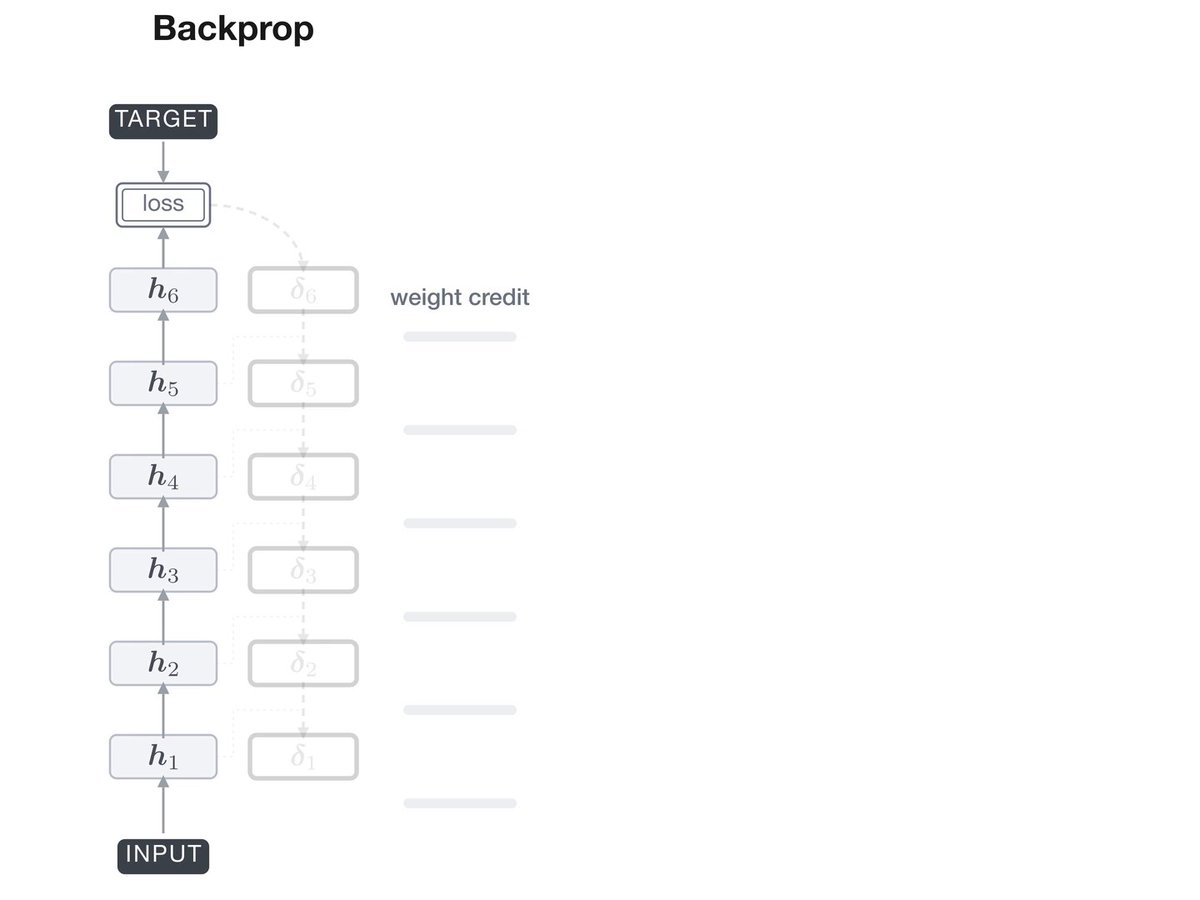
Introducing "Diffusing Blame": can a neural network learn competitively while strictly obeying Dale's principle, the rule that real neurons follow? We show it can, across both image classification and reinforcement learning. 🧠 Accepted at #ALIFE2026 https://t.co/oSsfRCpvc7 Real neurons generally follow Dale’s principle: each neuron is predominantly excitatory or inhibitory. Standard artificial networks usually ignore this constraint, allowing every unit to mix positive and negative outgoing weights. Backprop makes the gap even wider. Its backward pass needs exact transposed copies of the forward weights, the so-called "weight transport problem,” which biology doesn’t seem to have a mechanism for. So we asked: can a network that strictly enforces Dale's principle still learn well, without weight transport? Our approach builds on Error Diffusion (ED), a local rule that routes a single global error signal directly to every hidden unit, where each layer is split into separate excitatory and inhibitory streams with four non-negative weight matrices, so a synapse's sign comes from fixed population identity rather than a learnable weight. Our main contribution is to extend ED from binary to multi-class problems via modulo error routing. We then asked whether this routing mechanism could provide useful credit signals in the noisy setting of reinforcement learning. During PPO training on Ant, Humanoid, and HalfCheetah, we compared each local ED update with the corresponding true backpropagation gradient. Among the routing schemes we tested, modulo routing consistently produced the strongest alignment. Taken together, these results show that Dale-constrained networks can still learn without transporting weights backward, suggesting a potential path toward learning rules that are both effective and more biologically plausible.

Here is ED-PPO in action! 🕹️ To test our biologically constrained architecture, we integrated Error Diffusion into PPO. It achieves competitive returns against standard backpropagation across complex locomotion tasks (Ant, HalfCheetah, Humanoid) and open-ended exploration (Craftax). But the most fascinating discovery was an emergent biological property: • Self-Organization: During training, the network's excitatory and inhibitory weights naturally converge from an asymmetric initialization toward a balanced state. • Biological Mirroring: A depth-dependent inhibitory gradient emerges, closely mirroring how real biological cortical circuits mature. This happens all without any explicit balance-enforcing mechanisms!

Diffusing Blame: Task-Dependent Credit Assignment in Biologically Plausible Dual-Stream Networks https://t.co/Pv2Jpv5UeZ
Context
Sakana AI's Diffusing Blame research tests learning rules with biologically motivated constraints: connections retain excitatory or inhibitory roles, and learning avoids sending exact copies of forward connection weights backward through the network. Its Error Diffusion method sends designated components of the output error directly to hidden units, which use them to adjust local connections. The paper's method section explains this routing.
The results establish learning under these constraints, with substantial performance limits. On CIFAR-10, a ten-category image , the authors report 61.7% accuracy, and the paper calls roughly that level far from competitive with traditional gradient-based methods. A direct-feedback baseline without the excitatory and inhibitory constraint reached 69.1%, so the constraint carries a measurable cost on this task.
- benchmark — A standard public test set for comparing AI models — the shared scoreboards behind every "model X beats model Y" claim.


Checking sign-in…
Loading comments…