Tencent ships 440MB offline translation model using 1.25-bit quantization
- Source
- x.com
- Publisher
- Tencent
- Date

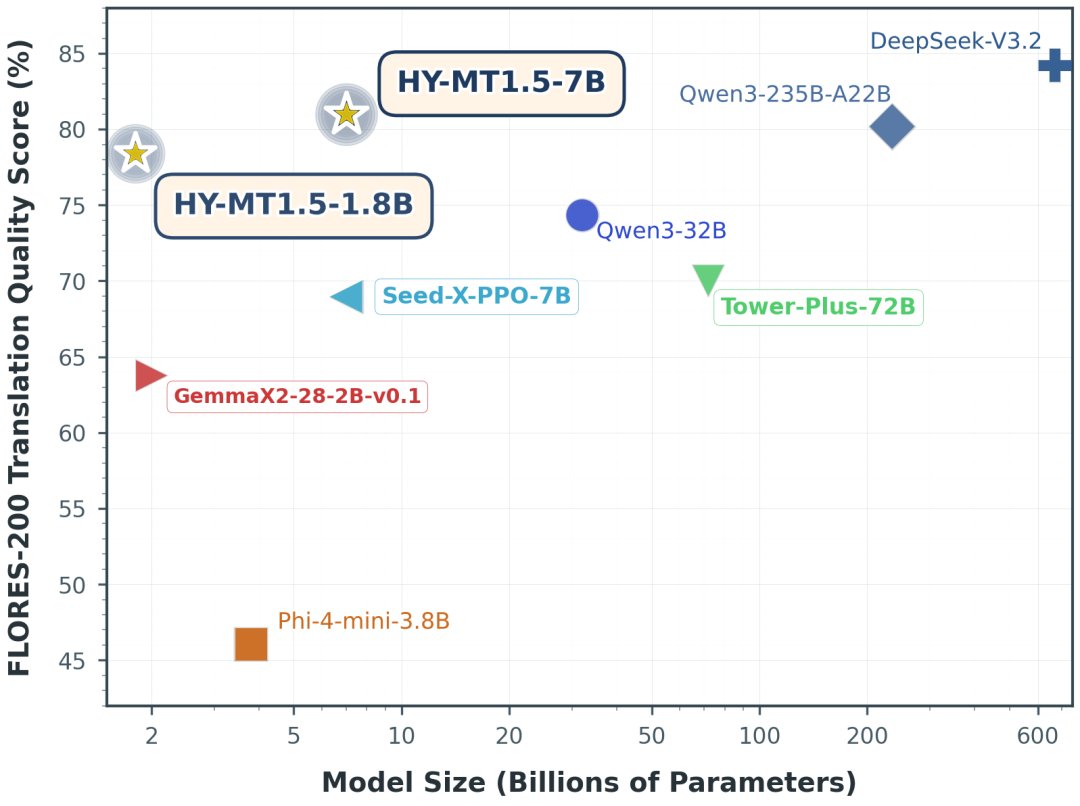
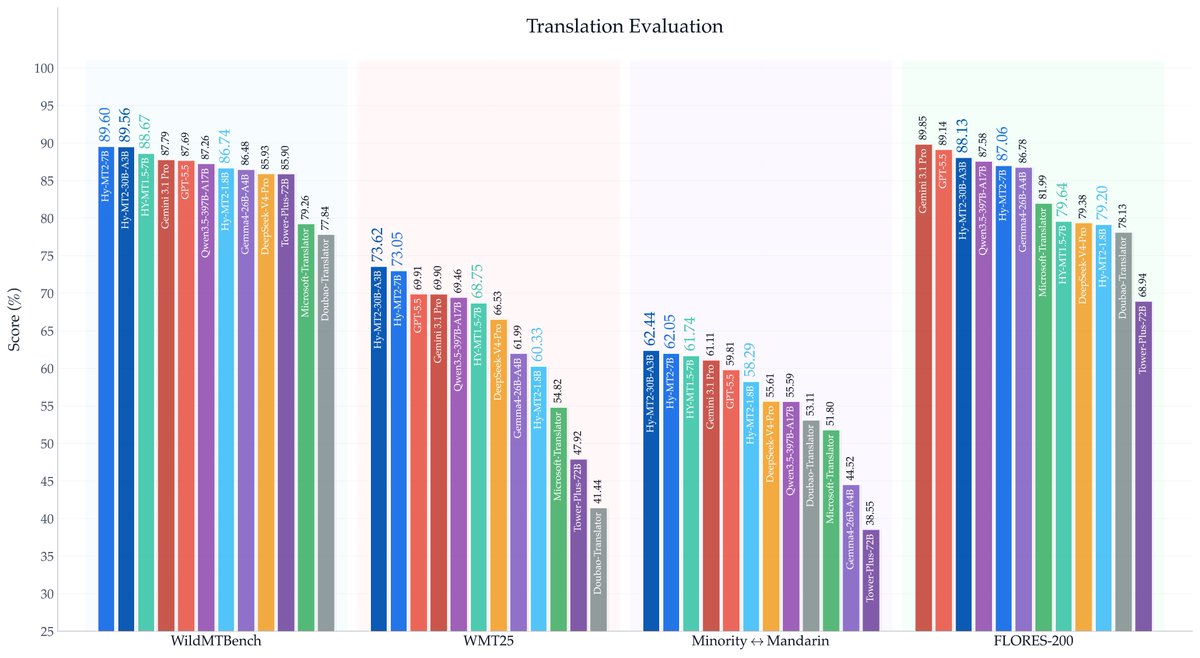
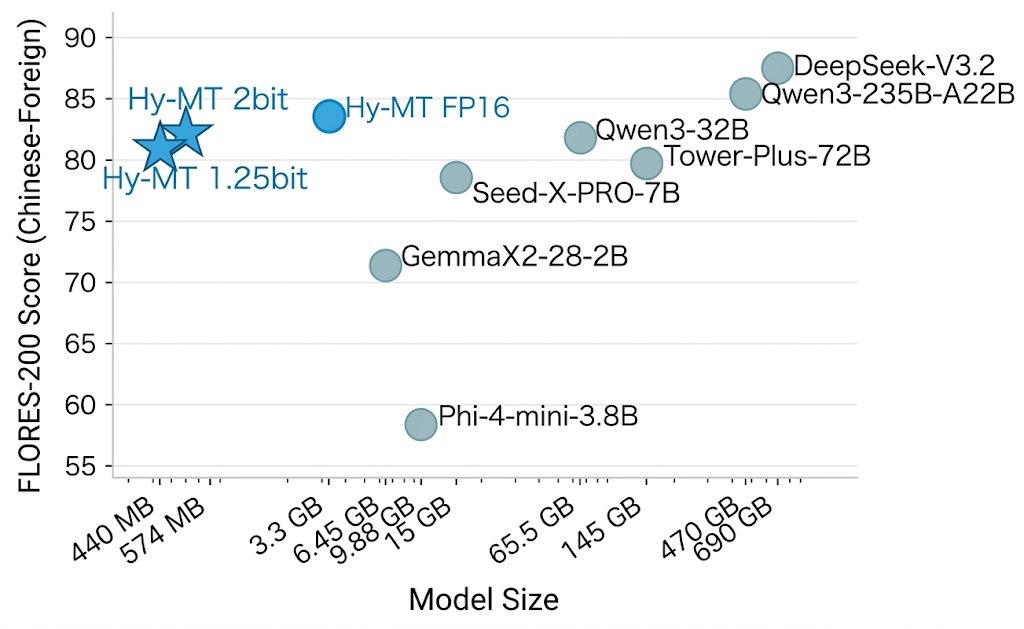
We're open-sourcing Hy-MT1.5-1.8B-1.25bit — a 440MB translation model that runs fully offline on your phone, supports 33 languages, and outperforms Google Translate. At 1.8B parameters, it matches commercial translation APIs and 235B-scale models on standard benchmarks. By quantizing to 1.25-bit, memory drops from 3.3GB (FP16) to 440MB — 25% smaller and ~10% faster than prior 1.67-bit approaches, with no accuracy loss. Covers 33 languages, 5 dialects, and 1,056 translation directions including minority languages like Tibetan and Mongolian. Our translation model has won 30 first-place rankings in international MT competitions and is already deployed across multiple Tencent products.🏆 📲Demo APK (Android): https://t.co/DbcwLBe6vw 🤗Hugging Face:: https://t.co/NgXKeNZz4L 🔗GitHub: https://t.co/b6DqGKDelf 📄Paper:


Context
Tencent released a heavily compressed copy of HY-MT1.5-1.8B, its small translation , that takes 440MB and runs offline on a phone, with an Android demo app. The compression is : storing each of the model's 1.8 billion weights with fewer bits. At the usual 16 bits per weight the model needs 3.3GB, Tencent says; this build uses about 1.25 bits per weight.
The 1.25-bit figure comes from Sherry, a method published in January by researchers working with Tencent, with code released in Tencent's AngelSlim compression toolkit. As the Sherry paper describes it, every weight becomes -1, 0 or +1, which lets a processor replace multiplications with additions. Earlier ternary formats had to choose between spending 2 bits per weight, which wastes space, or packing three weights into 5 bits, about 1.67 bits each, which fits badly with the vector units in ordinary chips because they data in power-of-two groupings, and three does not divide into them evenly. Sherry requires every block of four weights to contain exactly one zero, so the block has only 32 possible patterns and fits in 5 bits, 1.25 bits per weight in a power-of-two grouping.
The post's "25% smaller and ~10% faster than prior 1.67-bit approaches, with no accuracy loss" echoes the Sherry paper's headline result: 25% fewer bits per weight than the 1.67-bit format, about 10% faster generation, and accuracy matching the best earlier ternary methods. Those figures came from small general-purpose models, Meta's LLaMA-3.2 for the accuracy tests and BitNet-style models timed on an Intel laptop processor for speed, not from translation tests. The translation claims, beating Google Translate and matching commercial APIs and 235B-scale models, are Tencent's own, and the Hugging Face card for this build could not be read, so no measurement of the 1.25-bit translator's quality was checked here. Tencent used the same method three weeks later for the 1.8B model in Hy-MT2, again at 440MB.
- Model — A computational system that uses learned patterns to produce an output from information supplied to it.
- quantization — Shrinking a model by storing its numbers less precisely — like rounding — so it runs faster and fits on smaller hardware, at a small quality cost.
- Process — A running instance of a program, with its own working memory, open files and identity.