Anthropic's Scion: Source Control Rebuilt for Agent-Scale Merges
- Source
- anthropic.com
- Publisher
- Anthropic
- Author
- AnthropicAI
- Date

Context
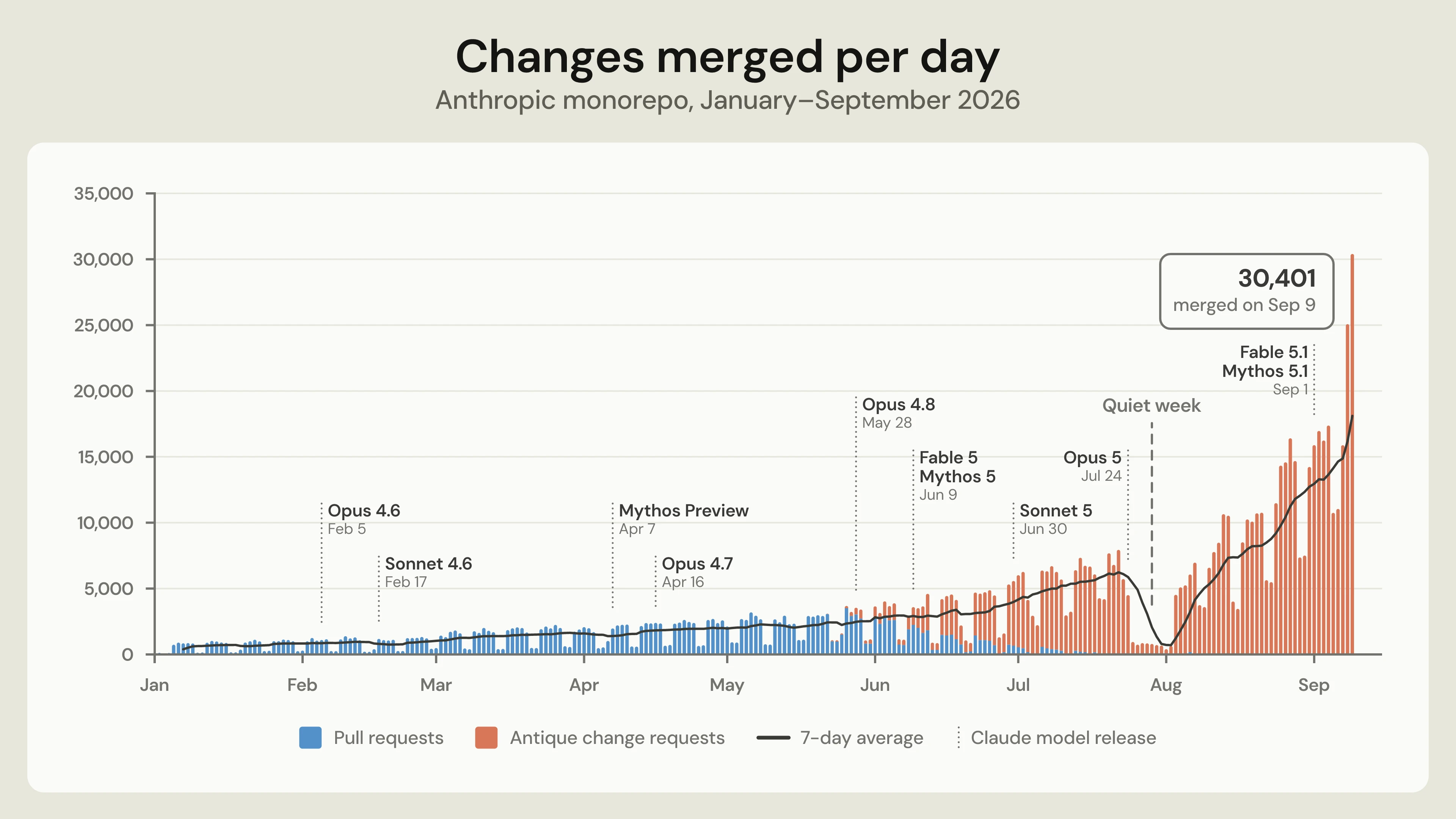
Anthropic replaced for its main code repository because its agents outgrew a design built for people working offline. In its account of the project, the company says merged code changes rose from about 2,500 a day in May 2026 to more than 30,000 a day in September. Git gives every copy of a repository its full history so it can compute diffs and history without a network. Anthropic's main-branch history is almost 100 GB, and it runs on the order of 25 million checkouts a day for testing alone, which it says would mean over 600 PB of git traffic a day if fetched naively. Workarounds such as several hundred internal git mirrors became harder to run as merges grew. Since nearly all of the clients were agents and automated jobs that are always online, Anthropic concluded that git's offline design was working against it.
Its replacement, Scion, moves the work to the . The server records each change as a list of the files it touched with pointers to their contents, answers questions about history and who last edited a line, and creates commits, merges and rebases itself. Clients request only the specific folders and files they need. Because every stored object is identified by its content and never changes, any layer of caches can answer those requests, and many testing jobs skip a checkout entirely by asking the server's for something like a diff. Anthropic reports that each cache layer hits over 99% of the time, that Scion needs 200 times less CPU and memory than its old git mirrors, and that checkouts now take seconds rather than minutes, a 25% CPU capacity gain for testing alone. A team of seven built Scion, a code review and related systems and finished the migration in five months, and Anthropic credits Claude's coding ability for that pace.
The design pays off only at very large scale, and the company says so. It calls Scion unsuitable as a general git replacement, sensible only for enormous repositories with tens of thousands of engineers or swarms of agents, and hard to share because it needs its own code review, search and testing systems. Anthropic expects other companies using AI coding tools to hit similar problems within six to 12 months, and what it proposes for them is narrower: git hosting platforms could answer repository questions on the server, as Scion does, without changing the git model. Scion also builds on earlier work. An October 15 update to the post credits Mononoke, the server half of Meta's Sapling, with pioneering many of its techniques, and a separate post argues that Scion is heavily inspired by it.
- Git and version control — A system for recording and comparing changes to a codebase.
- Server — Software that receives requests, processes them and returns responses; the computer running it is its host.
- API — Application programming interface: the agreed set of operations, inputs and outputs through which one piece of software uses another.
- Tool — An operation that the software around a model makes available for the model to request, with a name, expected inputs and a kind of result.