Redesigning Source Control
- Source
- anthropic.com
- Publisher
- Anthropic
- Author
- Anthropic editorial sitemap
- Date
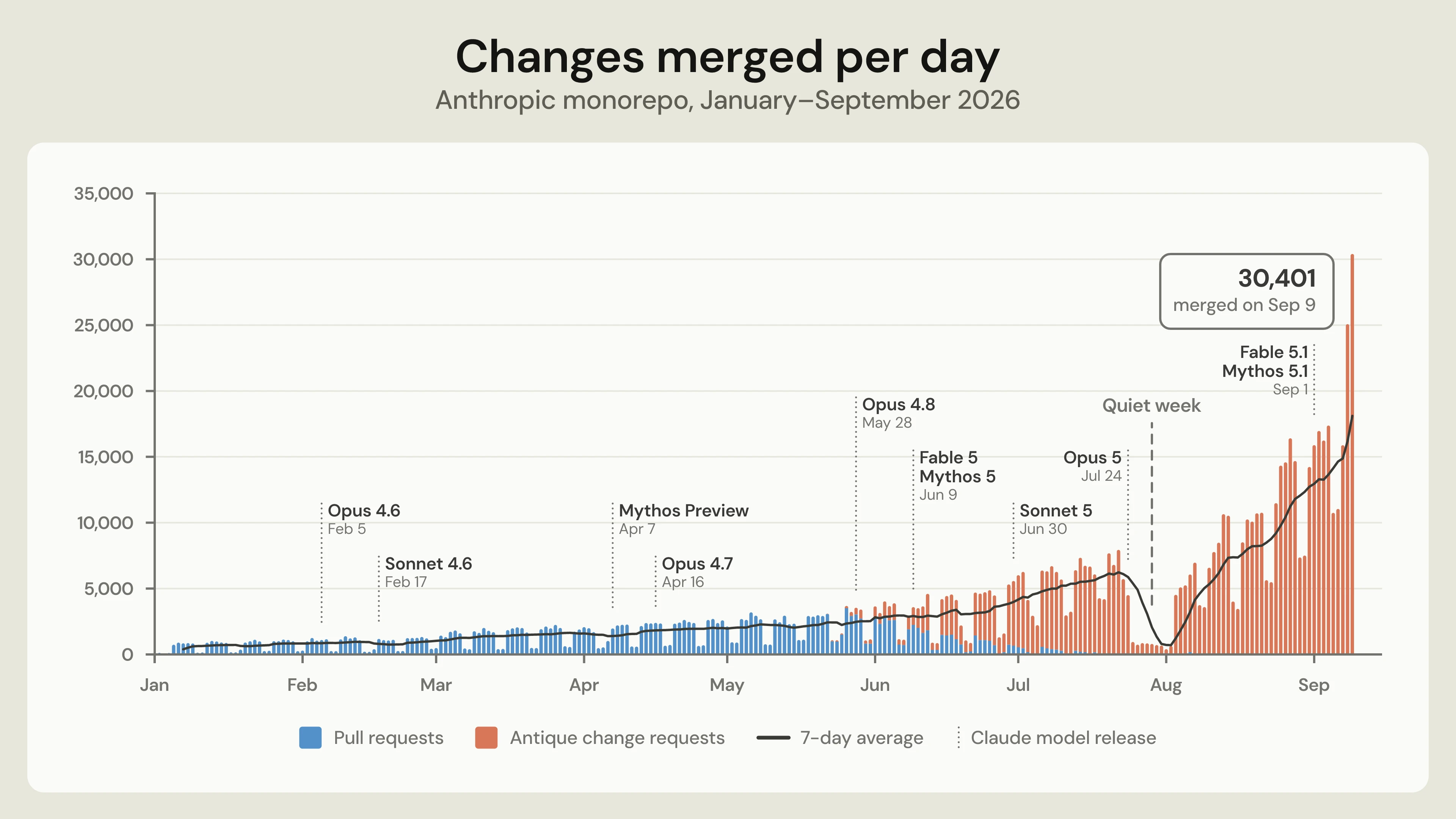
Anthropic says git stopped scaling for its monorepo once agents wrote most changes. Daily merged changes rose from roughly 2,500 to over 30,000, and Simon Willison's annotation of the post cites 25 million daily CI checkouts. The company built Scion, its own centralized version control system, and migrated in five months together with new code review, search and access-control tooling, with Claude helping build the replacement. The useful lesson is about where the bottleneck moves. When agents multiply merge volume, source control, CI and builds become the limit before model capability does. Earlier this month GitHub described similar strain on its Git storage layer, so this is a second large operator reporting the same failure point from the other side. Teams expecting agent-heavy workflows should load-test merge, checkout and CI capacity at ten times current volume before it becomes the constraint.

Context
Anthropic's Scion source-control system reduces the repository data that always-online agents and automated jobs need locally. Servers answer history queries and perform commits and merges; clients request only the files they need. Some jobs can ask for differences between revisions without checking out code at all. The company's engineering account explains why this design suits its enormous shared repository and heavy automated workload.
Anthropic reports that code checkouts for testing and research jobs fell from minutes to seconds. It also says Scion requires bespoke code-review, search and testing infrastructure, making adoption a substantial migration. The transferable idea is to avoid repeatedly copying repository data when a server query or on-demand file will suffice. The article presents Scion as a specialized internal system.
- Anthropic says its monorepo went from about 2,500 merged changes per day in May 2026 to over 30,000 in September, and that 's offline-first, every-clone-is-a-server design became the bottleneck.
- Its replacement, Scion, assumes clients are always online: the server handles history, blame, commits, merges and rebases, while clients keep a bounded cache and use sparse or virtualized checkouts that fetch only what they read.
- Commits are server-side changesets in a write-ahead log that only changed files; blame, history and ancestry are derived data computed per changeset, so commit cost scales with the change rather than the repo.
- Anthropic reports Scion's infrastructure is 200x smaller in CPU and memory than its old git mirrors, checkouts take seconds instead of minutes, and CI gained 25% CPU capacity; a team of seven built and migrated it in five months.
- Anthropic says Scion is not a general git replacement and will not be offered publicly; it suggests git forges adopt server-side RPCs and better-composing sparse and shallow features instead.
- Retrieval — Selecting evidence relevant to the current request.
- Git and version control — A system for recording and comparing changes to a codebase.
- Record — One unit of data in a file or table, such as one supplier's quote; distinct from a line of text.
- Path — A description of a file or folder location, written using directory names and separators.