Virtual Worlds Teach AI To Think Like a Physicist
- Source
- ri.cmu.edu
- Author
- Mallory Lindahl
- Date
Context
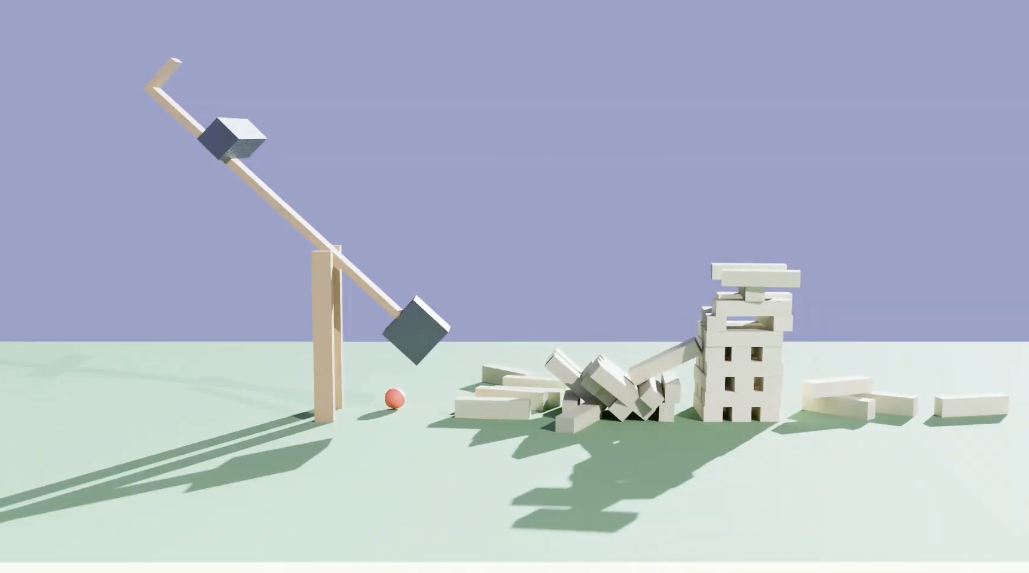
Sim2Reason uses physics simulations to generate both training questions and their answers. The CMU Robotics Institute's project account describes virtual scenes with moving blocks, pulleys and collisions. The simulator records physical quantities and produces questions such as when an object will land or what mass could explain its motion.
Because the simulator supplies the answers, researchers can create additional problems without obtaining a human-written solution for each one. The institution reports that trained models solved challenging physics questions, including Olympiad problems. That supports simulation-generated training as a research direction; successful physical-robot deployment is a proposed application.
- CMU's Sim2Reason trains language models inside physics simulators (blocks on inclines, pulleys, collisions) rather than on static human-written text, using the simulator's own force, velocity, and momentum outputs as ground-truth answers.
- The simulator generates unlimited training problems on its own, such as when an object will hit the ground or what mass produces a given trajectory, and grades the model's answers against its physics engine.
- Models trained this way solved problems from the International Physics Olympiad, a competition for top high-school physics students, according to lead researcher Deepak Pathak's team.
- The approach targets a specific bottleneck: real-world physical training data is expensive, difficult, or unsafe to collect at scale, so simulation is used to generate it instead.
- The CMU team trained models on progressively harder simulated scenarios, having them estimate properties like mass or force before applying that reasoning to new, unseen situations.



Checking sign-in…
Loading comments…