Introducing eve 1.0
- Source
- vercel.com
- Author
- Andrew Barba
- Date
Context
Vercel has released eve 1.0, making its open-source framework for production AI agents generally available after a public preview that began in June. eve supplies the , the loop that calls a model, runs the tools the model asks for and hands work to subagents. Developers choose the model, add or replace tools, edit instructions and decide which actions need a person's approval. Underneath, Vercel's open-source Workflow SDK saves the 's progress as it runs, so after a crash the agent picks up from its last completed step instead of starting over. The practical meaning of 1.0 is a stability promise: eve now follows semantic versioning, so breaking changes to stable APIs arrive only in major releases, although experimental and internal APIs can still change. Existing users have to follow an upgrade guide covering changes to extensions, agent APIs, session events, clients and saved history.
Vercel's two headline numbers measure the framework's own overhead. In a hosted stress test that sends 100 messages one at a time, each answered instantly by a mock model with no tool calls, the median time per turn fell from 3.036 seconds on the September 1 beta to 414 milliseconds in 1.0 (a chart in the same post gives 626 milliseconds for 1.0), and the slowest 5% of turns fell from 3.692 seconds to 633 milliseconds. Because the mock model replies immediately, the test leaves out the time a real model spends generating, which still adds to every real turn. Vercel credits changes in the Workflow SDK: each run now has a single orchestrator, so background steps no longer replay the workflow, fewer history reads repeat, and event and stream writes travel over WebSockets, a change Workflow SDK made the default earlier in November.
The cost figure is similarly narrow. For a 50-turn session, Vercel estimates the Vercel Workflows bill falls from 5.4 cents to 1.3 cents, about 76% lower, assuming roughly two model steps per turn and 30-day retention. The saving comes mainly from storing only the conversation data that changed between turns, instead of copying the growing conversation into every step. That is the cost of running and storing the workflow, not of the model calls. The customer results in the post, such as Rillet tripling its shipping rate in three months and an Evisions engineer reporting halved AI costs during an earlier migration, are reported by Vercel and its customers rather than measured independently.
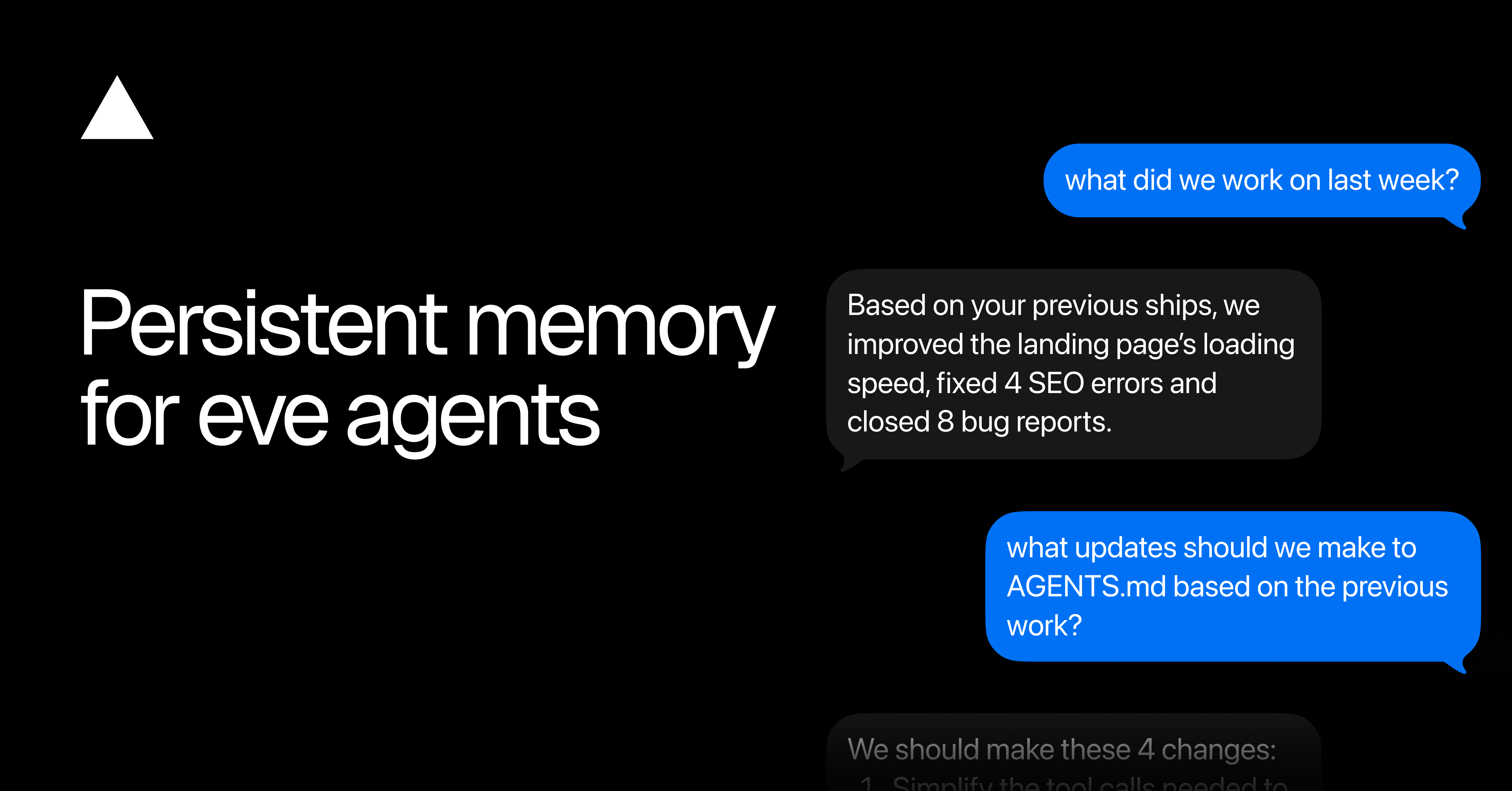
Other 1.0 additions target agents that serve teams. Several people can share one agent session, with eve tracking who said what and sending approvals to the right person, and a Slack thread can serve as that session. Agents can carry memory between sessions, and tracing is rebuilt on OpenTelemetry, the common format many monitoring tools read, with controls over what gets collected: in production, private conversations send only metadata by default, without prompts or tool results.
- eve's ambient mode lets an agent listen in chosen channels without being mentioned; to contain model costs, a small decision model screens every message first and only possibly relevant ones start a full turn.
- Vercel reports median per-turn overhead on a 100-turn hosted stress test fell from 3.036s in the September beta to 414ms, measured with a mock model and no tool calls, after Workflow moved to a single orchestrator per run and WebSocket writes.
- Vercel estimates a 50-turn session's Workflows cost drops from 5.4 cents to 1.3 cents because steps now save only changed conversation data and checkpoints store references to tool-returned images instead of copying the bytes.
- Tracing was rebuilt on OpenTelemetry with per-destination filtering and redaction, and private production conversations send only metadata by default, leaving prompts and tool results out of traces.
- Tools built with defineWorkflowTool can return a receipt immediately and then wait on a person, webhook or timer without holding compute, and their runs survive restarts, so no separate background-job system is needed.
- agent harness — The scaffolding around a model that turns it into a working agent — the loop, the tools it can call, and the rules for when to stop.
- AI agent — An AI system that doesn't just answer once but works toward a goal in a loop — taking actions, reading the results, and deciding what to do next.

Checking sign-in…
Loading comments…