AWS Challenger: Trainium3 Inference and Microarchitecture Deep Dive
- Source
- newsletter.semianalysis.com
- Publisher
- SemiAnalysis
- Author
- Kimbo Chen
- Date

Context
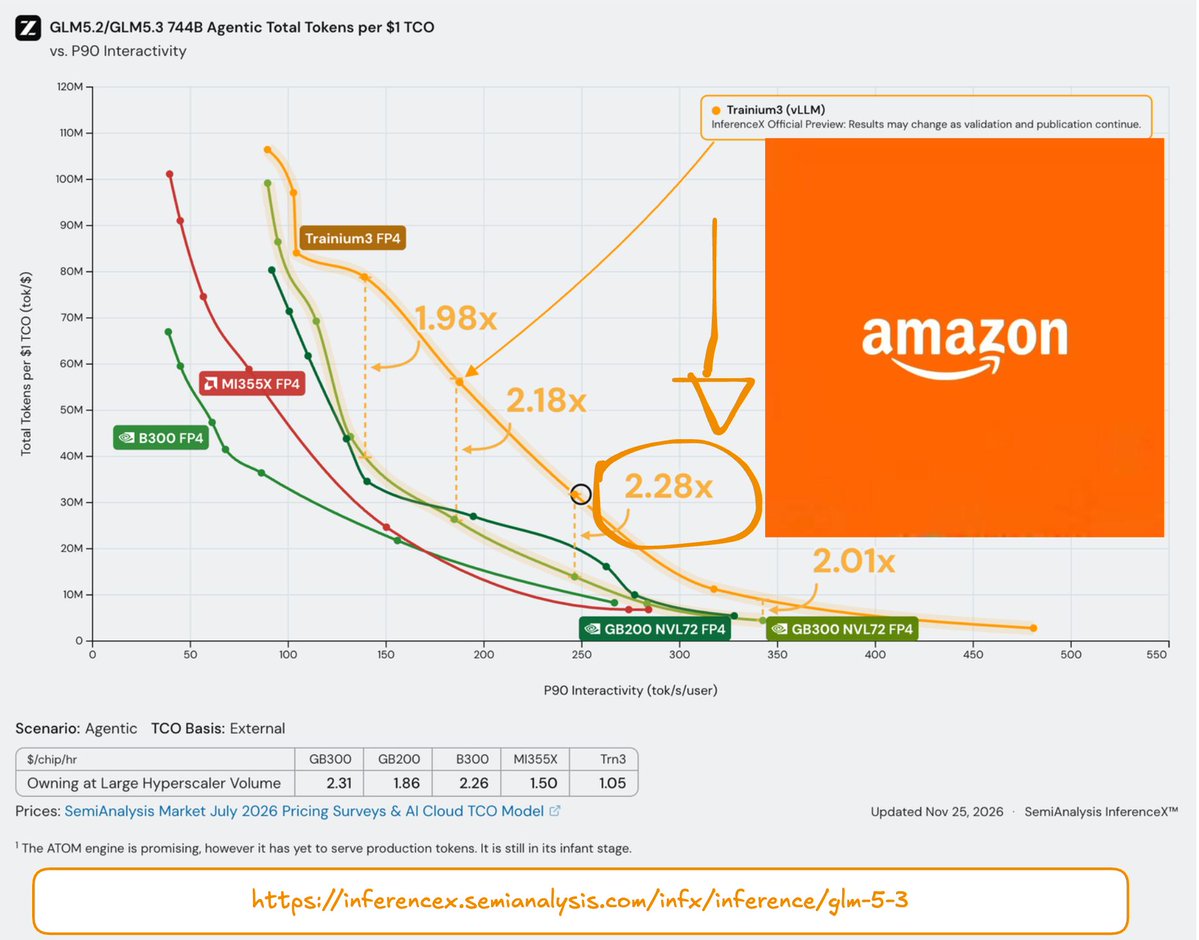
SemiAnalysis, a semiconductor research firm, reports that Amazon's Trainium3 chip now generates AI model output more cheaply than Nvidia's GB300 on its own benchmark, despite having far less raw compute. The benchmark, AgentX, replays real coding-agent sessions against a Trainium3 server and plots how much output each accelerator delivers per dollar of total cost of ownership (buying or renting and running the hardware) at each level of interactivity, meaning for each user, measured at the 90th percentile. In the deep dive by Kimbo Chen and seven co-authors, Trainium3 running the vLLM serving software beats every other accelerator except Nvidia's Vera Rubin across that whole curve.
The authors explain the result by which resource each stage of serving uses. Prefill, reading the prompt, is limited by compute, and there Trainium3 has 17% of the theoretical FP4 throughput of Blackwell Ultra, the Nvidia GPU in GB300: 2,517 against 15,000 TFLOPS. The authors say that is why it trails GB300 in some measures of . Decode, writing the answer one token at a time, is limited by memory bandwidth, and Trainium3 has 4.9 TB/s per chip against 8.0 TB/s for GB300: 61% of the bandwidth at about 30% of the cost. At 135 tokens per second per user, which the authors call a typical speed on OpenRouter, they calculate a 73.5% profit margin for Trainium3 with vLLM against 53% for the runner-up, GB300 with SGLang, at three-year rental prices. That calculation assumes Z.ai's list price for tokens and 60% use of the hardware fleet. Trainium3 gets there with 144 GB of memory per chip, half of GB300's.
The authors also tie the result to how the software is laid out on the chip. A Trainium3 chip has 8 NeuronCores, its processing cores, with each pair sharing one stack of high-bandwidth memory, and a server node holds 16 chips. In their collective benchmarks, exchanges among cores of one chip were well ahead of any wider group; for all-to-all, the exchange that models need when they route each token to a few specialised sub-networks, one chip reached about 9 to 10 times the bandwidth of a node or a rack. So prefill cuts the model's layers into 16 stages, one per chip, and keeps each stage's heavy exchanges inside its chip. Decode spreads one copy of the model over all 128 cores of a node, two routed experts per core for GLM-5.3, so gathering activations and combining expert outputs across all 128 cores sends traffic through the network switch on every layer. Newer racks with a single switch plane, labelled Trainium3n by AWS, reached 2.8 times the all-to-all bandwidth of the first-generation design at large message sizes in SemiAnalysis's tests.
A Hugging Face engineer's five days generating video on a Trainium3 machine shows what arranging software around this hardware takes in practice. There, the target resolution ran only after the model was split by sequence as well as by heads, so each core's compiled graph was small enough to load, and attention used the fast kernel only when the sequence length was a multiple of 128 tokens.
The figures are SemiAnalysis's own measurements and calculations, and the margins move with its price and utilization assumptions. The authors thank the team at AWS's Annapurna Labs, including Trainium's chief architect, for helping teach them the architecture and validate the benchmark experiments. The article is for paid subscribers. This explanation covers only the free portion, which runs through the benchmark results, the chip microbenchmarks and the node-level network tests, and stops where the rack-scale UltraServer measurements begin.
- throughput — How much model output a provider can generate over time, commonly measured in output tokens per second.
- time to first token — The delay between sending a model request and receiving the first piece of its response.
- mixture-of-experts — A model built from many specialist sub-networks where only a few activate per token, giving big-model capability at small-model running cost.
- attention — The mechanism that lets a model weigh which earlier words matter for the word it's currently processing — the core operation of a transformer.