Shows agents running hypothesis generation over DNA datasets and surfacing an uncharacterized enzyme system, an early indicator of autonomous scientific discovery. Function remains unconfirmed.
Key takeaways · AI-distilled
The authors describe a search run by roughly 950 agents over 21 hours consuming 210 million tokenThe chunk of text a model reads and writes in — roughly three-quarters of a word — and the unit AI usage is billed in.Full definition →, which gathered over 200,000 reverse transcriptases, picked out 3,500 candidate systems, and narrowed them to 20 written up for human review.
The reported ART system has three parts: the reverse transcriptase, a partner gene beside it of unknown function, and a long array of evenly spaced DNA repeats. The enzyme was already known from a jumbo phage; the array and partner gene are the new observations.
First experiments show the ART array is also expressed as a set of distinct short RNAs, which the authors read as a hint that something analogous to CRISPR may be at play, while stating the system's function is not yet known.
In the described workflow the model first reproduces established public results to check its methods, then writes candidate reports proposing a function and its evidence, then critically re-evaluates them; most are eliminated there, and a survey may end with none.
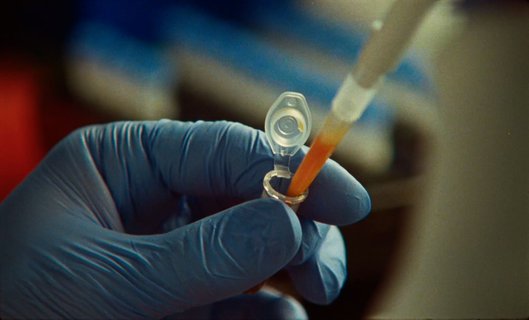
All lab work is done by human scientists at biosafety levels 1 and 2 with no pathogens that infect humans, and the authors say Claude produces hypotheses so prolifically that the hypotheses themselves became an object of study.
Terms in this piece · Glossary
AI agent — An AI system that doesn't just answer once but works toward a goal in a loop — taking actions, reading the results, and deciding what to do next.
token — The chunk of text a model reads and writes in — roughly three-quarters of a word — and the unit AI usage is billed in.