Agent Memory Architecture Guide
- Source
- x.com
- Author
- Akshay 🚀
- Date
Context
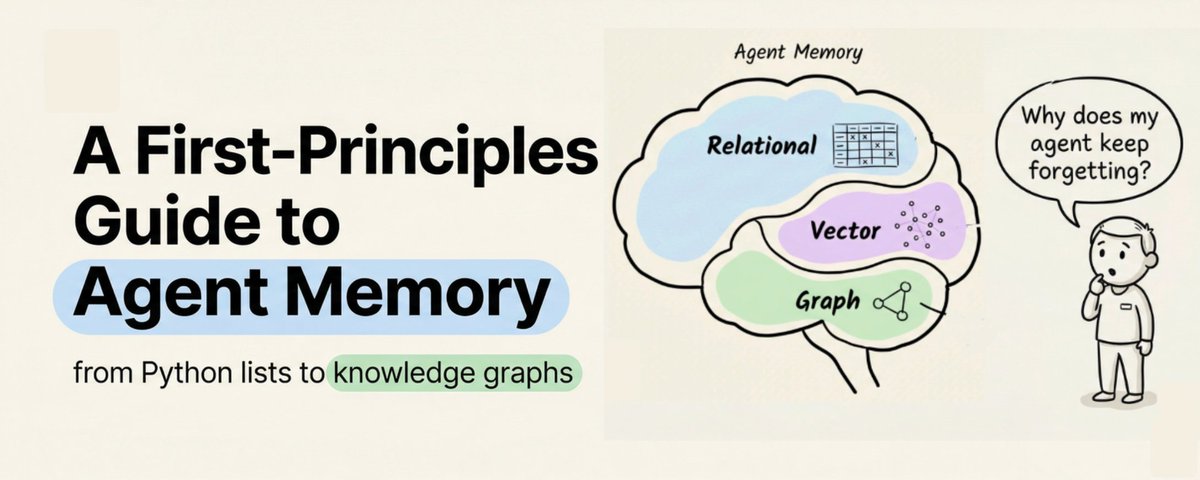
Saving information and finding the right connection are different problems. Akshay's agent-memory tutorial illustrates this with a person assigned to a project, that project's database dependency and a database outage. Answering whether the project was affected requires connecting those facts, rather than retrieving only passages that resemble the question.
The tutorial presents Cognee, an open-source memory system, as one answer. As described there, Cognee keeps three linked stores: a vector store that finds passages with similar meaning, a graph store that records how entities connect, and a relational store that tracks where each piece of data came from. A search can enter through similar text and then follow the graph to connected entities. The example illustrates the retrieval problem; it is not a measured guarantee that every dependency question will be answered correctly.
- Accuracy drops over 30% when the relevant fact sits in the middle of a long rather than near either end. Buying a bigger window does not buy reliable recall — it just moves where things get lost.
- A conversation list evicts strictly by age, so the user's name from turn one disappears before yesterday's throwaway joke. The flaw is not size, it is that chronology is standing in for importance.
- Flat markdown memory is genuinely good at four facts and useless at two thousand. Once the file outgrows the context window your only retrieval tool is keyword matching, which misses anything phrased differently.
- Consolidation is the piece people skip: repeated specific events should distill into a general rule, so noticing across dozens of sessions that users prefer executive summaries becomes a standing instruction rather than dozens of replayed episodes.
- AI agent — An AI system that doesn't just answer once but works toward a goal in a loop — taking actions, reading the results, and deciding what to do next.
- context window — The maximum amount of text a model can consider at once — its working memory for the current conversation or task.
“The "memory" you feel when chatting with ChatGPT is an illusion created by re-sending the entire conversation history with every request.”
“Accuracy drops over 30% when relevant information sits in the middle of a long context.”
“Memory isn't about cramming more text into the prompt. It's about structuring what the agent remembers so it can find what matters.”
“Strip away the frameworks and an agent is a loop: perceive, think, act.”


Checking sign-in…
Loading comments…