Interpreting a recent acceleration in pretraining loss
- Source
- metr.org
- Date
Context
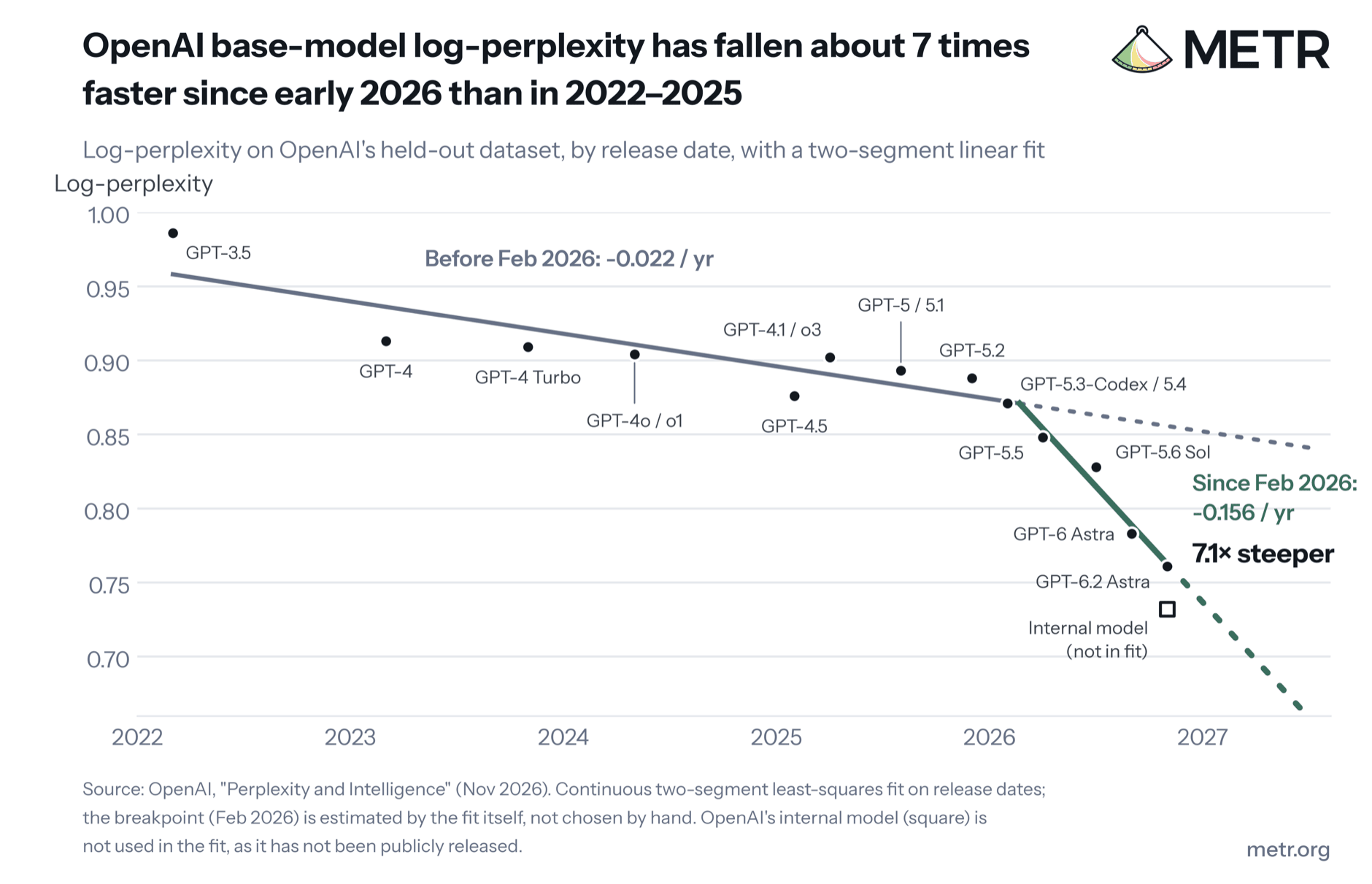
OpenAI recently published a number that frontier labs normally keep private: how well each of its base models, the raw models before any chat , predicts text it never saw during training. METR, a group that independently evaluates AI capabilities, looks at that data in this post and finds a sharp break. Since early 2026 the measure has been improving about seven times faster than it did from 2022 through 2025. METR's conclusion is that the published numbers show a striking acceleration, though the data could overstate true progress, and that its staff do not agree on what it means for future capabilities. It says plainly that it has no consensus view.
The measure is log-perplexity, also called loss. A model reads a passage one , roughly a word fragment, at a time and assigns a probability to each next token; log-perplexity averages how surprised it was by the tokens that actually came. Lower means better prediction. OpenAI measured it on a fixed held-out set of text drawn from its own internal codebase, and its post gives approximate values of 0.99 for GPT-3.5, 0.91 for GPT-4 and below 0.8 for later models. METR counts 13 models since GPT-3.5 and fits two straight lines: the loss fell about 0.022 per year until a break around February 2026, then about 0.156 per year. At the new pace, the drop from GPT-3.5 to GPT-4.1, which took three years, would take about six and a half months. METR finds this especially surprising because progress should get harder. Text is never perfectly predictable, so the loss has a floor above zero, and under standard scaling laws each tenfold increase in training compute buys a smaller drop than the last.
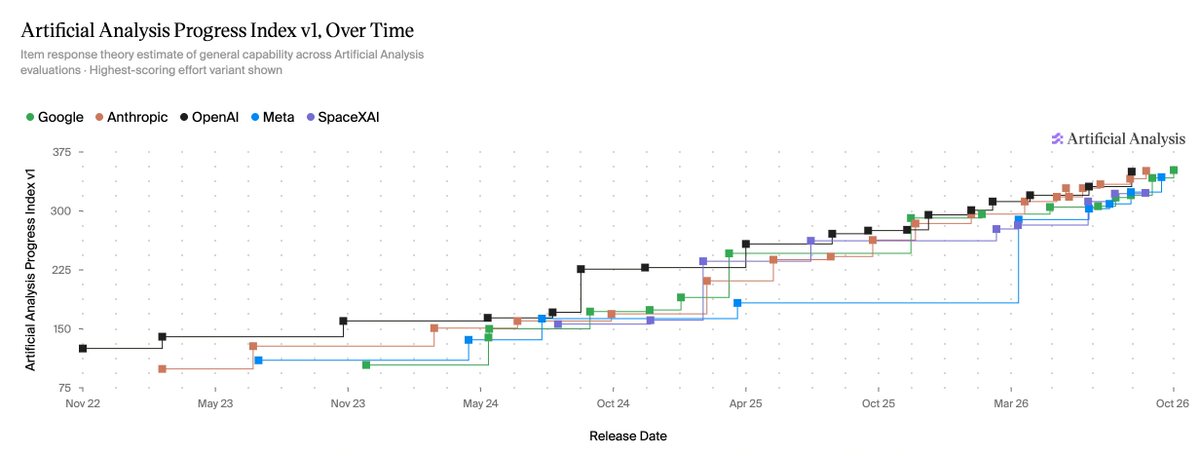
The disagreement is over whether lower loss means a more capable model. OpenAI's scores show no comparable jump, METR notes, for example on Epoch AI's capabilities index. One reading treats benchmarks as the better guide to real-world ability and loss as just one input, in which case forecasts barely move. Another, which METR says many AI researchers hold, treats loss as a deeper measure that benchmarks will catch up to, and on some interpretations that points to a broad acceleration in real-world capabilities over the next six months. METR adds a third consideration: to the extent AI helped produce the speedup, it hints at what AI could do for every other stage of model training. OpenAI's own footnote credits the 2026 acceleration mostly to long-term research and compute investment and only in a smaller part to automation, while saying the most recent models already had meaningful design contributions from AI.
METR also lists ways the chart could overstate progress, and asks labs for the data that would settle them. A single corpus taken from OpenAI's codebase could favor recent recipes that help most on code, and parts of it could have leaked into training data, so METR wants loss on very different held-out text, such as books written before 2022. The models are plotted at release dates, but loss belongs to the base model, which may be finished months earlier, so METR wants the date each pretraining run ended. It also wants to know how pretraining compute, spending on research labor and experiment compute grew, because some of those causes would predict a one-time spike and others a lasting trend, while help from AI could compound. Until that information exists, the chart is one lab's measurement on one dataset, and METR's own position is that it remains arguable how much it should change forecasts of AI capabilities. Microsoft has since published the same measure for its own models on OpenAI's dataset, which is the kind of disclosure METR is asking every developer to make.
- OpenAI's published base-model log-perplexity for 13 models since GPT-3.5, measured on a fixed held-out set drawn from its own codebase, has fallen about seven times faster since early 2026 than in 2022 through 2025, METR notes.
- That runs against standard scaling laws: each tenfold compute increase normally buys a smaller loss drop as models approach an irreducible floor, so loss progress would be expected to slow rather than speed up.
- METR says it has no consensus reading. Benchmark scores such as Epoch's ECI show no comparable jump, and the data could overstate progress through overfitting or small parts of the codebase leaking into training data.
- METR asks developers to publish loss on other pre-2022 held-out corpora such as books, each model's pretraining end date, and how compute and labor spending changed, because plotting at release dates can misplace when gains happened.
- Assuming one scaling law with irreducible loss of 0.3 to 0.6, METR estimates effective compute grew roughly 8 to 10 times faster since early 2026, but calls that assumption unrealistic because newer recipes likely follow different laws.
- Training — The process that adjusts a model using examples and a measure of how well it performs.
- pretraining — The first, biggest phase of building a model: training it on enormous amounts of text so it learns language, facts, and reasoning in general.
- Token — A piece of text, such as a word, part of a word or a punctuation mark, that a language model represents as numbers and handles as a unit.
- Benchmark — A fixed set of tasks with a stated way of scoring them, used to compare models or setups.

Checking sign-in…
Loading comments…