Agreement Overstates Evidence: Error Dependence in LLM Judge Consensus
Source
Elias Hossain, Niloofar Yousefi, Ser-Nam Lim
Author
Elias Hossain, Niloofar Yousefi, Ser-Nam Lim
Date
Key takeaways · AI-distilled
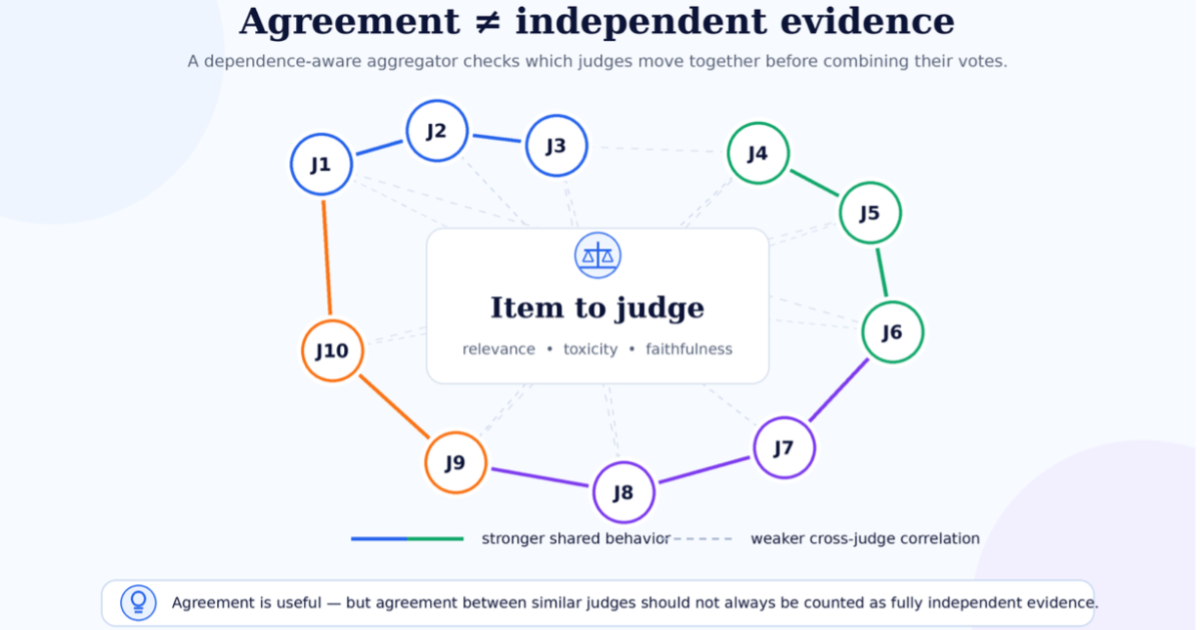
Error dependence was even stronger among the high-accuracy frontier judges, including judges from different providers, so mixing vendors does not by itself buy independent errors.
The pattern of shared errors matters, not just the amount: errors shared by most judges and errors concentrated in a smaller group affect consensus differently and favor different voting methods.
The authors recommend using a small set of trusted examples to estimate judge accuracy and find shared mistakes, then choosing the voting method on those examples before applying it to new data.
Terms in this piece · Glossary
LLM — A large language model — the neural network behind tools like Claude and ChatGPT, trained on huge amounts of text to predict what comes next.
eval — A repeatable test for AI quality — a set of tasks plus scoring — used the way software teams use test suites, because model output is too variable to judge by eyeballing.
Why it matters
If you use LLMA large language model — the neural network behind tools like Claude and ChatGPT, trained on huge amounts of text to predict what comes next.Full definition →-judge ensembles for evalA repeatable test for AI quality — a set of tasks plus scoring — used the way software teams use test suites, because model output is too variable to judge by eyeballing.Full definition →, this quantifies how much less independent evidence more judges actually add, and shows shared judge errors can silently invert which model looks better.

 articleWhen LLM judges agree, should we believe them?www.amazon.science
 articleInter-dimension Dependence for Multi-Dimensional Evaluation of Open-Ended TextHaoyuan Li, Snigdha Chaturvedi
 articleAgreement Is Not Alignment: Divergent Moral Grounds in Human and LLM Ethical JudgmentsOctavian M. Machidon, Alina L. Machidon, Vojko Strahovnik, Mateja Centa Strahovnik, Jonas Miklav\v{c}i\v{c}, Marko Robnik \v{S}ikonja