Put Gemini to work for you
- Source
- blog.google
- Date
Context
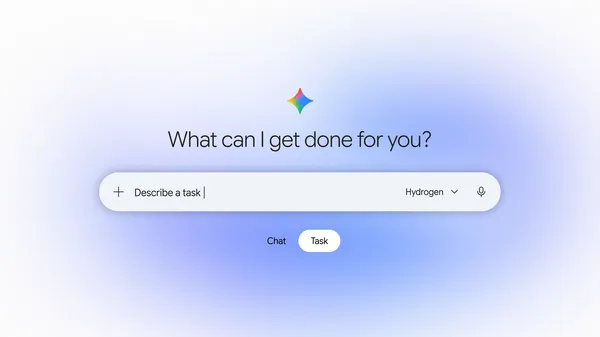
Google's Gemini app now has a Task mode in which it carries out chores for the user instead of answering questions: it places phone calls, logs into accounts, adds events to a calendar and completes purchases (Google). Josh Woodward, the vice president responsible for the Gemini app, announced it as free for what Google calls hundreds of millions of people in the U.S., Japan, Korea, Canada, Australia and India. It runs on Gemini 4 Hydrogen, the fast model Google introduced on November 12 for agentic work. Users flip the app's home-screen toggle from Chat to Task, and in the U.S. they can also forward emails to Gemini or text it.
Google's pitch is that the data such an assistant needs already lives with Google. Woodward's examples use Calendar, Maps, Gmail, Password Manager and Google Pay: Gemini called two car dealerships at once and booked a service slot that fit his calendar, logged into his utility's portal and traced a $389 electric bill to a heat pump running during peak-price hours, and added groceries to an Instacart order from a text and a photo. On calls, he says, Gemini discloses that it is an AI, and businesses can opt out. These are his own accounts of using it, not measured results. Purchases go through the Payments Protocol, AP2, which Google says secures payments with digital on supported Mastercard and Visa cards, with American Express coming. Users can set a hard spending cap, and Gemini is designed to ask for confirmation or pre-approval before clicking Buy; routine actions the user already trusts, such as adding an item to a grocery cart, can be set to always allowed.
An agent holding someone's logins is exposed to , where text on a webpage or in a search result tries to give the agent instructions of its own. Google says each task runs in a hardware-isolated virtual machine dedicated to the user's account, on Google Cloud's Agent Compute Engine, with filters that scan search results and webpages for injected instructions and Google Safe Browsing limiting which links Gemini can open. Google is also explicit that tasks still fail: it says it has not eliminated mistakes, and on some sites Gemini gets most of the way and then hands the screen back for the final click. The post describes the design and safeguards but gives no completion or error rates, so how reliably Task mode finishes jobs on its own is not yet known.
- Google says the task features roll out free in the U.S., Japan, Korea, Canada, Australia and India on its new Gemini 4 Hydrogen model, with advanced features starting in the U.S. Users flip the app from Chat to Task, text Gemini, or forward emails to gemini@google.com.
- Purchases run through the Agent Payments Protocol (AP2) with tokenized Mastercard and Visa cards, American Express coming soon. Users can set a hard spending cap, and Google says Gemini asks before clicking Buy unless a routine action is set to Always allow.
- When Gemini phones a business for a user, Google says it discloses right away that it is an AI, businesses can opt out, and it withholds payment or private account details unless the user says to share them.
- Beyond a dedicated isolated VM per account, Google lists prompt-injection filters that scan search results and webpages, plus Safe Browsing limits on which links Gemini opens. It also admits some sites still need the user to click the final button.
- In Josh Woodward's own example, Gemini used utility-portal access through Password Manager and past bills in his email to trace a surprise $389 electric bill to a heat pump that started around 4 p.m., during peak pricing.
- AI agent — An AI system that doesn't just answer once but works toward a goal in a loop — taking actions, reading the results, and deciding what to do next.
- token — The chunk of text a model reads and writes in — roughly three-quarters of a word — and the unit AI usage is billed in.
- prompt injection — An attack that hides instructions in content an AI will read — a webpage, email, or document — tricking it into following the attacker instead of the user.

Checking sign-in…
Loading comments…