Scaling Laws And Interpretability Of Learning From Repeated Data
Source
anthropic.com
Author
Anthropic research
Date
Why it matters
Shows that a tiny fraction of heavily repeated data can erase much of a model's effective capacity, which is a reason to deduplicate carefully when training or fine-tuningTaking a trained model and training it a bit more on your own examples so it gets better at one specific job.Full definition →.
Key takeaways · AI-distilled
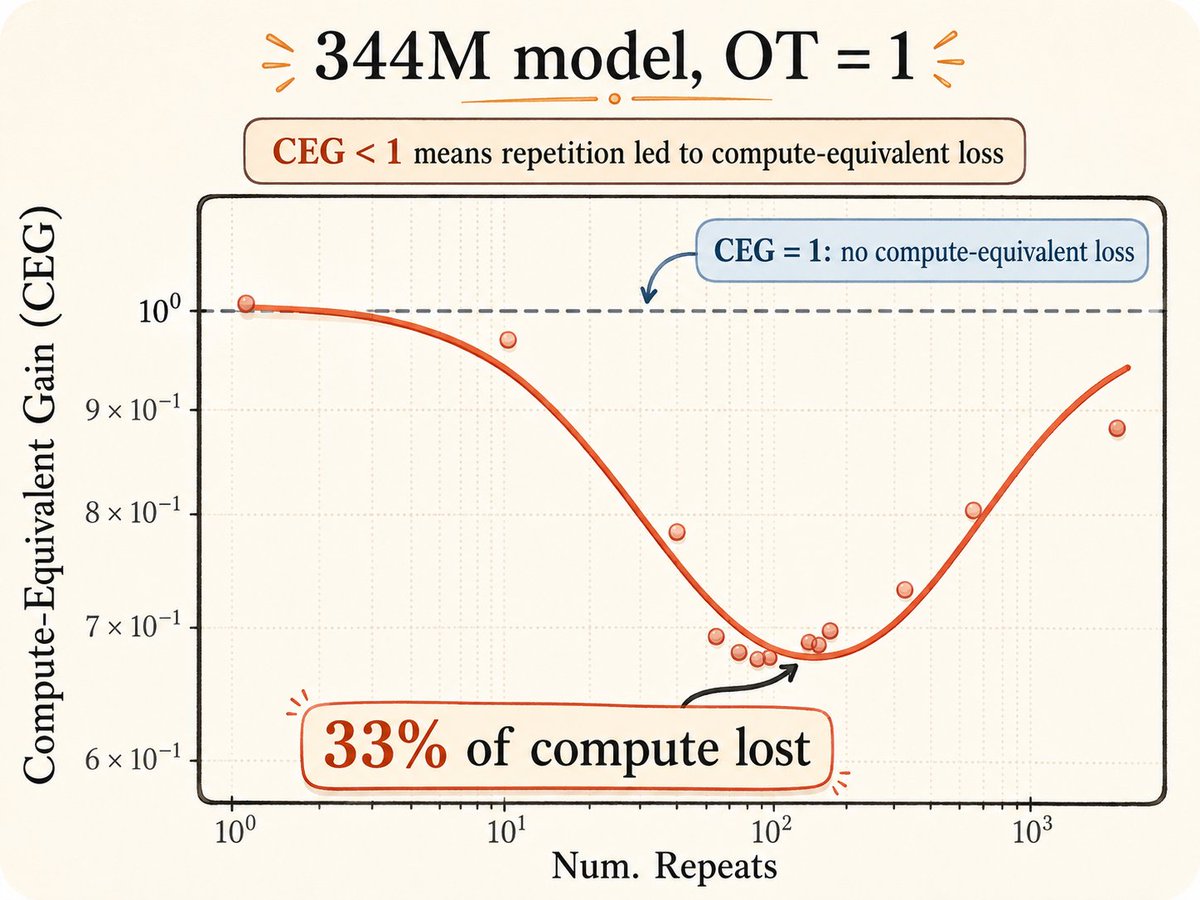
Anthropic trained models where most data was unique but a small fraction was repeated many times, and found a double descent effect in which repeated data can make test loss rise midway through training.
The damage can be severe: repeating 0.1% of the data 100 times degraded an 800M-parameter model to the performance of a 400M model, even though 90% of training tokenThe chunk of text a model reads and writes in — roughly three-quarters of a word — and the unit AI usage is billed in.Full definition → stayed unique.
The authors hypothesize the worst degradation occurs where repeated data can be memorized and that memorization eats a large share of capacity; repetition disproportionately damaged copying and induction heads, suggesting a shift from generalization to memorization.
Terms in this piece · Glossary
token — The chunk of text a model reads and writes in — roughly three-quarters of a word — and the unit AI usage is billed in.
fine-tuning — Taking a trained model and training it a bit more on your own examples so it gets better at one specific job.