GPT 6.2 Astra Solves a Historical Mystery
- Source
- generativehistory.substack.com
- Author
- dr_red_dog
- Date
Context
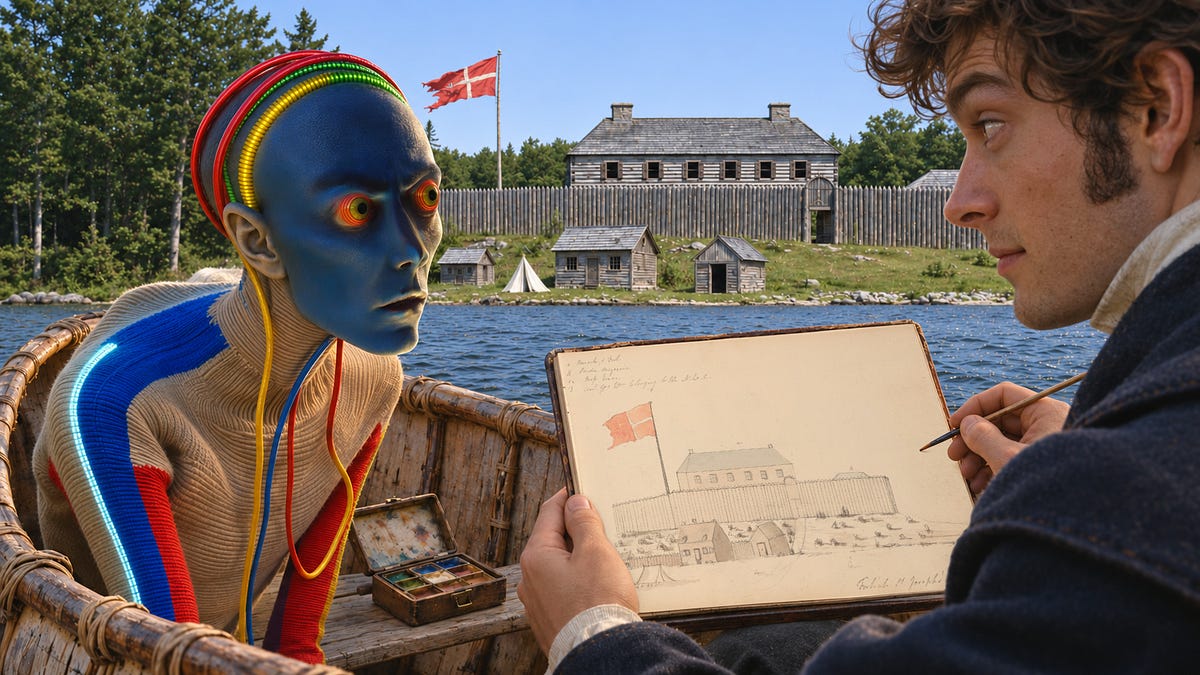
Historian Mark Humphries gave a pre-release version of OpenAI's GPT-6.2 Astra a puzzle he had failed to solve for years, and he reports that it produced the answer in 22 minutes. The puzzle was an anonymous sketchbook that Yale's Beinecke Library bought from a bookseller in 2020. Its 84 pages, 34 of them with drawings, depict a journey in 1808 from Montreal to Fort William on Lake Superior and back, and it matters because it shows Great Lakes sites destroyed a few years later. The difficulty was the route itself: hundreds of canoes made the trip every year, only three drawings are dated, the captions are short, and the surviving records are handwritten, mostly untranscribed and scattered across archives. Without a name to search for, there was nowhere obvious to start.
Humphries gave the the sketchbook images, his own article on a related authorship question, and a suggesting two people he had wondered about. Set to its Ultra effort level, the model came back with a specific answer: Louis-Guy-Charles-Guillaume de Rohan-Chabot, vicomte de Chabot, a French émigré serving as a British Army officer in Canada in 1808, "probably made the travel drawings". It also proposed a test: order a microfilmed journal of Chabot's trip that it had found listed in an archival inventory at Cleveland University. According to its reasoning summaries, it used the three dated drawings to rule out both of Humphries's suggestions, then found a diary entry by the Montreal fur trader Joseph Frobisher recording Chabot leaving Lachine for the west on 6 June 1808, five days before the sketchbook places its artist on the Ottawa River. A published letter placed Chabot at Fort St. Joseph later that month. Humphries had cited Frobisher's diary in the article he attached, though not for this purpose, and he says it is still unclear exactly how the model found the journal, which traces to a single footnote in a 2014 doctoral thesis.
The confirmation came from the documents, which Humphries ordered himself. The journal survives in two parts, one in a family archive in France and one on Library of Congress microfilm. He reports that its handwriting has the sketchbook's distinctive letter forms, that its itinerary puts the writer at the dated drawings' locations on the same days, and that on 18 June 1808 at Fort St. Joseph Chabot wrote "I took a sketch" before describing the view in the matching drawing. Humphries reproduces that page in his post. The journal runs to 162 notebook pages and came with excerpts from long-destroyed papers of the North West Company, a fur trading business, which he expects to interest historians of Canada and the fur trade.
The test shows a model doing the part of historical research that is hardest for people: connecting a name in one obscure to facts in others when nobody knows whom to look for. Humphries's view that a human was unlikely to make the connection is his judgment, though he reports that fur trade specialists he spoke to were equally surprised, and it is one case without a record of other attempts. It is not unique to Astra: he says Anthropic's Fable 5.2, given the same prompt, named Chabot in about 35 minutes but did not find the journal. Astra also kept hedging after reading the journal, calling it "an anonymous diary attributed to Chabot", which Humphries considers unreasonable doubt. A commenter on the post, Timothy Burke, argues that establishing authorship is a narrow forensic task that precedes interpretation, which remains historians' work. Humphries himself calls the example narrow.
- Model — A computational system that uses learned patterns to produce an output from information supplied to it.
- Prompt — Information or instructions supplied to a model; in a chat, the request you type is often called your prompt.
- State — Information describing a system at a particular moment, such as its current text, settings or saved records.
- Record — One unit of data in a file or table, such as one supplier's quote; distinct from a line of text.