Nace AI ships Drex Max, a multimodal decision model for computer-use agents
- Source
- nace.ai
- Author
- Nace AI
- Date
Context
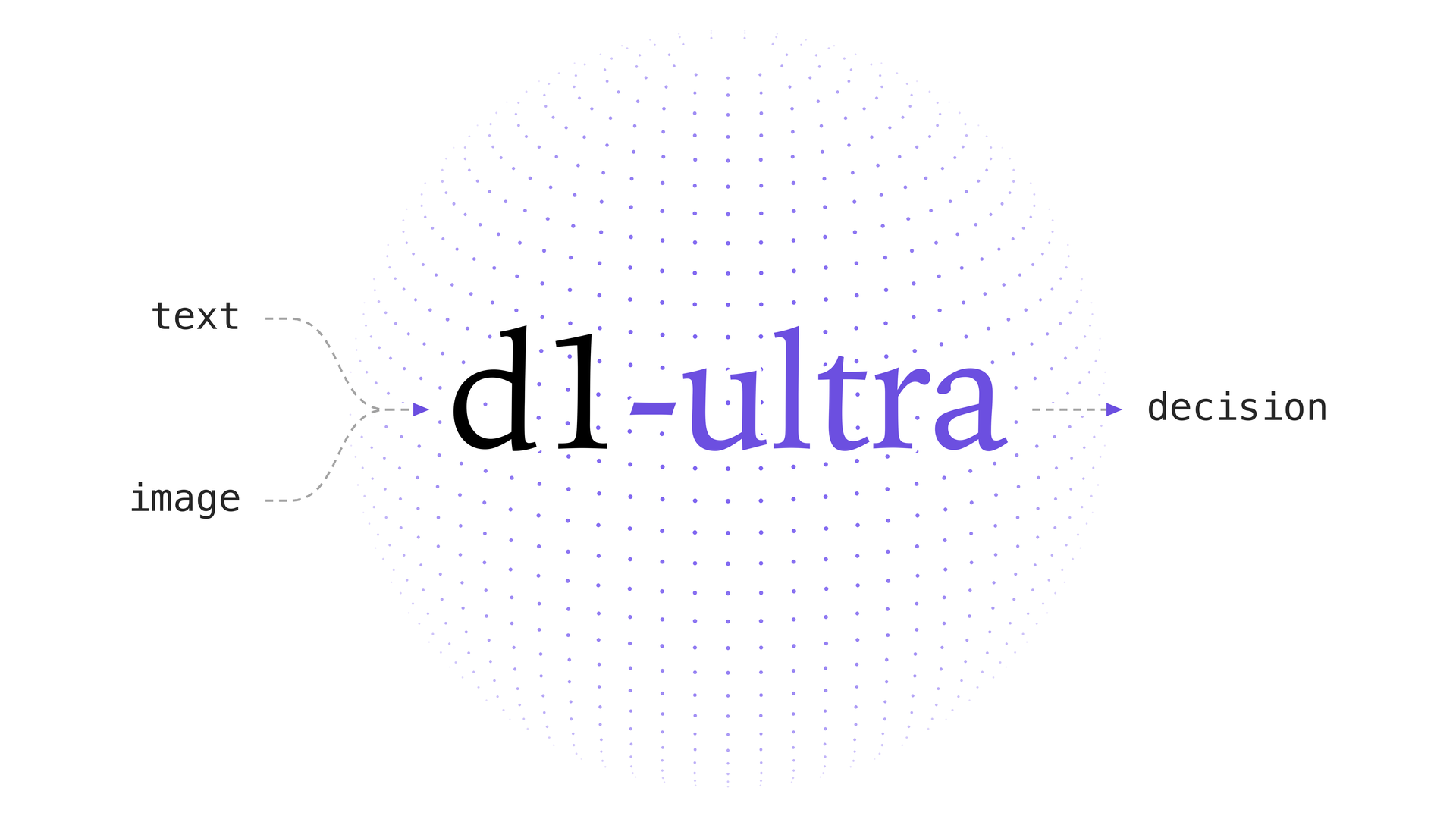
Nace AI builds what it calls decision models: instead of writing a reply, the model receives a description of a situation plus a set of questions with the allowed answers, and returns a probability for every option in one pass (nace.ai). A question can be a choice among named options, a yes or no, or a rating on a scale, and the model can only answer with options the caller supplied. Nace argues this removes chat-model failure modes such as truncated output, malformed JSON or invented options. A similar model, launched about a month earlier, is TypeSafe AI's Jev, which Nace uses as its main point of comparison.
Drex Max is the Drex model that can look. According to Nace's API guide, it is the only Drex that reads images: a request can attach up to eight, which every question sees, and each is downscaled to roughly 1,280 by 1,280 pixels' worth of detail. The product page pitches this at agents that operate computers and browsers, where every step is a decision made from a screenshot, and says Drex Max also takes video. It uses the same request shape as the other Drex models but must be selected by name, since requests without a model go to the Drex 2.0 that Nace released earlier. The guide lists the price as $0.06 per million input , with output tokens unbilled.
The performance claims are Nace's own. It reports 67.6 on the public Decision Index, edition 0.3.2, against 60.7 for Jev 1.14, while trailing Jev on knowledge tests such as MMLU-Pro and HLE. Nace's FAQ also says Drex is trained on the official training splits of the index's benchmarks and evaluated on held-out splits, which it says explains why the model is strongest on kinds of decisions it has seen before.
- Nace AI describes Drex Max as a decision model: it returns a probability for each caller-supplied option in one forward pass instead of generating text, so it cannot return malformed output or options the caller did not supply.
- Nace reports Drex Max at 67.6 on its own public Decision Index of 37 chance-corrected tests, 6.9 points above Jev 1.14, while trailing Jev 1.14 on MMLU-Pro, HLE and ARC-Challenge.
- Per Nace's table, Drex Max answers in a median 183 ms at $0.06 per 1,000 decisions, against about 2 seconds and $3.33 for GPT-6 Sol, which Nace shows for reference rather than scoring on its index.
- Nace says Jev 1.14 rejects 15.9% of images by size (a side under 280px or over 1,568px), while Drex Max answered all of them, at a median 174 ms per screenshot decision versus 253 ms for Jev 1.14.
- Nace says Drex is trained on the official training splits of its index benchmarks and evaluated on held-out splits, so it is strongest on decision types it has seen; the open-weight Drex 2.0 sibling is a 35B with about 3B active.
- open weights — A model whose trained parameters are published for anyone to download and run — unlike API-only models you can access but never possess.
- token — The chunk of text a model reads and writes in — roughly three-quarters of a word — and the unit AI usage is billed in.
- multimodal — A model that works with more than text — reading images, audio, or video, and sometimes generating them too.
- mixture-of-experts — A model built from many specialist sub-networks where only a few activate per token, giving big-model capability at small-model running cost.

Checking sign-in…
Loading comments…